Schools, homes and workplaces
Connect measurements to occupancy, exposure periods, building use and the specific claim or intervention being considered.
TA-14 AUTHORITY GOVERNANCE INSTITUTION · GLOBAL OPEN INITIATIVE
GOIAQG
From measuring the air to governing what happens next. Global Open Indoor Air Quality Governance (GOIAQG) is a TA-14 initiative under development connecting preserved environmental evidence, accountable decisions, authorized interventions and verified outcomes.
For researchers, building teams, educators, communities and public institutions worldwide. Explore a shared method, examine its limits, and contribute perspectives grounded in your own operating context.
EDUCATIONAL ARCHITECTURAL DEMONSTRATION · NO LIVE BUILDING CONTROL · NO REGULATORY OR INSTITUTIONAL ENDORSEMENT IMPLIED
↓ EXISTING INDOOR-AIR TECHNICAL REFERENCE v1.0 (PDF)
ONE METHOD · LOCAL CONTEXT
Indoor-air decisions cross disciplines and borders. The initiative offers an open educational framework for examining those decisions; it does not impose one universal air-quality score, threshold or legal mandate.
Connect measurements to occupancy, exposure periods, building use and the specific claim or intervention being considered.
Examine interacting requirements, including ventilation, humidity and pressure relationships, with the responsible professionals.
Consider indoor and outdoor conditions together, preserve changing evidence, and define who can authorize protective measures.
Adapt the examination to local law, climate, equipment, measurement capability and institutional responsibilities. Document evidence gaps rather than treating missing information as reassurance.
Open means public access to this guide and an invitation to scrutiny and contribution. It does not require disclosure of private building or occupant data, imply an open-source software licence, or establish adoption by any institution.
THE DISTINCTION
A sensor reading may justify investigation. A dashboard may support understanding. Neither automatically creates admissible evidence or permission to change a building. Atmospheric Integrity Records (AIR) address preserved environmental chronology; Environmental Integrity Governance (EIG) examines how environmental evidence is used responsibly. TA-14 tests the boundary between a proposed action and an authorized consequence.
DATA → EVIDENCE FIT FOR A DECISION
A reading is data. Admissible evidence is evidence shown to be fit for a specified decision within documented spatial, temporal and methodological limits. Provenance alone does not establish measurement accuracy. Record sensor suitability, calibration and quality checks, units, location, timestamps, operating conditions, coverage, missing intervals and uncertainty.
Preserve original observations and context. Identify corrections, transformations and exclusions separately, with traceable versions. An interpretation must not overwrite the measurements it relies on.
Keep diagnostic findings and proposed improvements separately attributable to their evidence, assumptions and limits. Predictions remain predictions until checked against actual outcomes.
Define acceptance criteria, response thresholds, responsibilities, review deadlines and escalation. Address competing requirements and retain accountable ownership through handovers.
Examine the exact proposed action against current evidence, applicable authority and established standing. Bind its scope and constraints, revalidate at commit, and verify what actually followed.
These are distinct responsibilities connected by a common record. A low reading at one location cannot, by itself, establish acceptable conditions throughout a building. This technical use of admissibility does not assert judicial admissibility.
THE GOVERNING QUESTION
THE EIGHT-ANCHOR EXAMINATION
Identify the actual occupied-space condition and its operating context.
Preserve raw readings, time, location, instrument identity and relevant HVAC state.
Keep the record attributable through changes, handoffs and missing intervals.
Determine whether the evidence supports this specific proposed action.
Connect the evidence, applicable policy and responsible equipment to the proposal.
Confirm established standing and locally applicable authority at the decision point.
Allow, hold, deny or escalate the bounded action before physical execution.
Verify what actually changed and preserve the new environmental reality.
WORKED EXAMPLE · ILLUSTRATIVE
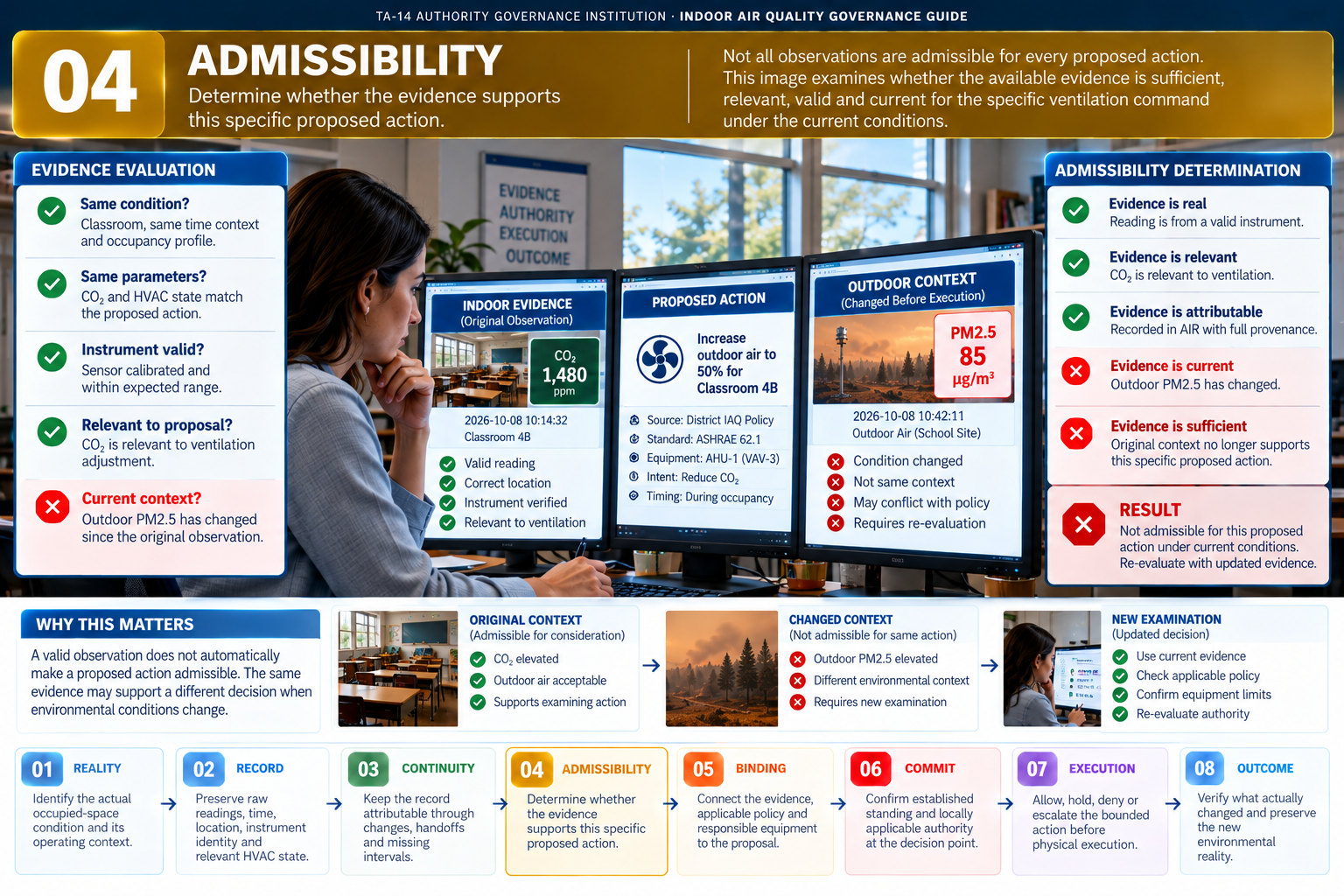
An occupied classroom's CO₂ level supports consideration of additional ventilation. Before a prepared HVAC command executes, outdoor PM2.5 rises with wildfire smoke. The earlier observation does not automatically authorize the same command under changed conditions.
Indoor CO₂ supports examining a ventilation response while the original outdoor-air context is acceptable.
Outdoor PM2.5 rises before execution. The evidence context supporting the prepared command is no longer the same.
Refresh the outdoor-air record, examine district IAQ policy and equipment constraints, and confirm locally established authority before a new commit.
This is a teaching scenario, not a claim that TA-14 controls a real school or that HOLD is the correct determination for every building.
EXAMINE THE SCHOOL-AIR SCENARIO →ONGOING COMMISSIONING
Initial commissioning demonstrates performance under the conditions tested. Occupancy, weather, filters, equipment and control settings change afterward. Ongoing commissioning combines monitored evidence with investigation, functional testing, justified corrections and outcome verification.
GOIAQG connects that cycle to preserved records and assigned responsibilities: establish the baseline, examine deviations, authorize any necessary intervention, verify results against predefined criteria, and preserve the history. Revised baselines require documented review. An old acceptable record does not authorize reliance after a material change.
This framework supports qualified engineering practice. Live enforcement requires suitable instrumentation, integration, validated controls and locally authorized personnel; the educational showroom itself does not operate building equipment.
EIGHT TEACHING IMAGES · ILLUSTRATIVE ONLY
These are hypothetical teaching illustrations, not live readings, certified evidence, or real authorization records. Scroll freely and examine each stage.
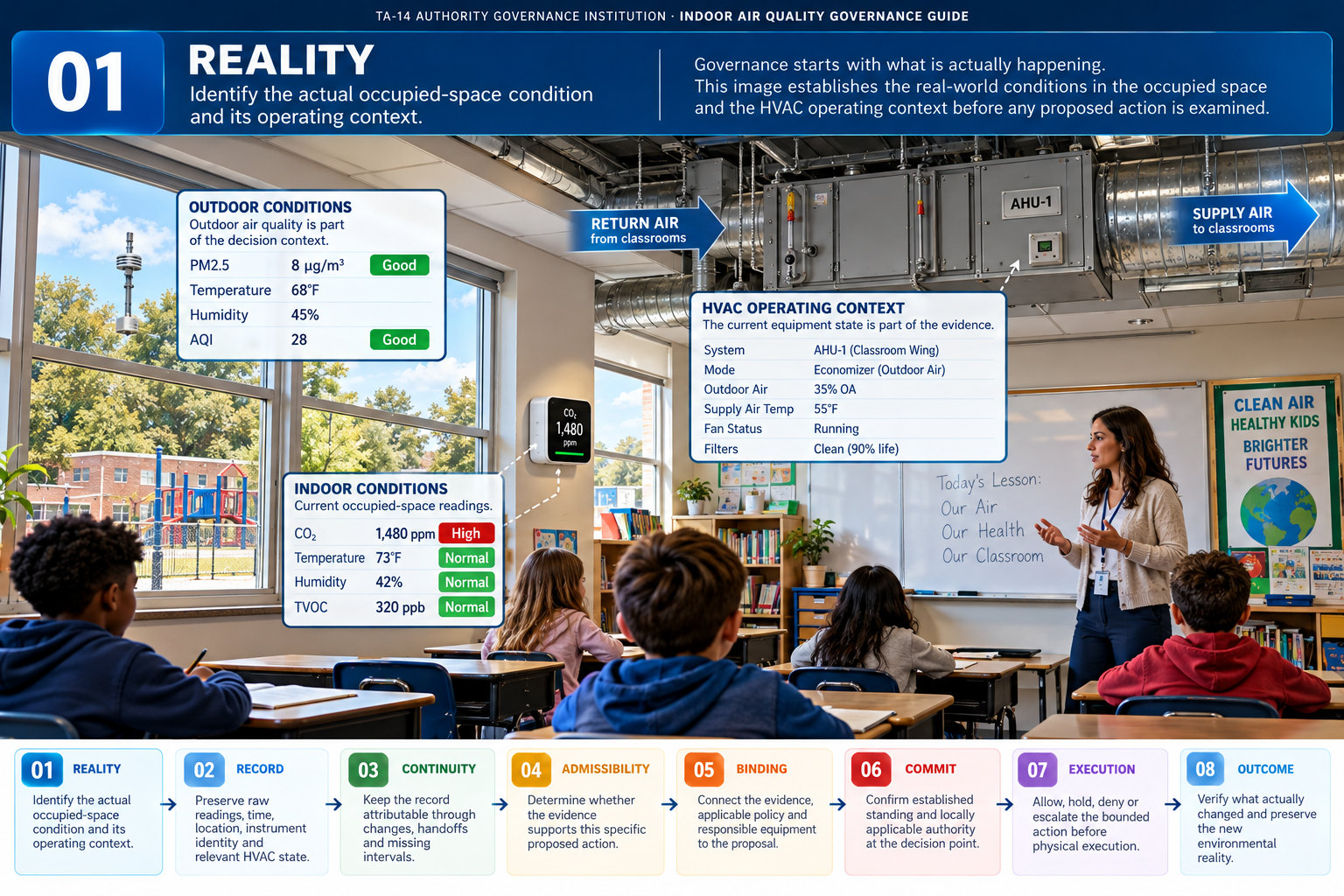
01 — REALITY. We begin with the actual classroom, not a dashboard conclusion. Occupancy, indoor carbon dioxide, outdoor particulate matter, and the operating state of the air-handling system establish the physical context. Observation alone is not permission to intervene.
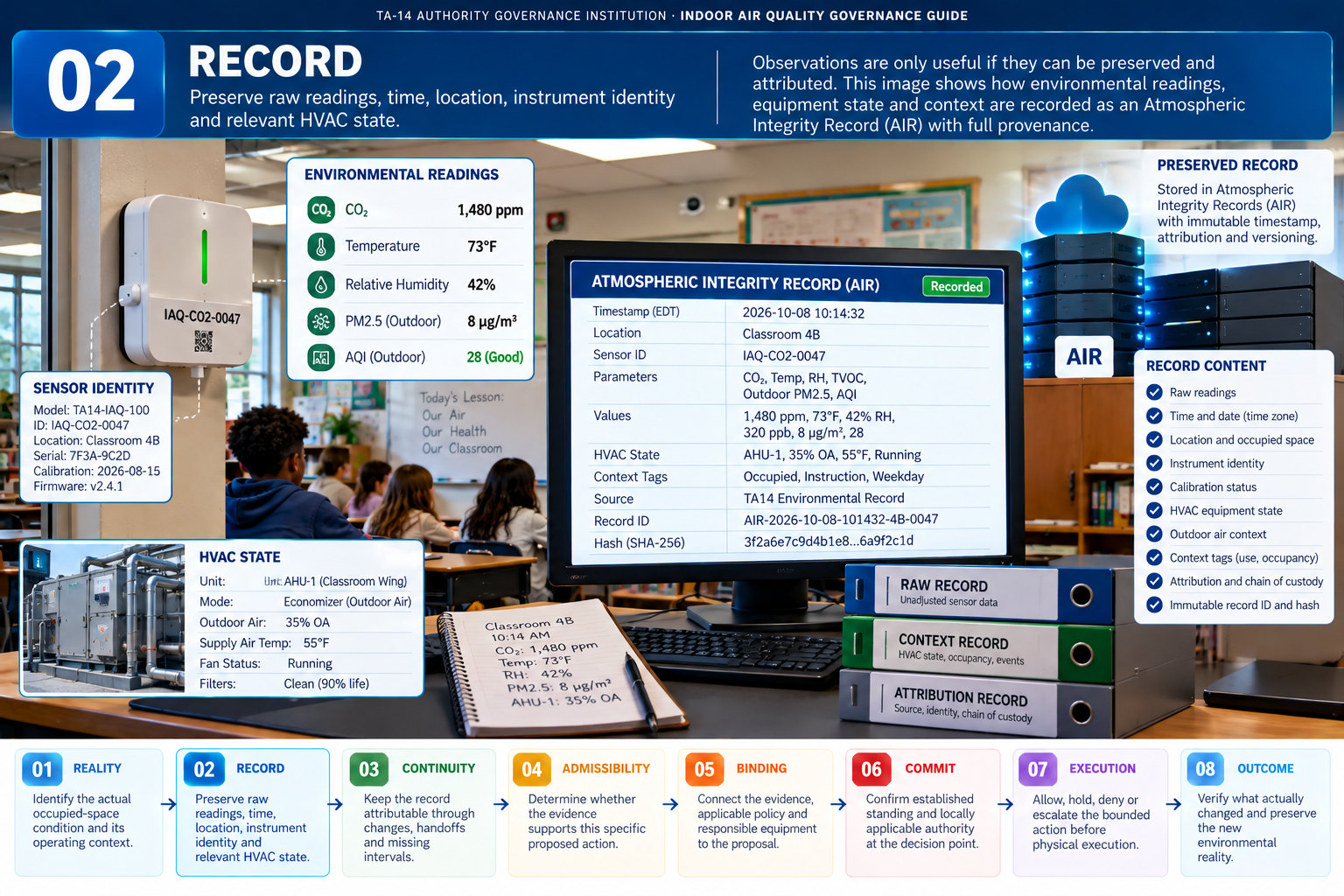
02 — RECORD. Preserve the raw readings, instrument identity, timestamp, location, and HVAC state. The Atmospheric Integrity Record must retain what was actually observed and where it came from. A summary cannot replace its original evidence.
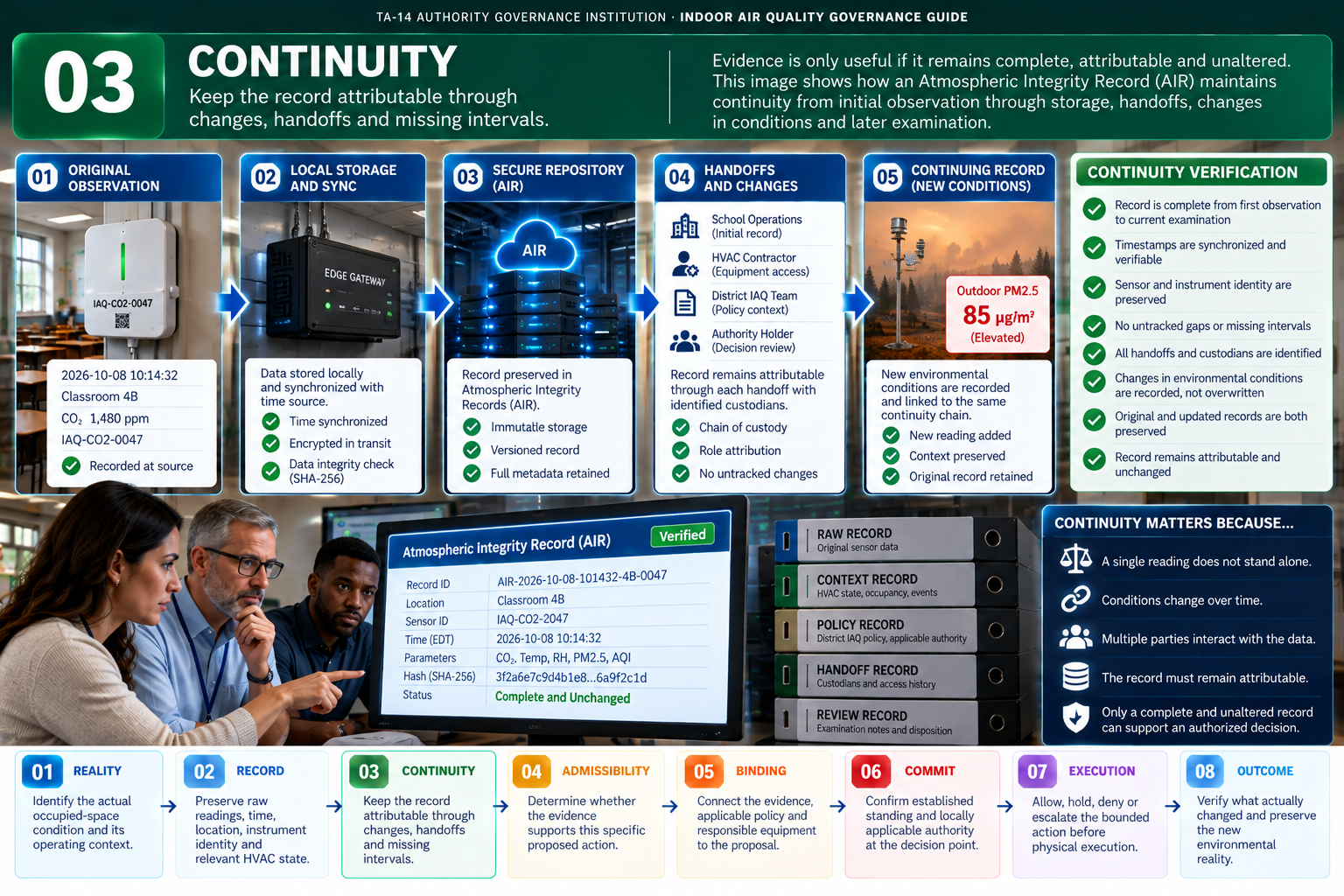
03 — CONTINUITY. The original evidence must remain attributable as it moves through storage, processing, handoffs, and time. Changed conditions do not erase the original record. They change what that record can support now.
04 — ADMISSIBILITY. A preserved reading may be authentic but insufficient for the proposed ventilation action. The question is whether current evidence is relevant, reliable, and sufficient for this particular consequence.
05 — BINDING. Connect the evidence to the specific HVAC asset, applicable policy, operating constraints, responsible decision maker, and proposed action. An observation does not independently grant authority.
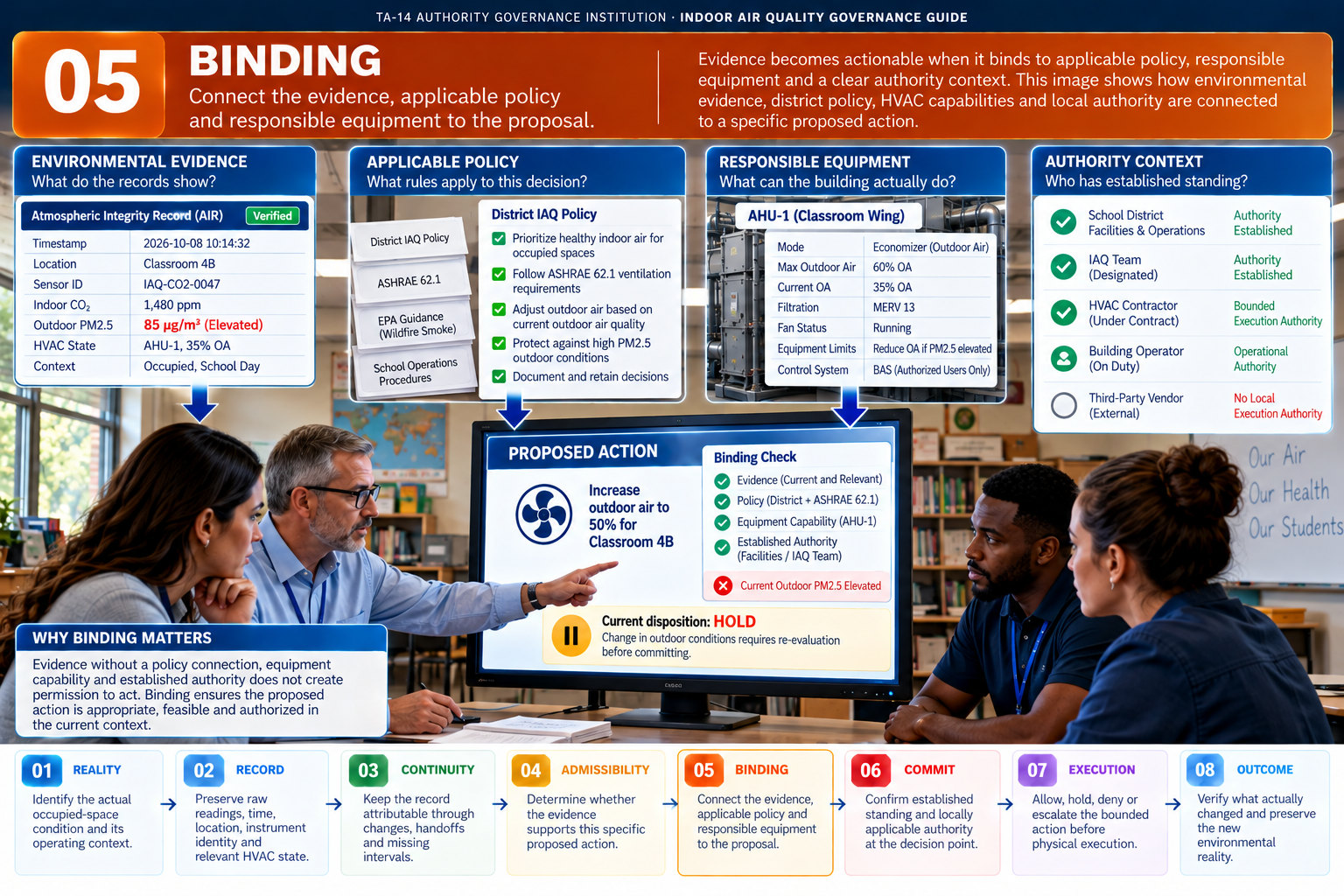
06 — COMMIT. Before any physical action, test admissible evidence, applicable authority, and established standing. With wildfire smoke changing outdoor air, the earlier proposal is held pending renewed examination.
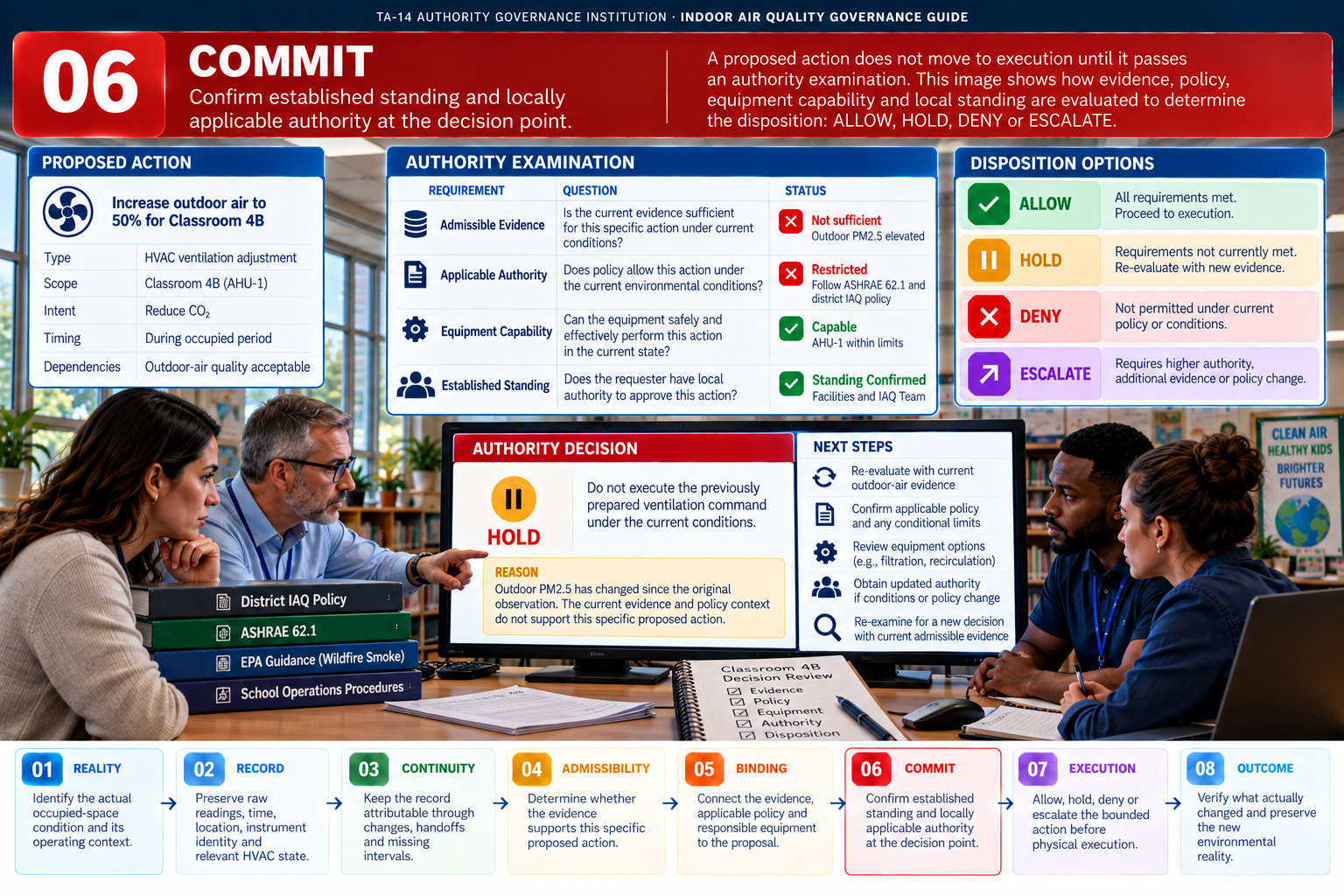
07 — EXECUTION. HOLD means the prepared ventilation command is not released. The equipment remains under its existing authorized control. Capability is not authority.
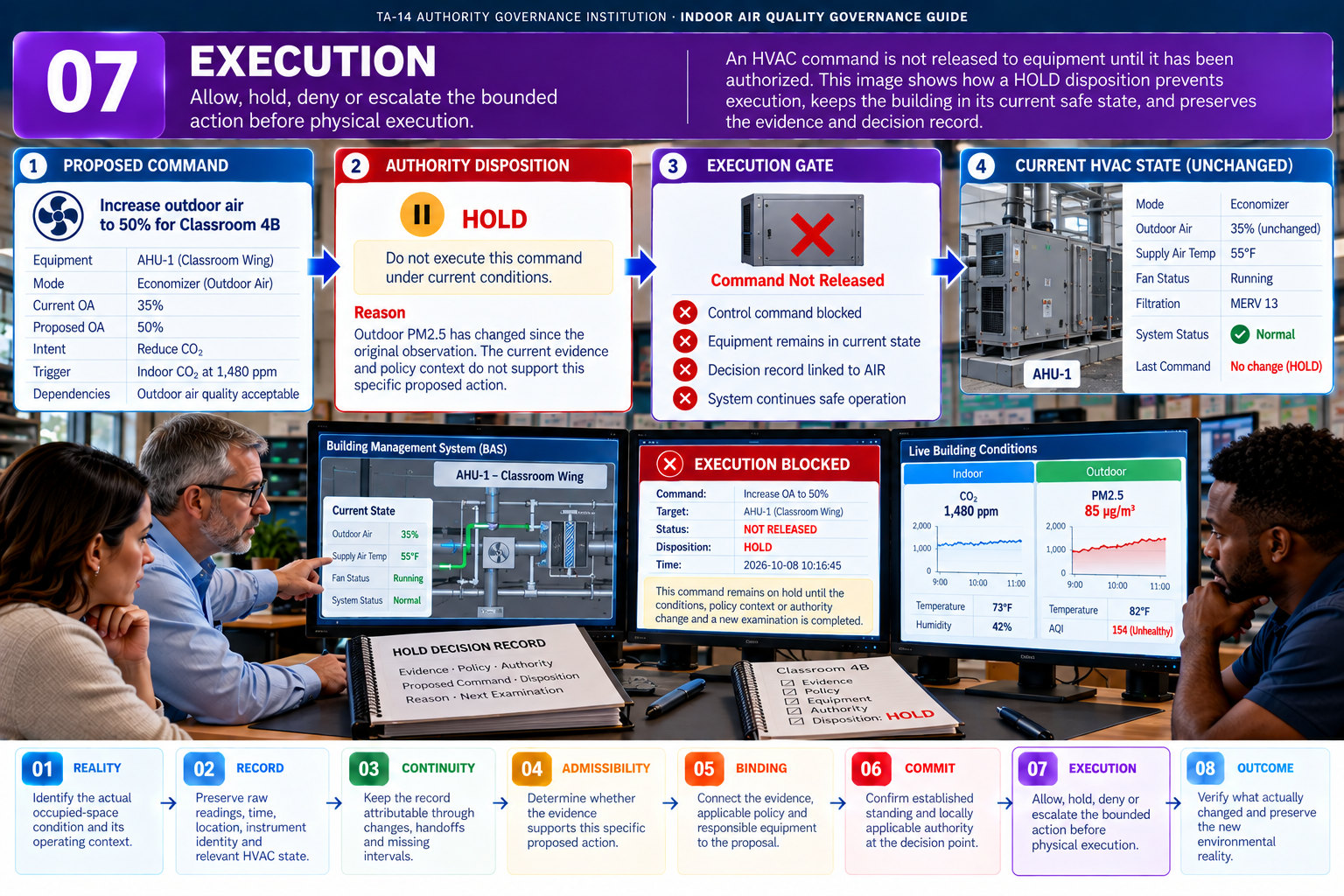
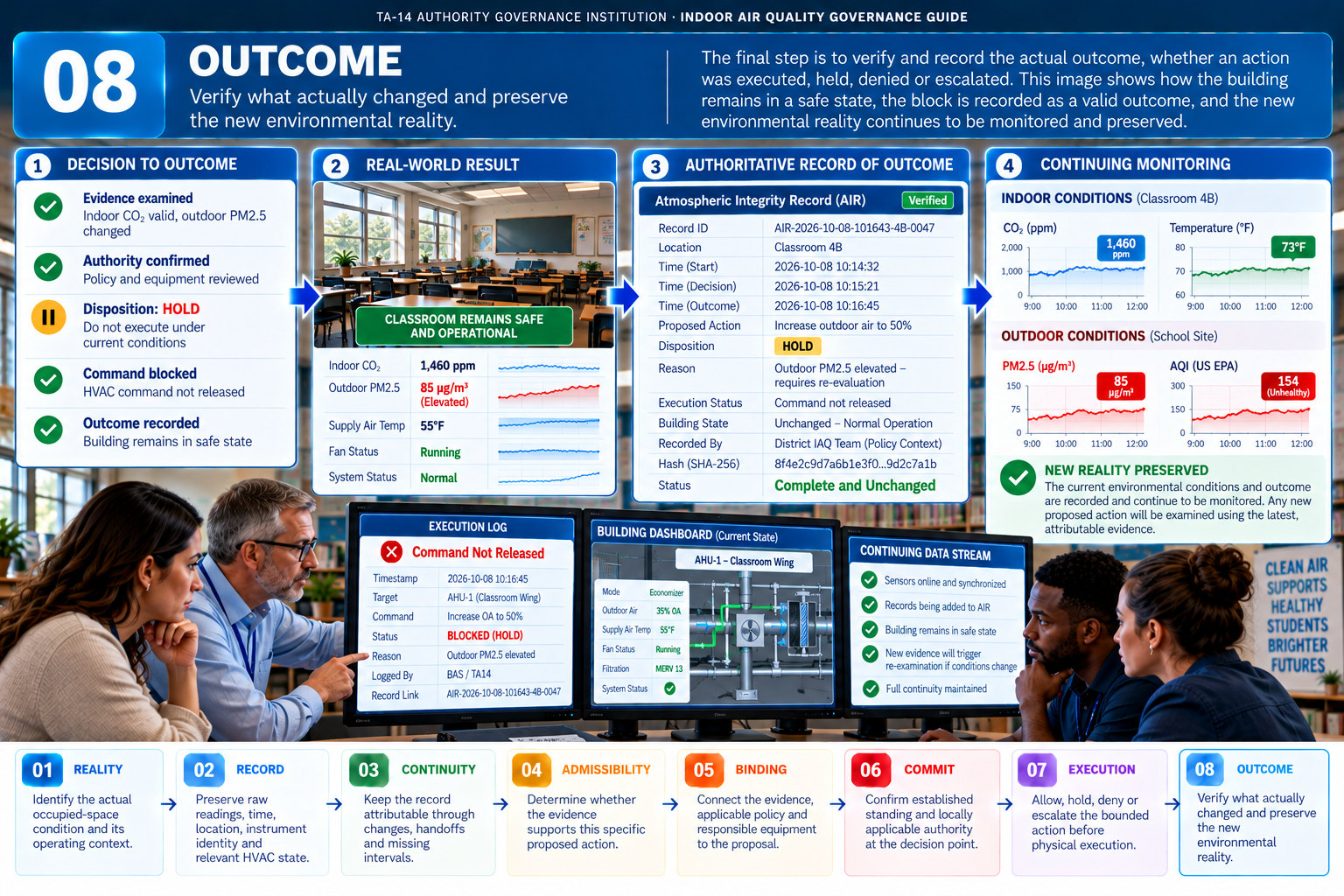
08 — OUTCOME. Verify and record what actually happened, including non-execution. Preserve the held command, decision context, equipment state, and new environmental observations. A documented HOLD is an outcome.
PARTICIPATE IN GOIAQG
Start with the public resources. If you would like to contribute, bring a defined question, building context or research method. Share only information you are authorized to disclose.
Exploration and discussion do not establish a partnership, approval or endorsement. Any formal examination, integration or pilot requires separately agreed scope, responsibilities and terms.
REFERENCE LIBRARY