TA-14 ACADEMY // HVAC // ACADEMY-GROUNDED ARTIFACT

Evidence Before Intervention

HVAC Service Competency & Assessment Blueprint v0.2

Evidence first. Truth preserved. Intervention earned.The technician must establish and preserve the original system state before disturbance, use NIRET to determine whether refrigerant-side entry is evidentially necessary, declare what the evidence supports, intervene only within established authority, and prove the result by comparing the post-performance record to the preserved original state.
BLUEPRINT → LIVE PRACTICE

The competency now has two playable proving grounds.

Use EPA 608 Refrigerant Ops to build refrigerant readiness, then enter the TA-14 14-Step Field Ops Lab to practice the complete 7-In / 7-Out evidence-before-intervention sequence.

01

The nine proof elements

The original state is established before consequence-bearing intervention. NIRET belongs inside that baseline process: non-invasive evidence determines whether refrigerant-side entry is evidentially necessary. Evidence may justify an action; applicable authority and standing must still be established.

01Sequence
02Non-Invasive Evidence
03NIRET
04Refrigerant-Side Evidence (if justified)
05Original-State HVAC Performance Record
06Declared Diagnostic Determination
07Evidence-Based Intervention
08HVAC Post-Performance Record
09Proof of Performance
02

Learn the complete evidence-to-outcome sequence

Move through the visuals in order. Each image teaches one boundary in the field method. The final image closes the chain from observation to verified outcome.

00Evidence Before Intervention
TA-14 HVAC teaching visual 00: Evidence Before Intervention
SAMANTHA · AUDIO GUIDE 00

Welcome to Evidence Before Intervention. Imagine you arrive at a building because someone says a room is too hot. You may have the training and tools to change the equipment, but that does not mean you know what is wrong, and it does not mean you have permission to make every possible change. The first responsibility is to establish what the system is actually doing. We call that original reality. Before touching a refrigerant connection, changing a setting, or replacing a component, preserve the observations that explain the operating condition. Write down the complaint, equipment identity, time, weather, thermostat settings, operating mode, and any visible conditions. Notice the difference between a report and a measurement. Someone saying the room feels warm is important evidence of a concern, but it is not a measured supply-air temperature. You will learn to move from observation to a preserved record, from a record to an evidence-supported determination, and only then to an appropriately authorized intervention. After the work, you must measure again and compare the results. That comparison is how we establish whether the work improved anything. The central rule is simple: establish reality before changing reality. As you continue, ask yourself what would be lost if you changed the system before documenting how it behaved.

Voice depends on the voices available on your device. Written narration is always available.
AFTER THE IMAGE · WHAT YOU JUST LEARNED

This opening image introduces the whole method. A service call is not permission to change a system.

CHECK YOUR UNDERSTANDING

Explain why a technician must preserve the original state before disturbing equipment.
Next: establish the sequence that keeps observation ahead of intervention.↓
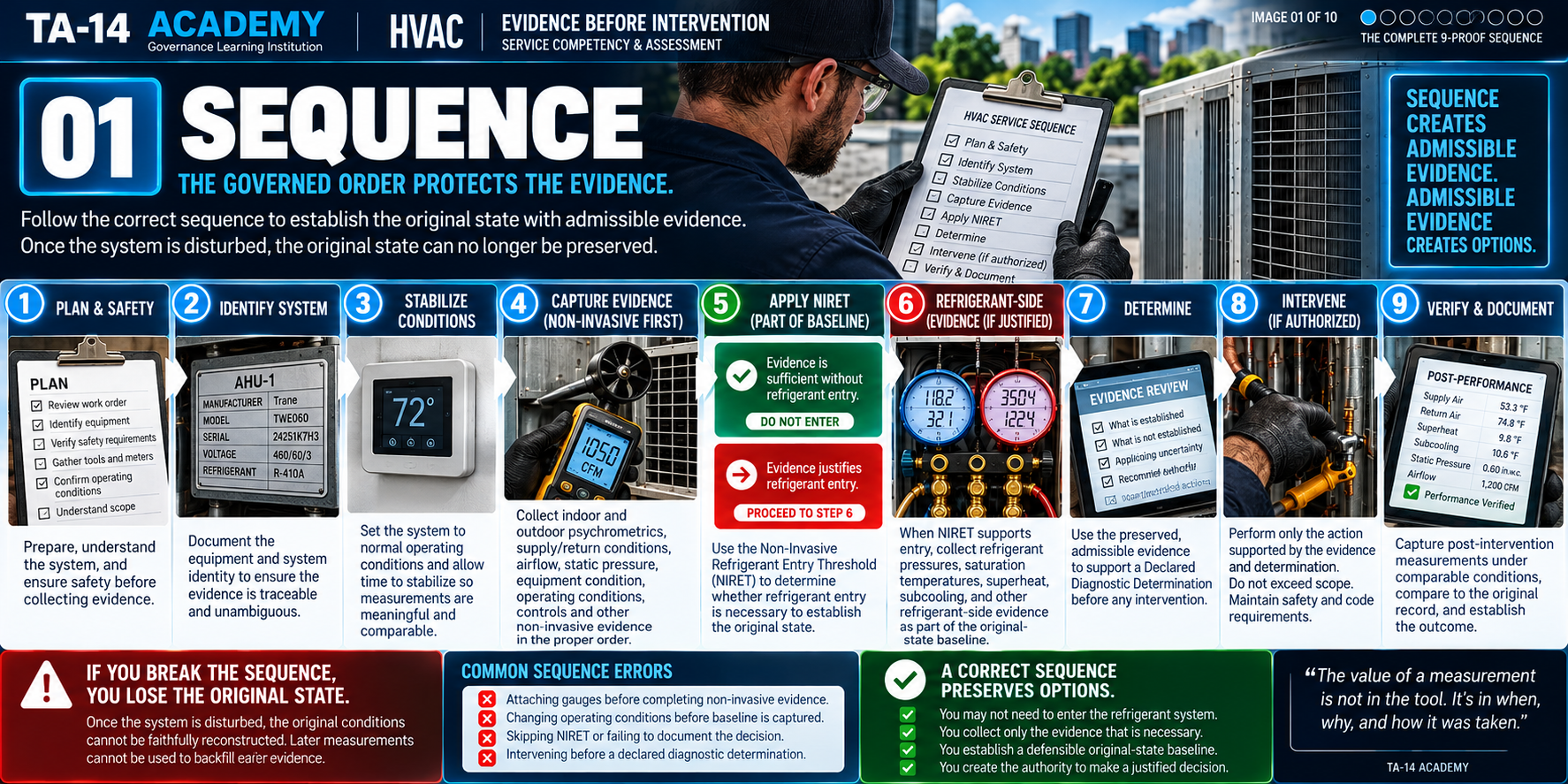
01Sequence
TA-14 HVAC teaching visual 01: Sequence
SAMANTHA · AUDIO GUIDE 01

Image one is about sequence: doing the right things in the right order. Picture a technician who walks up to a running air conditioner and immediately connects gauges. The gauges may provide useful information, but attaching them can disturb the system and skips evidence that could have been gathered without entering the refrigerant circuit. A governed sequence starts with safety and the service concern. Identify the equipment, operating mode, and conditions. Observe and preserve what is already available. Measure accessible air-side and electrical conditions where safe and appropriate. Record what was actually measured, not what you expect to find. A sequence is not just a checklist to finish quickly. It protects the original state from being overwritten by your own actions. If you turn off a system, change a thermostat setting, or reset a controller, you may erase clues about the original fault. Sometimes immediate safety action is required; safety always takes priority, and the reason for the action must be recorded. Sequence also includes stop points. If evidence is missing or authority is uncertain, the next step may be to hold rather than proceed. Think about the last service call you saw. What did the technician know before the first change? What did the technician merely assume? The next image shows how to gather non-invasive evidence that makes the sequence meaningful.

Voice depends on the voices available on your device. Written narration is always available.
AFTER THE IMAGE · WHAT YOU JUST LEARNED

Sequence is the order of operations, not proof by itself. Record what was observed and when.

CHECK YOUR UNDERSTANDING

Identify the next permissible investigative step without skipping prerequisite evidence.

Next: gather non-invasive measurements while the original operating state is intact.↓
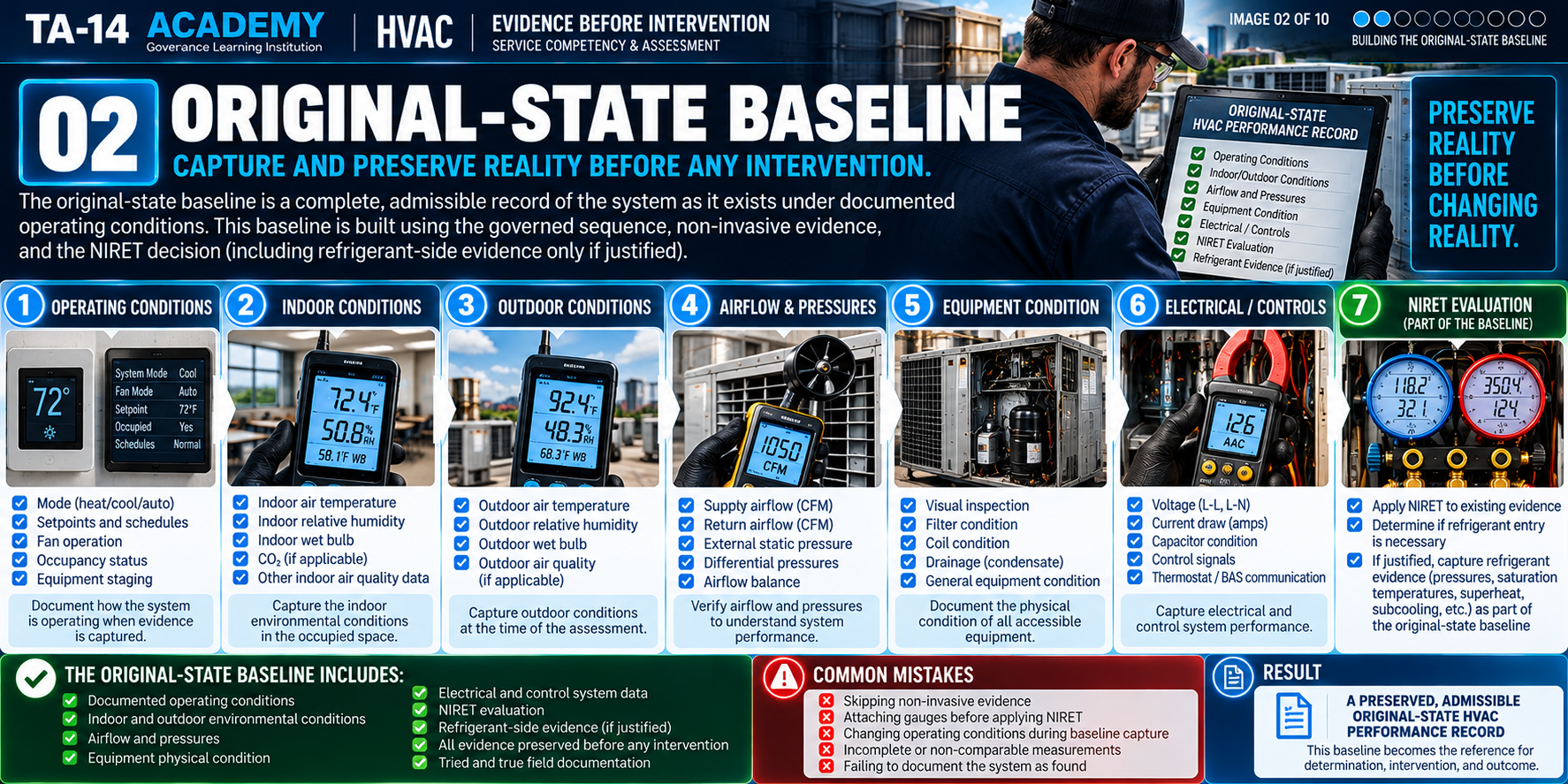
02Original-State Baseline
TA-14 HVAC teaching visual 02: Original-State Baseline
SAMANTHA · AUDIO GUIDE 02

Now we are building the original-state baseline. Baseline does not mean one magic reading. It means a documented picture of the system under known operating conditions. Start with the complaint and the conditions in which it occurs. Record indoor and outdoor conditions, thermostat command and actual mode, return-air and supply-air conditions, airflow evidence, filter and coil observations, static pressure where appropriate, condensate condition, and safe electrical and control measurements. The exact measurements depend on the equipment and the task; do not treat this list as permission to bypass safety procedures. Suppose the supply air is warmer than expected. That observation alone does not prove the refrigerant charge is low. Reduced airflow, controls, operating mode, load, or other factors may also matter. Preserve the units, instrument, measurement point, time, and system state so someone else can understand what you observed. Separate measured facts from calculations and inferences. A temperature difference may be calculated from two measurements, but a diagnosis requires more reasoning. A strong baseline lets another qualified person review the evidence without guessing what you meant. Most importantly, non-invasive evidence comes first. We have not yet decided that connecting gauges is necessary. The next image introduces the threshold used to make that decision.

Voice depends on the voices available on your device. Written narration is always available.
AFTER THE IMAGE · WHAT YOU JUST LEARNED

Build the baseline from observations such as operating conditions, airflow, temperatures, controls, and electrical evidence.

CHECK YOUR UNDERSTANDING

Separate what was actually measured from what is only suspected.

Next: use that preserved evidence to evaluate whether refrigerant-system entry is necessary.↓
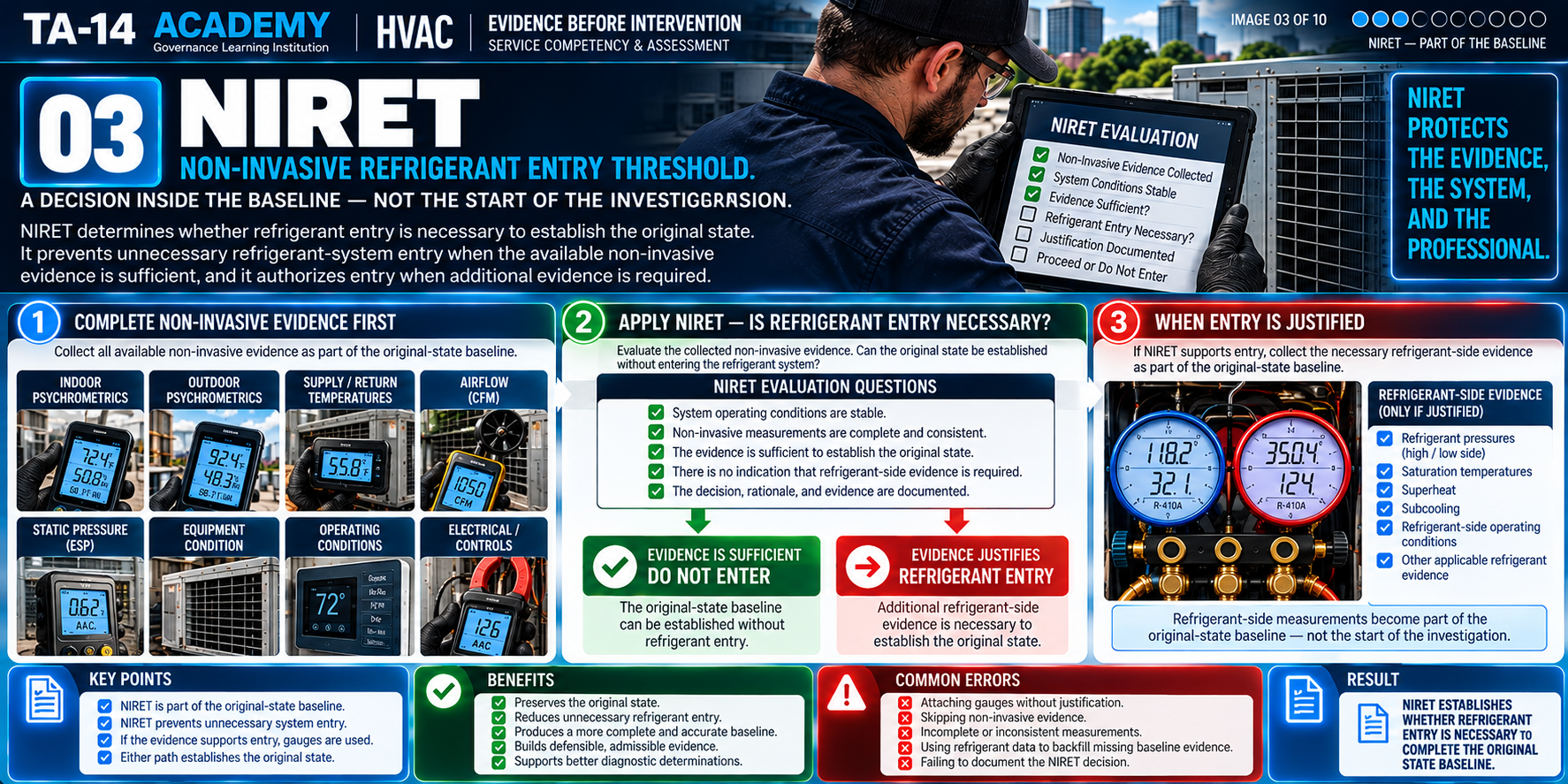
03NIRET
TA-14 HVAC teaching visual 03: NIRET
SAMANTHA · AUDIO GUIDE 03

NIRET stands for Non-Invasive Refrigerant Entry Threshold. It is a disciplined decision about whether the evidence justifies entering the refrigerant system. It is not a requirement to connect gauges on every call, and it is not a substitute for permission or safety. Begin with the non-invasive evidence you have preserved. Ask whether the service concern can be explained, narrowed, or resolved without disturbing the refrigerant circuit. Ask what specific uncertainty refrigerant-side measurements would address. If you cannot explain why entry is necessary, the correct decision may be to hold, gather more evidence, or avoid entry. If the evidence supports entry, the technician still needs applicable authority, proper qualifications, safe conditions, and an appropriate scope. NIRET does not create those things. Consider a dirty filter and clearly inadequate airflow. Connecting gauges first could distract from the established air-side problem. In a different case, documented air-side and electrical evidence may leave a refrigerant-side question unresolved. Then entry may be justified. The decision and its basis belong in the record, including when the decision is not to enter. Remember: the question is not whether you own gauges. The question is whether the evidence has earned their use. Next we look at what to preserve if entry is justified.

Voice depends on the voices available on your device. Written narration is always available.
AFTER THE IMAGE · WHAT YOU JUST LEARNED

NIRET is a threshold for evidential necessity, not a grant of execution authority.

CHECK YOUR UNDERSTANDING

Explain what non-invasive evidence supports entry—or why entry should be avoided.

Next: if entry is justified and separately authorized, capture refrigerant-side evidence.↓
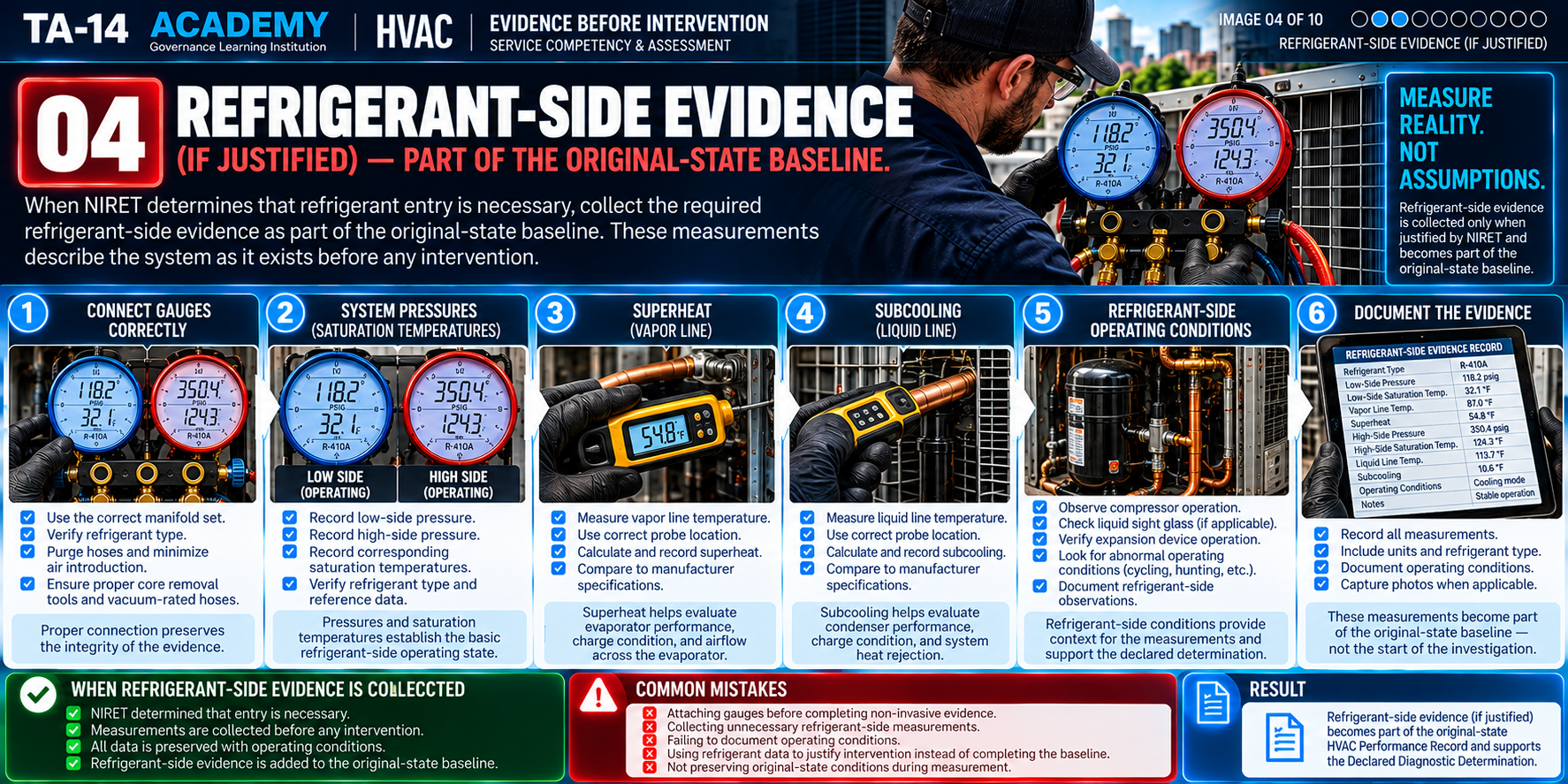
04Refrigerant-Side Evidence — if justified
TA-14 HVAC teaching visual 04: Refrigerant-Side Evidence — if justified
SAMANTHA · AUDIO GUIDE 04

This image covers refrigerant-side evidence, but only when NIRET supports entry and the technician is separately authorized to perform it. A pressure reading is not a diagnosis by itself. Pressures must be interpreted with the refrigerant type, operating mode, load, airflow, temperatures, and equipment information. When safe and applicable, the technician may document pressure, corresponding saturation temperature, line temperature, superheat, subcooling, and relevant manufacturer specifications. These are examples, not a universal instruction to attach gauges or manipulate equipment. Use proper safety practices and refrigerant-handling requirements. Before you take a measurement, know why you need it and what question it should help answer. Preserve the instrument, units, point of measurement, timestamp, and operating condition. If a system is changing rapidly or not stabilized, say so rather than presenting a number as though it represents steady operation. Do not silently adjust or reconstruct a reading later. The refrigerant-side observations, if justified, become part of the original-state evidence, alongside the non-invasive observations. They do not replace the air-side baseline. And they do not automatically prove a charge problem. Next we assemble the preserved evidence into a coherent original-state performance record.

Voice depends on the voices available on your device. Written narration is always available.
AFTER THE IMAGE · WHAT YOU JUST LEARNED

Refrigerant pressures, saturation temperatures, superheat, and subcooling require appropriate system access.

CHECK YOUR UNDERSTANDING

Record conditions and measurements without treating refrigerant data as automatically required.

Next: combine justified observations into the preserved original-state performance record.↓
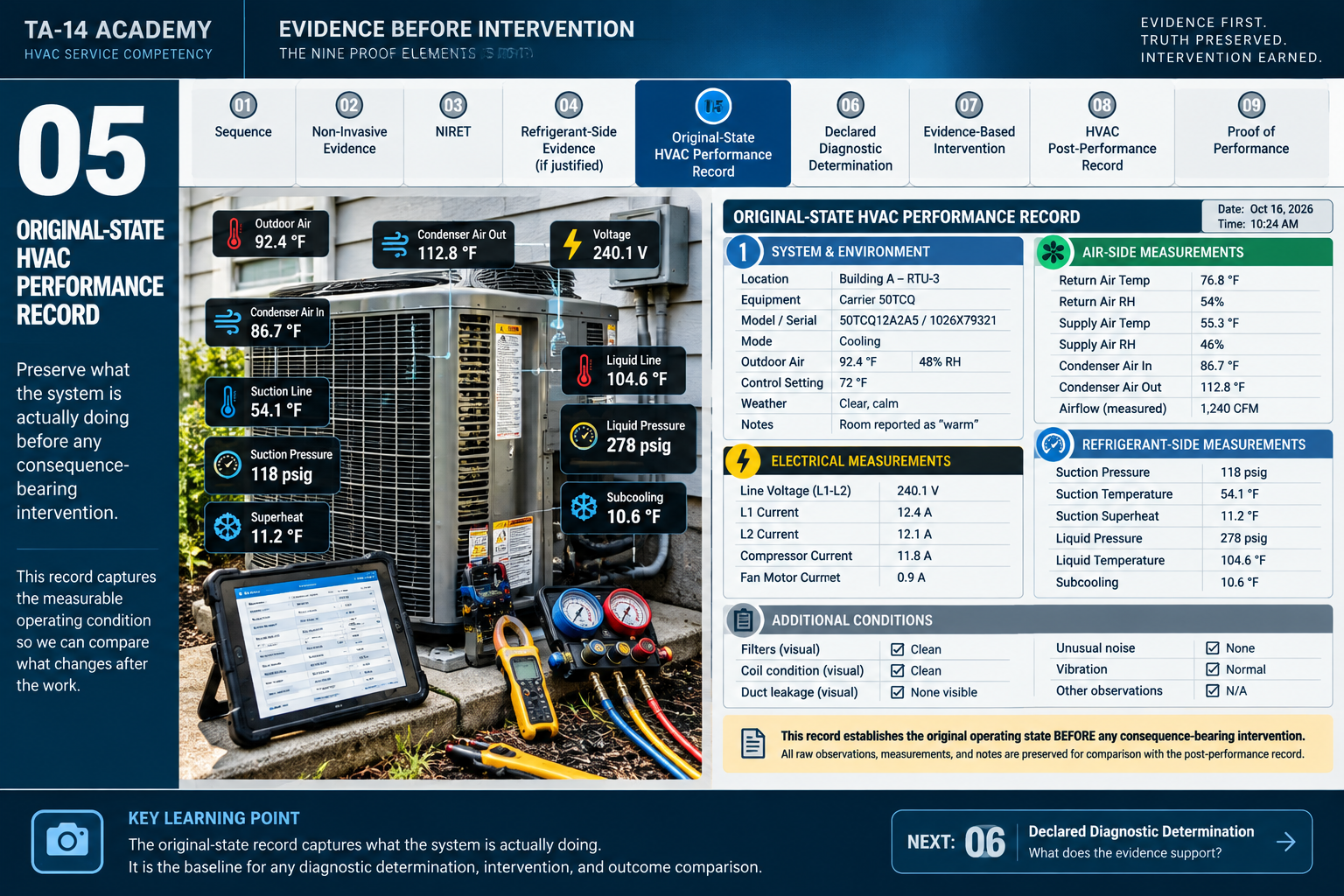
05Original-State Established
TA-14 HVAC teaching visual 05: Original-State Established
SAMANTHA · AUDIO GUIDE 05

We have now reached the original-state HVAC Performance Record. This is the point where separate observations become a reviewable record of how the equipment was operating before consequence-bearing intervention. Think of it as a carefully labeled before picture, except the picture contains measured conditions, instrument references, timestamps, operating state, and uncertainty. The record should identify the equipment and the person making observations. It should preserve non-invasive evidence and any justified refrigerant-side evidence. It should make clear which measurements were observed directly, which values were calculated, and which conclusions remain uncertain. If conditions changed during investigation, do not pretend the record is one uninterrupted snapshot. Record the sequence and explain what changed. A good record can be examined by an instructor, owner, technician, or independent reviewer without asking the original technician to reconstruct missing details from memory. It is also the comparison anchor for later Proof of Performance. Without a preserved before state, a later claim of improvement becomes much weaker. Pause here and ask: could another qualified person reproduce the reasoning from this record? If not, what evidence is missing? The next image teaches how to declare a diagnostic determination without confusing a finding with permission to act.

Voice depends on the voices available on your device. Written narration is always available.
AFTER THE IMAGE · WHAT YOU JUST LEARNED

The original-state record preserves equipment identity, operating context, raw observations, measurement provenance, NIRET decisions, and uncertainty. It becomes the fixed comparison anchor for later Proof of Performance.

CHECK YOUR UNDERSTANDING

Check that sources, units, methods, timestamps, and uncertainty are preserved.

Next: declare what this evidence actually establishes before proposing a change.↓
06Declared Diagnostic Determination
TA-14 HVAC teaching visual 06: Declared Diagnostic Determination
SAMANTHA · AUDIO GUIDE 06

Now we make a declared diagnostic determination. That phrase matters. A determination is a carefully bounded statement of what the preserved evidence supports. It is not a confident-sounding guess and it is not automatic authority to perform repairs. Imagine you have measured low airflow, an unusually high pressure drop across a filter, and a supply-air condition that changes when airflow is restored. You may have evidence supporting an airflow-related performance problem. State the observations, the reasoning, and what remains unproven. Do not claim that the refrigerant charge is wrong simply because the system is not cooling as expected. A good determination says what was established, what alternatives were considered, and which uncertainties remain. It also identifies the proposed next action and why that action follows from the evidence. The distinction between observation, inference, and authorization must stay visible. Observed is not inferred. Inferred is not authorized. Even a well-supported determination does not grant permission to execute. Applicable authority and established standing must be checked independently, including who owns or controls the equipment and who can approve the proposed change. If the evidence is insufficient, the honest determination may be unresolved. The next image shows how a justified and authorized intervention is kept within its proper boundary.

Voice depends on the voices available on your device. Written narration is always available.
AFTER THE IMAGE · WHAT YOU JUST LEARNED

A declared diagnostic determination states the supported finding, its limits, and unresolved uncertainty.

CHECK YOUR UNDERSTANDING

Distinguish evidence-supported determination from assumption; a determination does not grant authority.

Next: evaluate a bounded intervention under applicable authority and established standing.↓
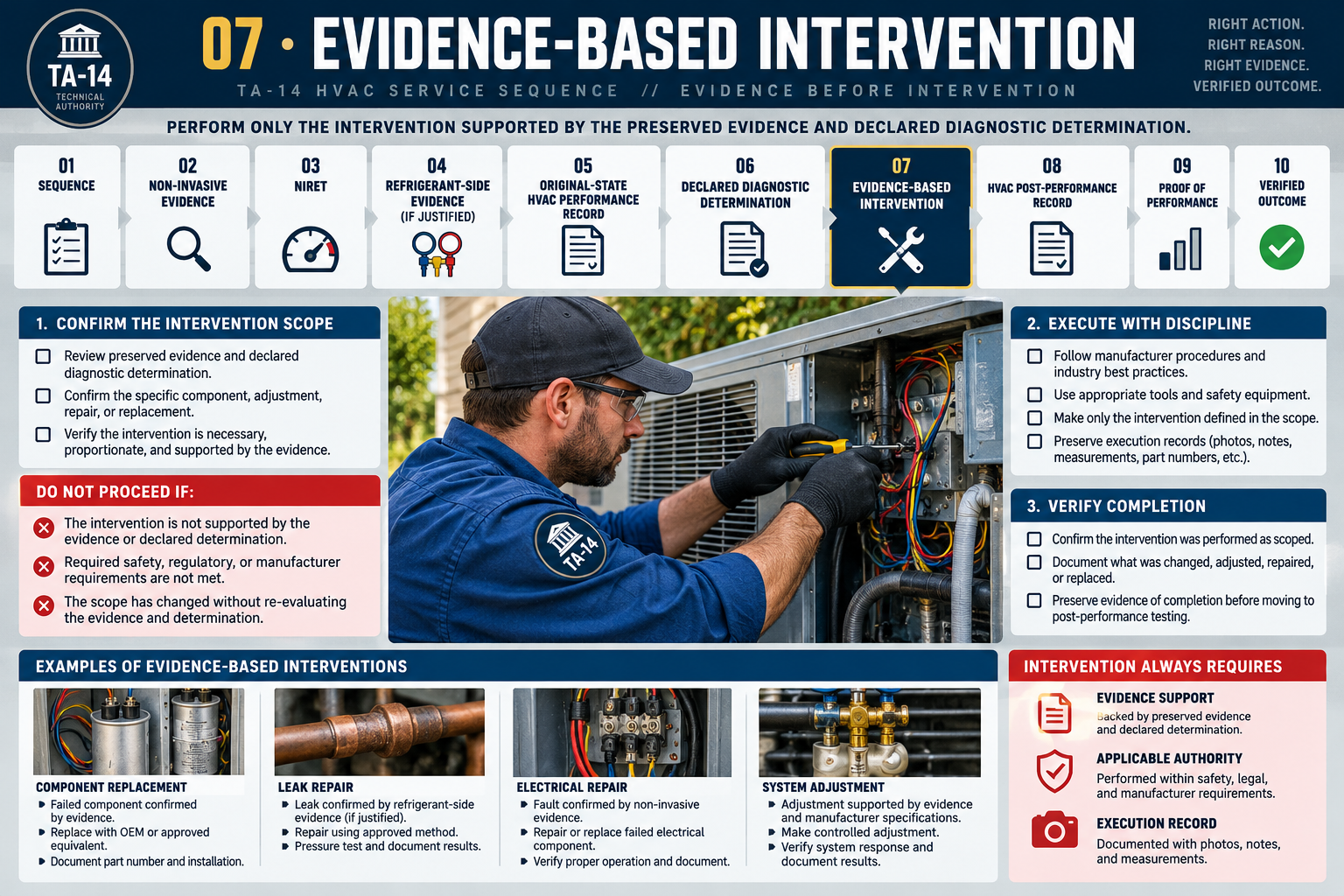
07Evidence-Based Intervention
TA-14 HVAC teaching visual 07: Evidence-Based Intervention
SAMANTHA · AUDIO GUIDE 07

This is image seven: Evidence-Based Intervention. We are finally discussing changing the system, but notice how much work came first. We observed, preserved evidence, considered whether refrigerant entry was justified, assembled the original-state record, and declared an evidence-supported determination. Now ask three questions. What exact intervention is proposed? What evidence supports that intervention? And who has applicable authority to permit it now? Capability is not authority. A technician may know how to replace a part, adjust a control, or repair a refrigerant circuit without being authorized to do so in this situation. The approved scope should identify what may change, the safety controls, and what would require stopping or escalating. Before execution, confirm the equipment and current conditions still match the basis for the decision. If conditions have changed, revalidate rather than assuming yesterday's permission still applies. During the work, record what was actually done, including parts, settings, timing, and deviations from the plan. Do not expand the repair because another possibility comes to mind. If you discover something outside the authorized scope, stop and seek a new decision. The intervention is not the finish line. After the change, the system must be observed again. Next we create a post-performance record that shows the new reality rather than merely declaring success.

Voice depends on the voices available on your device. Written narration is always available.
AFTER THE IMAGE · WHAT YOU JUST LEARNED

The intervention must match the preserved evidence, declared determination, approved scope, and applicable authority.

CHECK YOUR UNDERSTANDING

Identify the action, safety controls, scope limits, and execution record; stop if conditions change.

Next: capture the system's new operating state without rewriting the original record.↓
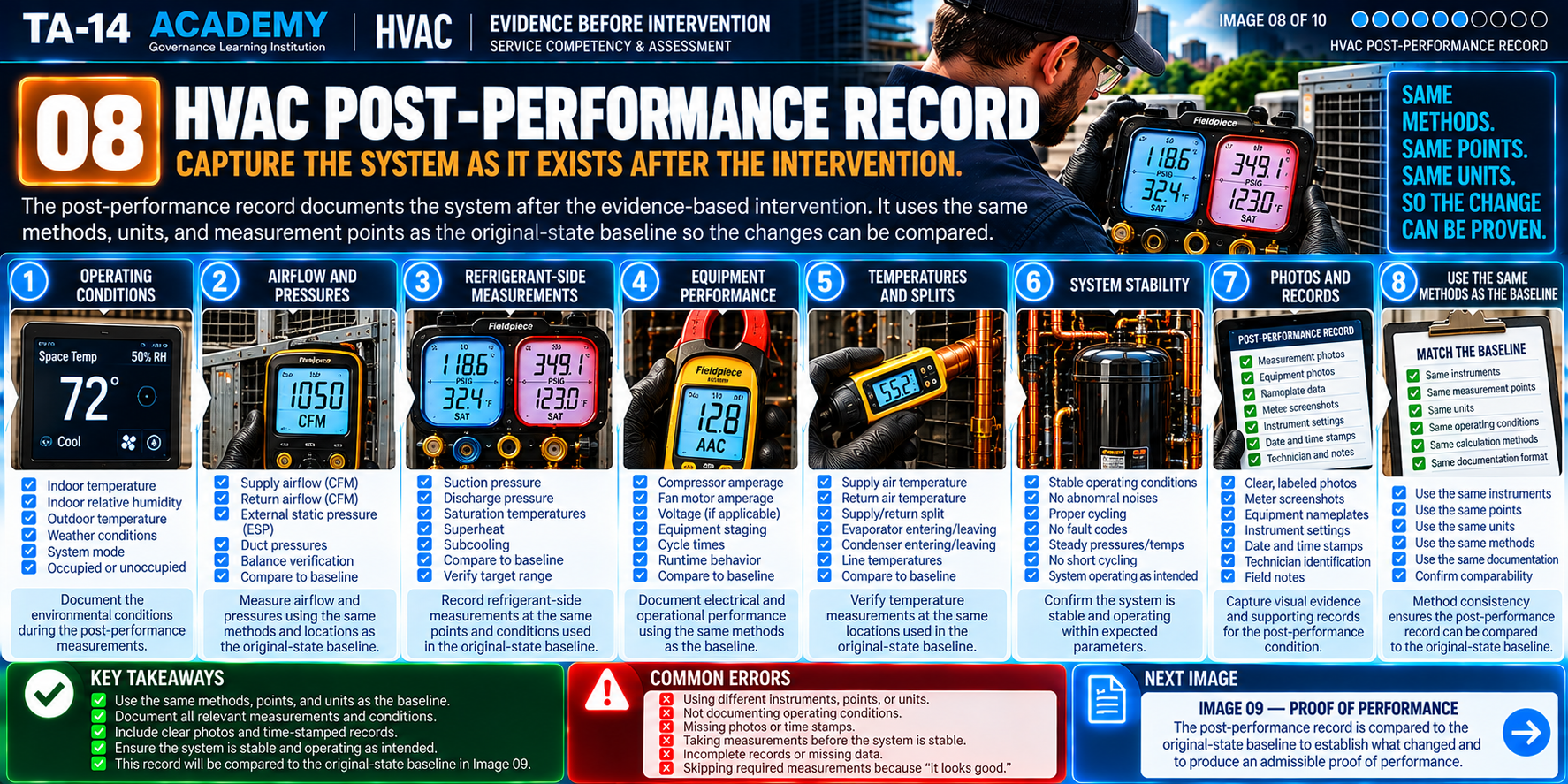
08HVAC Post-Performance Record
TA-14 HVAC teaching visual 08: HVAC Post-Performance Record
SAMANTHA · AUDIO GUIDE 08

After the intervention, the system has a new state. Image eight teaches the HVAC Post-Performance Record. This record must describe what the system actually did after the work. Do not simply write fixed, cooling, or operating normally. Those statements may be useful summaries, but they are not substitutes for measurements. Capture the relevant operating mode, environmental conditions, airflow and air-side measurements, control behavior, electrical observations, and refrigerant-side values only when justified and appropriate. Record the time and whether the system had reached a comparable operating condition. The word comparable is critical. A temperature reading taken before repair at one load cannot always be compared directly with a reading taken after repair at a very different load. Preserve raw observations separately from any adjusted or normalized values, and explain the method and uncertainty of adjustments. Never rewrite the original-state record to make the result look better. The post-performance record tells us what happened after intervention; it does not, by itself, prove that the intervention improved the system. We need to compare the before and after records and determine what conclusions the evidence actually supports. That is the subject of the next image.

Voice depends on the voices available on your device. Written narration is always available.
AFTER THE IMAGE · WHAT YOU JUST LEARNED

The post-performance record documents what the system did after intervention.

CHECK YOUR UNDERSTANDING

Capture comparable operating conditions, points, methods, and units.

Next: compare the two records; the post-state record alone is not proof of improvement.↓
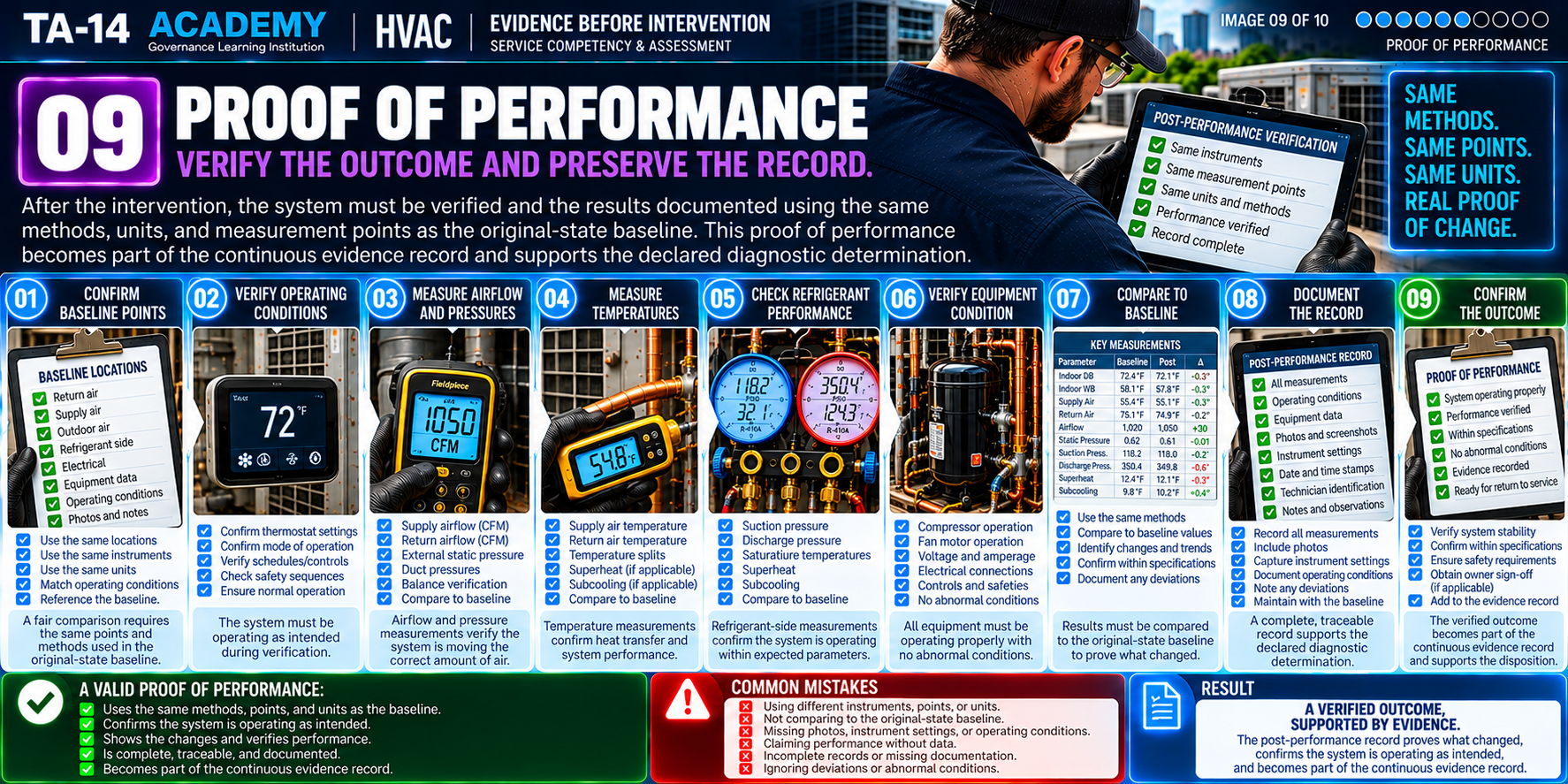
09Proof of Performance
TA-14 HVAC teaching visual 09: Proof of Performance
SAMANTHA · AUDIO GUIDE 09

Image nine is Proof of Performance. Here we compare the preserved original-state HVAC Performance Record with the HVAC Post-Performance Record. Think of two photographs taken with different camera settings. Even if the pictures look different, you need to understand the conditions before claiming that the subject changed. HVAC measurements work the same way. Check whether the measurement points, instruments, units, operating modes, and loads are sufficiently comparable. If they are not, identify the limitation instead of forcing a conclusion. Compare the values that matter to the declared service concern. Did airflow improve? Did the system achieve a required operating condition? Was the original fault resolved? Did a new problem appear? An outcome can be improved, restored, unchanged, degraded, or unresolved. Unresolved is not a failure of honesty; it is the appropriate disposition when the available evidence cannot support a stronger claim. Remember that successful execution of a repair is not the same as proof of a successful result. A technician can complete the authorized action and still discover that the performance target was not achieved. Record that truth. Proof of Performance is the comparison and reasoning, not merely the after readings. In the final image, we connect the complete chain and look for missing links.

Voice depends on the voices available on your device. Written narration is always available.
AFTER THE IMAGE · WHAT YOU JUST LEARNED

Proof of Performance is the supported comparison between original and post-intervention records.

CHECK YOUR UNDERSTANDING

Determine whether the evidence supports IMPROVED, RESTORED, UNCHANGED, DEGRADED, or UNRESOLVED.

Next: examine the complete chain and verify whether the outcome claim is warranted.↓
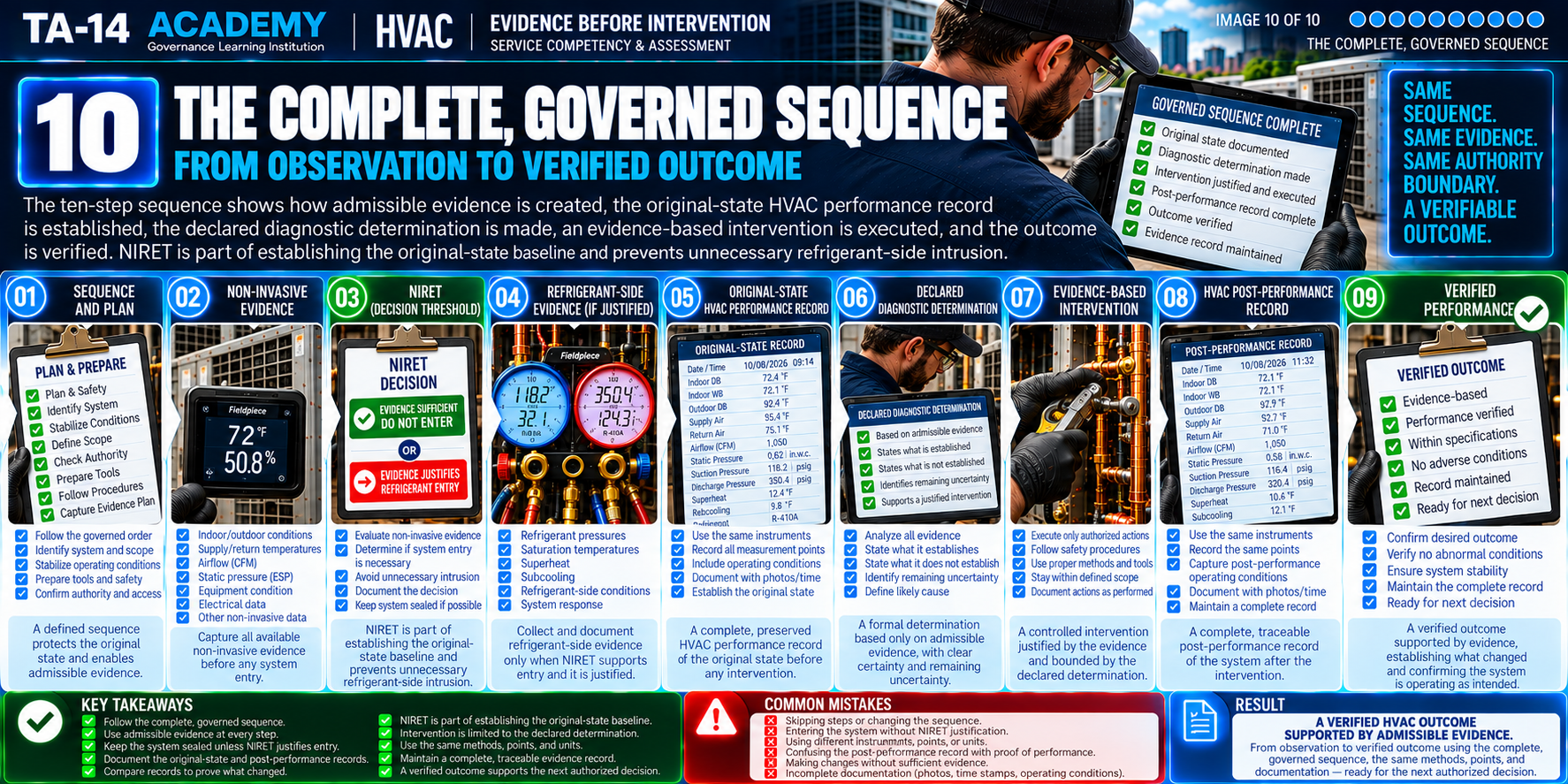
10Complete Governed Sequence
TA-14 HVAC teaching visual 10: Complete Governed Sequence
SAMANTHA · AUDIO GUIDE 10

We have reached the complete governed sequence. Let us walk through it one final time. First, establish a safe and orderly sequence. Second, gather and preserve non-invasive evidence. Third, apply NIRET to decide whether refrigerant-system entry is evidentially necessary. Fourth, if entry is justified and authorized, preserve refrigerant-side evidence. Fifth, establish the original-state HVAC Performance Record. Sixth, declare the diagnostic determination and its uncertainty. Seventh, perform only an evidence-supported intervention within applicable authority and established standing. Eighth, preserve the HVAC Post-Performance Record. Ninth, establish Proof of Performance through a defensible comparison. The verified outcome follows from that comparison; it is not an extra shortcut around the nine proof elements. At every consequential step, ask the governing question: Does this proposed consequence have sufficient Admissible Evidence, Applicable Authority, and Established Standing to become reality NOW? If not, the correct disposition may be hold, deny, or escalate instead of allow. In field work, professionalism means knowing when to proceed and when to stop. You are not being trained to fill in boxes. You are being trained to preserve reality, make defensible decisions, and show whether your work produced the claimed result. Return to the fourteen-step field lab to practice, and use assessment to demonstrate the complete chain.

Voice depends on the voices available on your device. Written narration is always available.
AFTER THE IMAGE · WHAT YOU JUST LEARNED

This closing image brings observation, evidence, authority, intervention, comparison, and outcome together.

CHECK YOUR UNDERSTANDING

Trace the complete record and identify any unsupported leap or missing authority.

Return to the field lab to practice the method, then use assessment to demonstrate competency.
03

Assessment domains

20%WEIGHT

Sequence + Non-Invasive Evidence

Preserve the governed order and establish operating reality before invasive disturbance.

20%WEIGHT

NIRET + Original-State Record

Apply NIRET inside baseline establishment and preserve refrigerant-side evidence only when entry is justified.

15%WEIGHT

Declared Diagnostic Determination

State what the evidence establishes, what it does not establish, and remaining uncertainty before intervention.

15%WEIGHT

Evidence-Based Intervention

Execute only an intervention supported by evidence and within separately established applicable authority.

15%WEIGHT

HVAC Post-Performance Record

Capture the post-intervention state using comparable methods, points, units, and operating conditions.

15%WEIGHT

Proof of Performance

Compare original-state and post-performance records and issue the supported verified outcome.

04

NIRET inside the original-state baseline

Non-Invasive Refrigerant Entry Threshold

NIRET is part of establishing the original-state baseline. The technician first preserves non-invasive operating evidence. If that evidence supports refrigerant-system entry, refrigerant-side measurements are added to the original-state record. If it does not, unnecessary intrusion is avoided. NIRET does not itself create execution authority.

The assessment must use the current Academy NIRET standard. This blueprint does not invent or silently redefine the threshold.
05

Critical-failure boundary

A passing aggregate score cannot override a critical failure. The credential fails closed when the candidate breaks the evidence-before-intervention chain.

01Creating a consequential intervention before the original HVAC Performance Record is preserved.
02Entering the refrigerant system before the applicable NIRET is satisfied.
03Fabricating, backfilling, reconstructing, or silently changing baseline evidence.
04Failing to declare the diagnostic determination before intervention.
05Performing an intervention materially unsupported by the evidence or declared determination.
06Claiming improvement from a post-performance record alone, without Proof of Performance against the preserved original state.
07Creating an unsafe condition or violating applicable safety or legal requirements.
06

Candidate evidence record

1Candidate / session identity
2Equipment / system identity
3Sequence execution record
4Original HVAC Performance Record
5NIRET evidence set and entry decision
6Declared Diagnostic Determination
7Intervention scope
8Intervention execution record
9HVAC Post-Performance Record
10Proof of Performance — original-state to post-performance comparison
11Verified outcome / disposition
12Assessor scoring / critical-failure review
07

Close the performance loop with Proof of Performance

ORIGINAL STATE

HVAC Performance Record

Preserved before intervention. This is the baseline against which the service outcome will be judged.

→
POST-INTERVENTION STATE

HVAC Post-Performance Record

The post-performance record establishes the new state. Proof of Performance comes from comparing it with the preserved original-state record under comparable methods and conditions, producing an outcome of IMPROVED, RESTORED, UNCHANGED, DEGRADED, or UNRESOLVED.

08

Credential separation

TA-14 ACADEMY

Teach the competency

Sequence, simulations, evidence discipline, NIRET reasoning, stop rules, labs, and candidate preparation.

→
INDEPENDENT ASSESSMENT PATHWAY

Determine the credential

A mature pathway should preserve independence between instruction and final credential determination wherever feasible.

Sequence → Non-Invasive Evidence → NIRET → Refrigerant-Side Evidence (if justified) → Original-State HVAC Performance Record → Declared Diagnostic Determination → Evidence-Based Intervention → HVAC Post-Performance Record → Proof of Performance → Verified Outcome.

HVAC SCHOOLSBring TA-14 Into Your Program