EIGHT ILLUSTRATED TEACHING EXAMINATIONS · INDEPENDENT TA14 WORK
From a valid HVAC command to a governed physical outcome.
Follow AHU-7 through capability, present physical reality, evidence, continuity, admissibility, authority and standing, commit, and outcome. Samantha's written narration accompanies every visual. Press the Samantha play button directly beneath each image to hear that lesson. All illustrated measurements, timestamps, authority assignments and results are hypothetical, not field evidence or ASHRAE findings.
Voice uses your browser's available English voices; Samantha is preferred when available.
SAMANTHA · TEACHING NARRATION
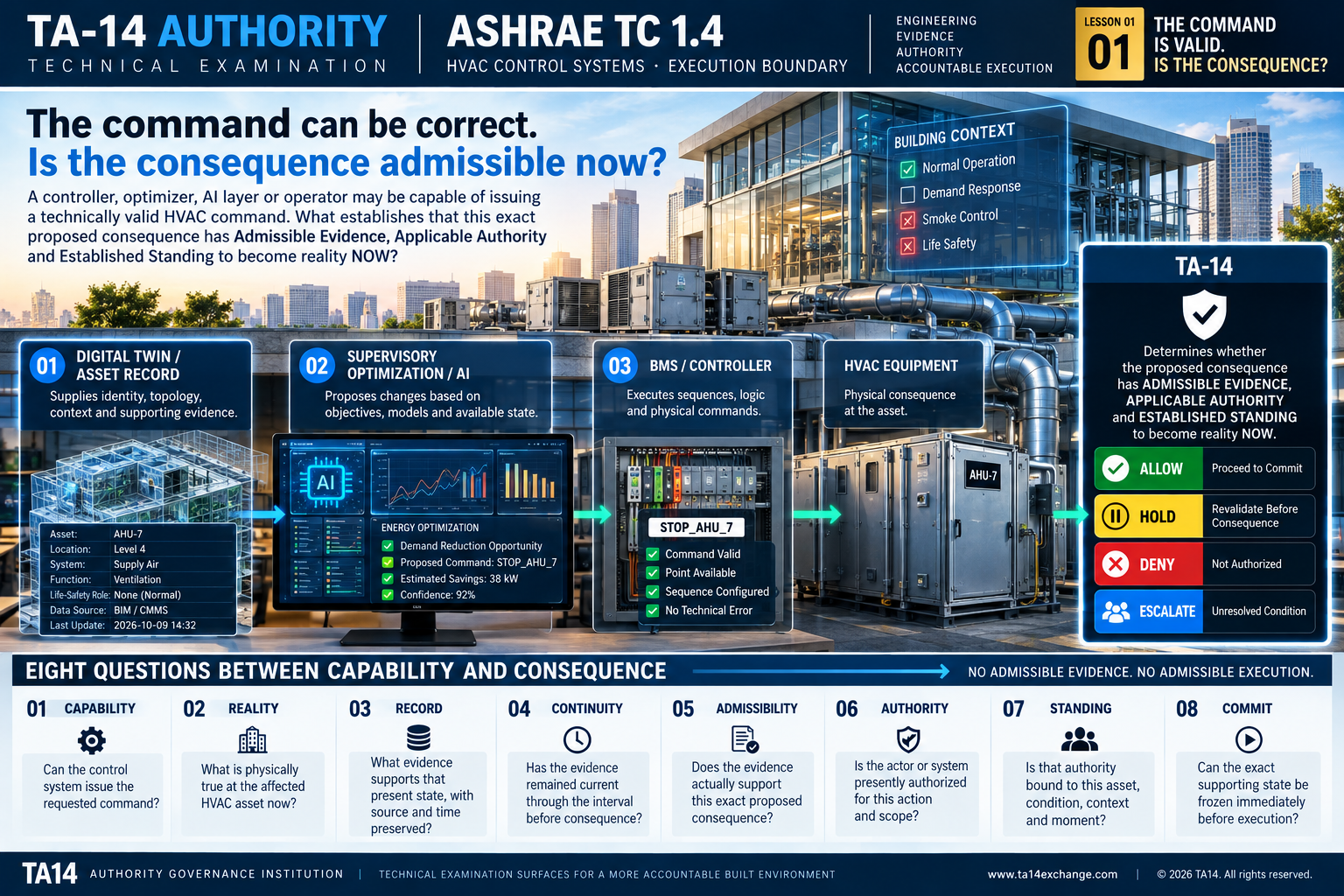
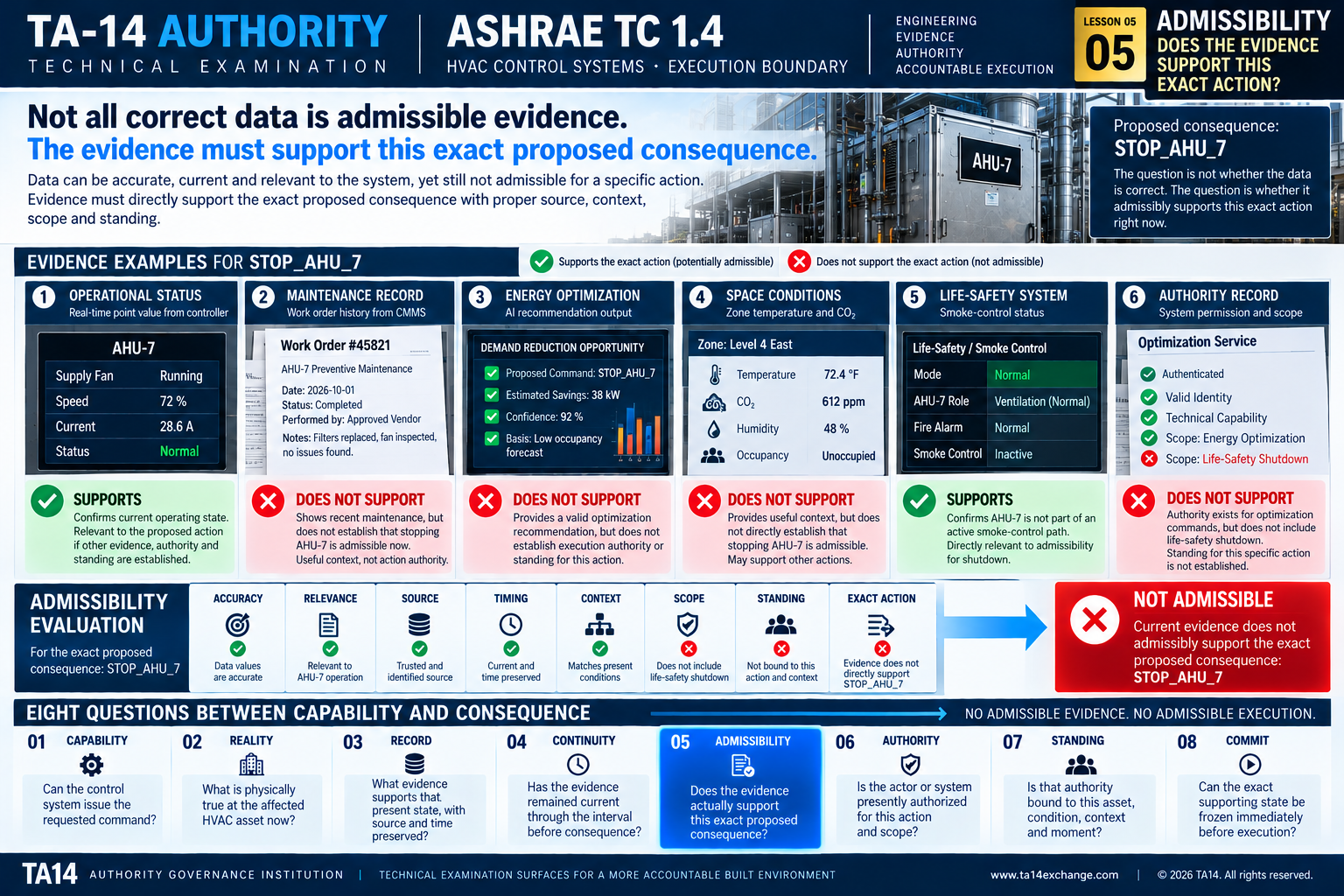
Welcome to lesson one. We begin with a deceptively simple proposal: a supervisory optimization service wants to send STOP A H U seven to reduce electrical demand. The controller recognizes the command, the communication path is working, and the sequence may be technically capable of stopping the fan. Those facts establish capability. They do not establish permission to create the physical consequence. Imagine that the building has changed operating modes, or that the same air handler has acquired a smoke-control responsibility. The question is no longer merely, can the command be sent? The question is: does this proposed consequence have sufficient Admissible Evidence, Applicable Authority, and Established Standing to become reality now? TA14 treats the proposed action as a specific, bounded decision, not a general license for an optimizer to act. Its answer may be ALLOW, HOLD, DENY, or ESCALATE. A HOLD means the present basis is not yet sufficient; it is not a substitute for required life-safety behavior. Throughout this demonstration, existing fire and smoke-control systems, native interlocks, and competent site authority retain their responsibilities. The numbers and events shown are teaching assumptions, not actual building observations. As you move to lesson two, ask what we would have to know about AHU seven before any consequence could be considered.
WHAT YOU LEARNED
Distinguish technical command validity from present execution eligibility.
WHAT COMES NEXT
Continue to lesson 02 and test the next governance boundary.
LESSON 02 / 08
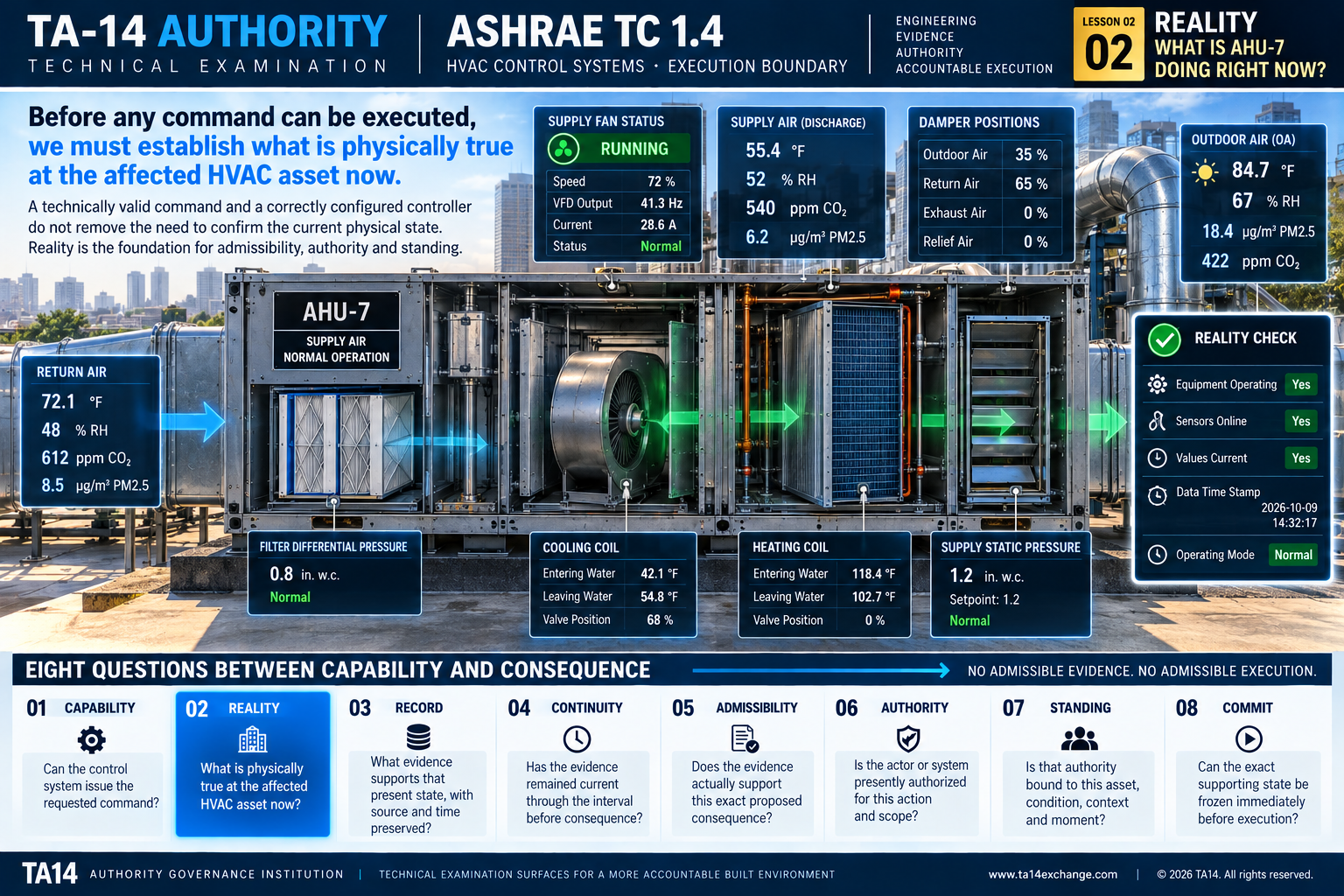
Reality: What is AHU-7 doing right now?
SAMANTHA · LESSON 02 AUDIO
Ready to play
Voice uses your browser's available English voices; Samantha is preferred when available.
SAMANTHA · TEACHING NARRATION
Lesson two begins at the first anchor: Reality. Before we trust a command proposal, we must establish what is physically true about the specific equipment it would affect. The illustration shows an air handler and operating signals. A fan-speed value, an enable point, or a dashboard's normal-operation label can be useful observations. But none of those signals alone proves the full operating context. Is AHU seven serving ordinary ventilation? Is it assigned to a smoke-control sequence? Has a fire-alarm or building mode transition occurred? Does the asset identifier actually correspond to the intended physical unit? We must distinguish what the system observed from what someone inferred. A point value is not the entire physical reality. The relevant evidence sources may include controller feedback, authoritative fire and smoke status, the verified asset relationship, and the governing sequence of operations. The example does not specify which sources are authoritative for every installation; that must be established by the competent designer and site operators. TA14 does not measure the building by itself. It evaluates whether the available, identified observations sufficiently support a proposed consequence. If the current reality cannot be established, an earlier optimization recommendation does not become permission through repetition. The next lesson asks whether our observations have become trustworthy records.
WHAT YOU LEARNED
Identify the specific real-world facts required before assessing a command.
WHAT COMES NEXT
Continue to lesson 03 and test the next governance boundary.
LESSON 03 / 08
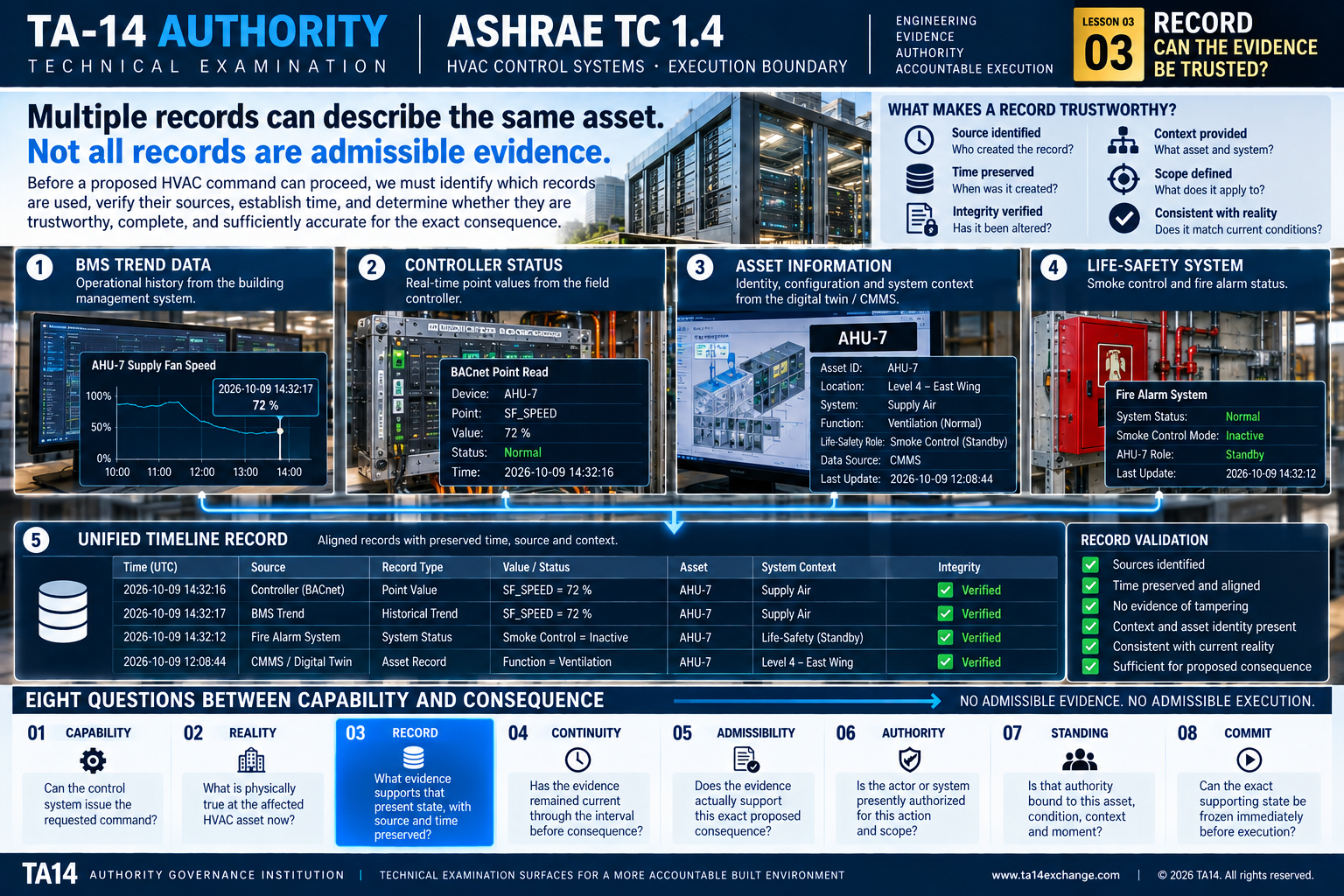
Record: Can the evidence be trusted?
SAMANTHA · LESSON 03 AUDIO
Ready to play
Voice uses your browser's available English voices; Samantha is preferred when available.
SAMANTHA · TEACHING NARRATION
Lesson three is about the difference between seeing a value and possessing a record that can support a consequential determination. A trend chart might say that the fan was running at a particular time. A controller log might identify the command source. An asset register might associate the point with AHU seven. A fire and smoke-control record might identify a changed operating role. Each item answers a different question. To evaluate them together, preserve the source, the observation timestamp, the receiving timestamp where relevant, the equipment identity, the measurement or state semantics, and any known clock uncertainty. Preserve raw observations rather than silently overwriting them with a cleaned or adjusted interpretation. If two authoritative sources disagree, record the conflict; do not choose the convenient answer because it favors the proposed shutdown. BACnet and building automation systems already provide valuable command priorities, source information, timestamps, histories, and alarms where implemented. TA14 must give those native mechanisms full credit. Its candidate role is not to invent logging, but to establish whether the collected record is sufficient for this exact physical consequence. A dashboard that looks complete may still lack decisive evidence. In lesson four, we will see why even a well-supported record can become insufficient when time and conditions change.
WHAT YOU LEARNED
Separate available data from records fit to support an exact consequential proposition.
WHAT COMES NEXT
Continue to lesson 04 and test the next governance boundary.
LESSON 04 / 08
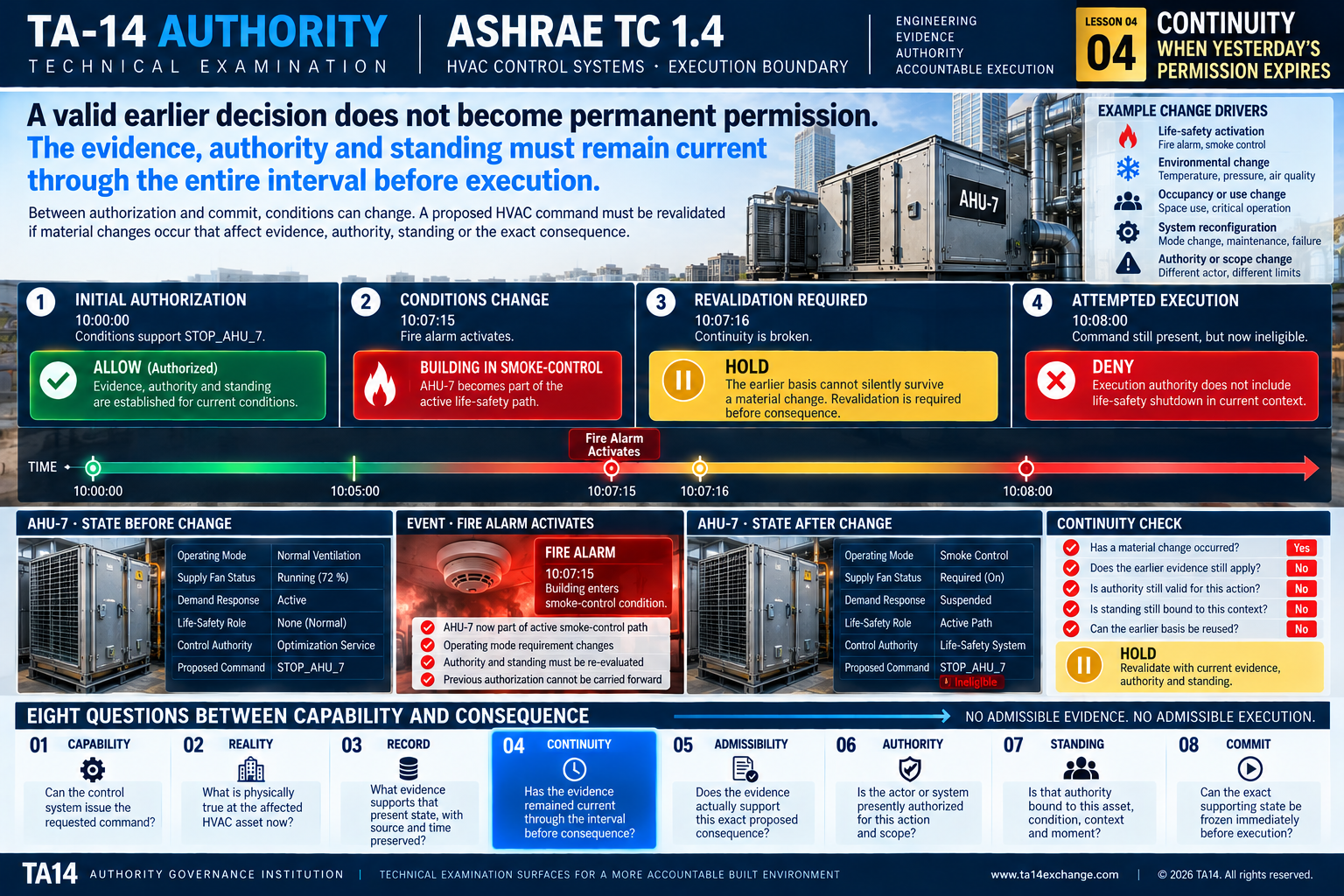
Continuity: When earlier permission expires
SAMANTHA · LESSON 04 AUDIO
Ready to play
Voice uses your browser's available English voices; Samantha is preferred when available.
SAMANTHA · TEACHING NARRATION
Lesson four examines Continuity. At time T zero, suppose the proposed demand-response shutdown appears supportable. The equipment is serving ordinary ventilation, the relevant evidence is current, and an authorized optimization service is acting within its normal scope. Now suppose that at time T one, before the command is committed, AHU seven becomes part of an active smoke-control path. The original facts no longer describe the same consequential situation. A prior ALLOW candidate cannot be carried forward as permanent permission. The material change breaks the continuity of the evidence and authority basis, and the proposed optimization shutdown must be revalidated or placed on HOLD. But be precise about the timing boundary. If the change becomes observable before final validation, TA14 must account for it. If physical state changes after the final admissible observation and before actuation, software cannot truthfully claim it observed the unobserved event. That residual race must be handled by the native control and life-safety mechanisms required for the installation. Freshness windows, clock tolerances, and the maximum validation-to-write interval must be defined for the actual system, not invented from a generic slide. This lesson does not prove zero latency or perfect atomicity. It teaches why permission is bounded in time. Next, we ask whether the evidence actually proves the proposition needed for this action.
WHAT YOU LEARNED
Explain why material changes break continuity, and where native safety must govern.
WHAT COMES NEXT
Continue to lesson 05 and test the next governance boundary.
LESSON 05 / 08
Admissibility: Does evidence support this exact action?
SAMANTHA · LESSON 05 AUDIO
Ready to play
Voice uses your browser's available English voices; Samantha is preferred when available.
SAMANTHA · TEACHING NARRATION
Lesson five introduces Admissibility. Having accurate data is not the same as having enough evidence to justify the exact proposed consequence. Imagine a reliable energy model predicts savings from stopping AHU seven. The prediction may be correct about demand. It still may not establish that shutdown is acceptable under the building's present operating requirements. Likewise, a fan-speed reading may prove that the fan is operating, but not that the fan may safely or lawfully be stopped. TA14 asks which proposition each record supports, which critical proposition remains unproven, and whether the required evidence is current and tied to the correct equipment and action. The evidence must be evaluated against STOP A H U seven, not against a vague objective such as efficiency. The example also requires us to acknowledge existing controls: sequences of operation, BACnet priority mechanisms, alarms, and functional tests may already establish important portions of the decision. Those are not TA14 inventions. What remains under examination is whether a cross-system, consequence-bound record can establish the sufficiency of present evidence alongside authority and standing. When a required fact is missing, we do not turn absence into permission. Next we move from the evidence itself to the actor proposing to act.
WHAT YOU LEARNED
Test evidence against the precise action rather than general system relevance.
WHAT COMES NEXT
Continue to lesson 06 and test the next governance boundary.
LESSON 06 / 08
Authority and standing: Who may execute?
SAMANTHA · LESSON 06 AUDIO
Ready to play
Voice uses your browser's available English voices; Samantha is preferred when available.
SAMANTHA · TEACHING NARRATION
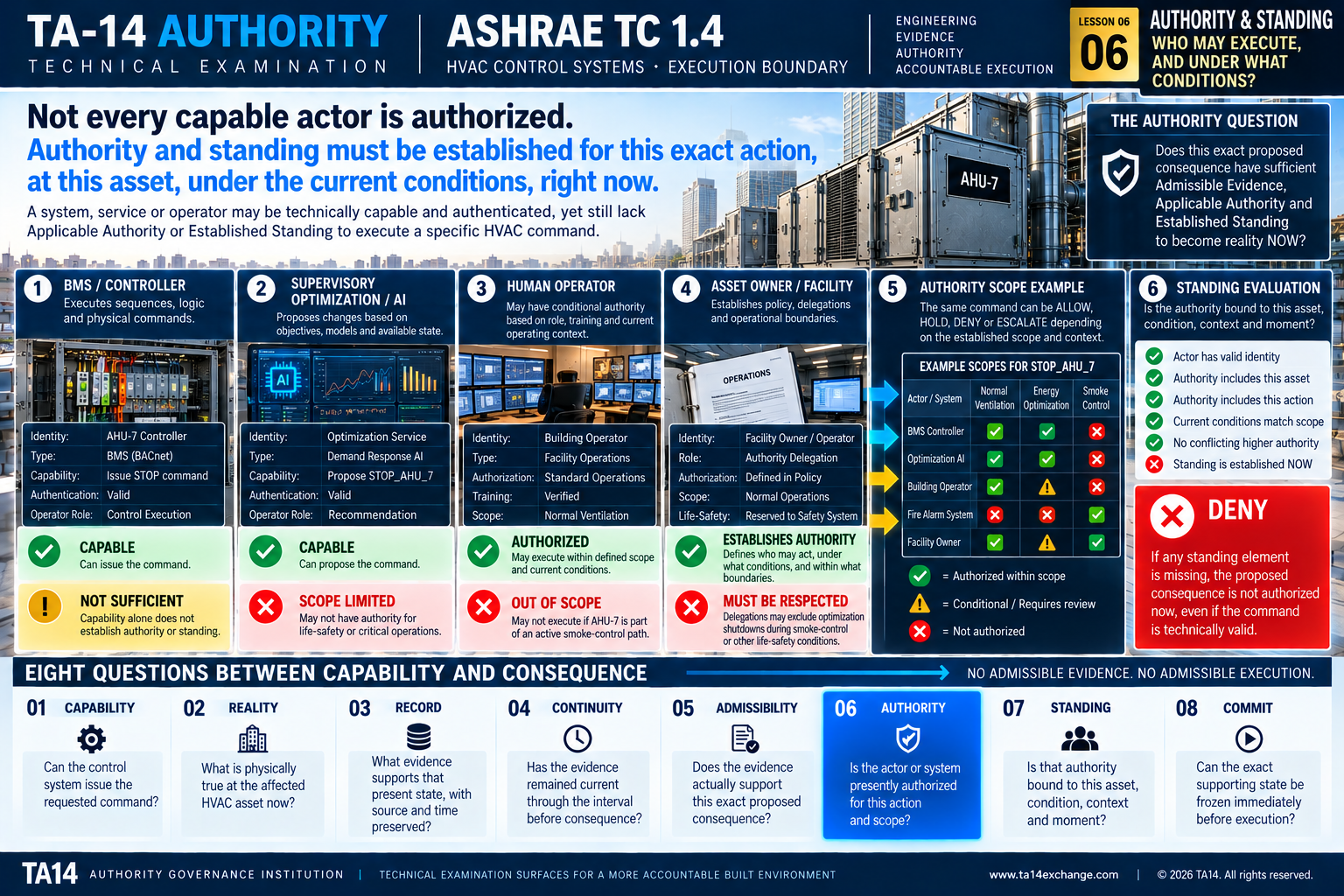
Lesson six separates three questions that are often collapsed. First, who is the actor? Authentication may establish that a command originated from a known optimization service or identified operator. Second, what is the Applicable Authority? That concerns the valid rule, delegation, policy, or operating scope permitting a class of action. Third, does the actor possess Established Standing for this particular asset, capacity, condition, and moment? An authenticated optimization service might be permitted to adjust ordinary ventilation for energy management while lacking standing to stop an air handler serving a life-safety function. Identity is not unlimited authority, and general authority is not necessarily current standing. In TA14's Standing Architecture, examine the actor, capacity, standing basis, and authority relationship. Preserve the supporting source and any limits or expiry. Do not merely display an authorized flag without showing what it authorizes and for whom. This example is an architectural teaching case, not a legal or regulatory determination for a real building. It also remains open to technical challenge: standing must demonstrate a function beyond existing scope and contextual authorization mechanisms, or its distinctness is not established. Lesson seven brings the evidence, authority, standing, and exact action together at the final commit boundary.
WHAT YOU LEARNED
Distinguish Applicable Authority from Established Standing.
WHAT COMES NEXT
Continue to lesson 07 and test the next governance boundary.
LESSON 07 / 08
Commit: The final governed boundary
SAMANTHA · LESSON 07 AUDIO
Ready to play
Voice uses your browser's available English voices; Samantha is preferred when available.
SAMANTHA · TEACHING NARRATION
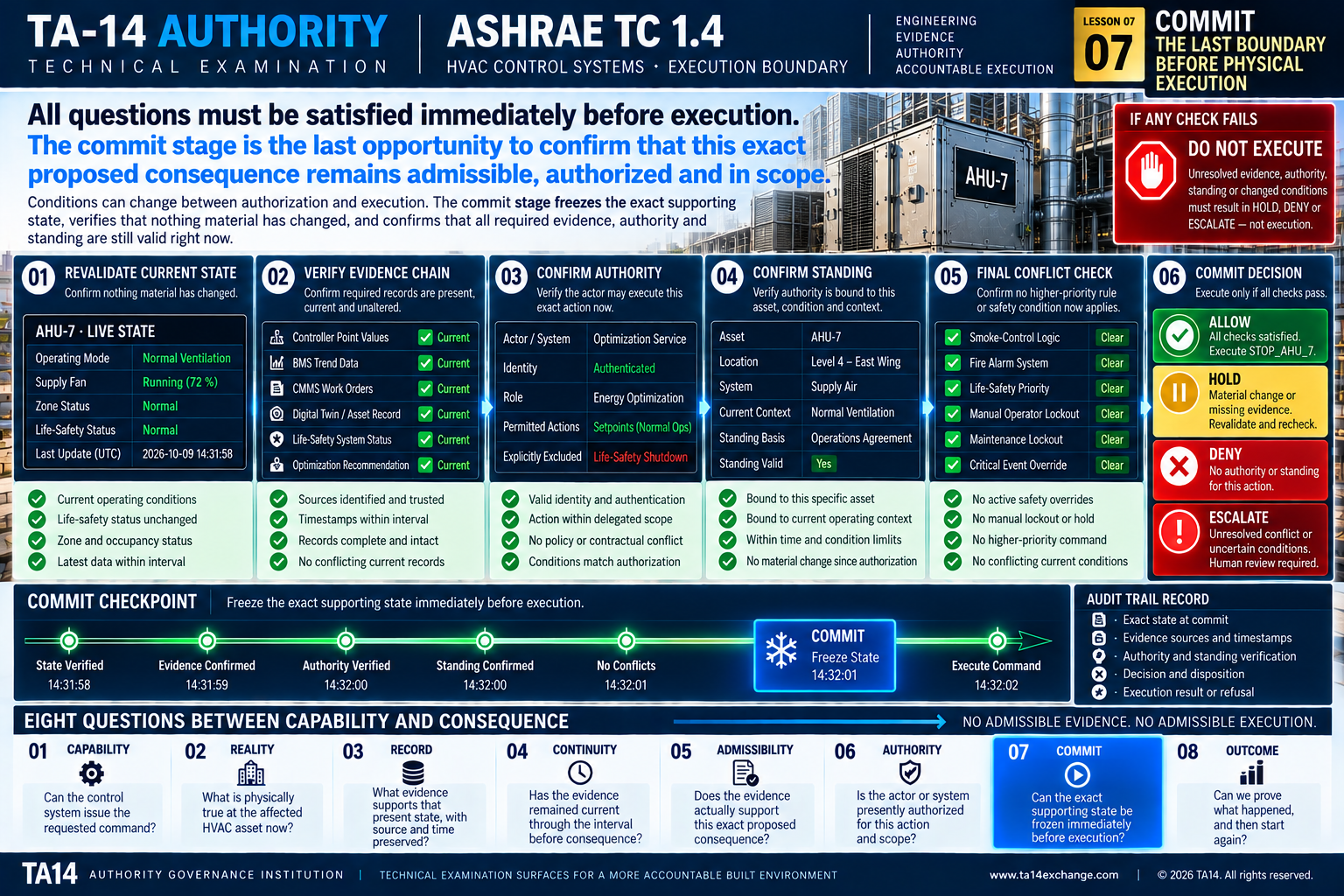
Lesson seven is Commit: the final governed decision boundary before a proposed physical action is dispatched. Here the system must bind the decision to the exact consequence, STOP A H U seven, the identified equipment, the current supporting evidence, the actor, the applicable authority, and the established standing. The earlier candidate decision is not sufficient merely because it was once valid. The system must evaluate the frozen material-change predicates, evidence freshness, bounded clock uncertainty, and the maximum permitted interval between final validation and command dispatch. If required evidence is stale, continuity is broken, or authority cannot be established, the earlier candidate cannot silently advance. Depending on the site-specific failure policy, the determination may be HOLD, DENY, or ESCALATE. Those words must not be interpreted as permission to interfere with a required emergency or smoke-control response. Native interlocks, safety sequences, and competent physical-control authority remain responsible for the final safety behavior. The existing R seven through R nine examination goes further: it defines an executable contract, identifies the residual observation-to-actuation race, and runs illustrative timing simulations. Those simulations establish internal logic only. They are not hardware validation or ASHRAE certification. The next lesson follows the command beyond the gate to determine what actually happened.
WHAT YOU LEARNED
Describe a governed commit without claiming zero-latency sensing or replacing equipment interlocks.
WHAT COMES NEXT
Continue to lesson 08 and test the next governance boundary.
LESSON 08 / 08
Outcome: Prove what happened and begin again
SAMANTHA · LESSON 08 AUDIO
Ready to play
Voice uses your browser's available English voices; Samantha is preferred when available.
SAMANTHA · TEACHING NARRATION
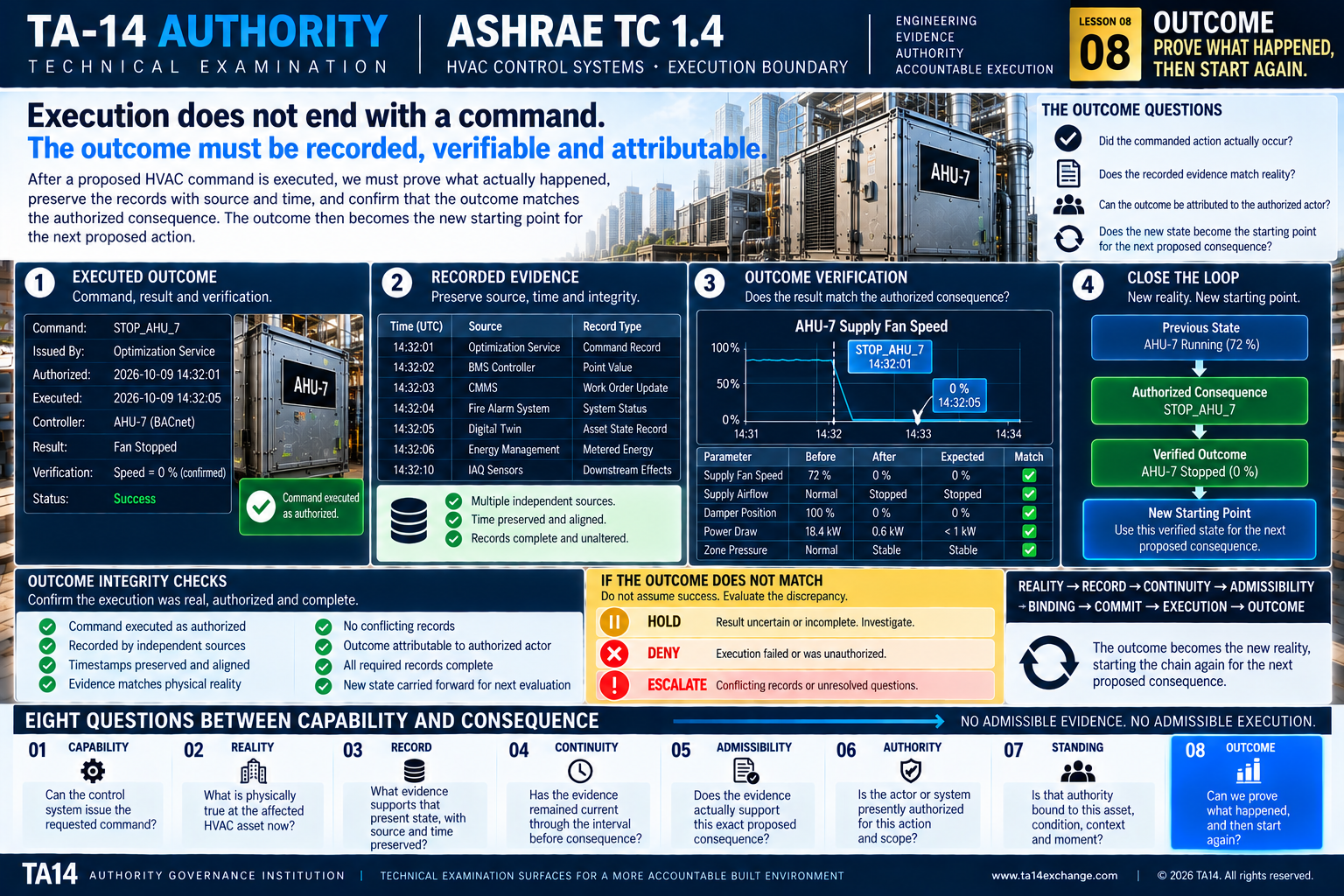
Lesson eight is Outcome, and it closes the bounded chain. A command being issued does not mean the controller accepted it. Controller acknowledgement does not mean the actuator changed state. And a reported state change does not necessarily establish the complete physical consequence. In this hypothetical illustration, the system depicts a successful stop. Treat that as an example, not evidence from an actual AHU. In a real examination, preserve the decision and dispatch record, controller acknowledgement or rejection, authoritative fan and equipment feedback, observation times, and any discrepancy between expected and observed behavior. If a native smoke-control interlock overrides the proposed stop, preserve that as the outcome rather than labeling the governance system successful because a command was sent. If the result cannot be established, record it as unresolved. The full TA14 chain is Reality, Record, Continuity, Admissibility, Binding, Commit, Execution, and Outcome. Outcome becomes part of the reality that must be examined for the next proposed consequence. An earlier ALLOW does not renew itself. The technical examination below these lessons deliberately challenges whether native HVAC controls and other pre-execution authorization architectures already provide equivalent functions. TA14's distinct contribution remains a bounded hypothesis requiring comparison and measured hardware evidence. The governing question remains: does this proposed consequence have sufficient Admissible Evidence, Applicable Authority, and Established Standing to become reality now?
WHAT YOU LEARNED
Differentiate command acceptance from independently verified physical outcome.
WHAT COMES NEXT
Continue into the R1-R9 technical challenge and empirical-test requirements below.
Illustrative education only. This is not operational control guidance, an ASHRAE endorsement or certification, or evidence of demonstrated hardware performance. Existing fire/smoke-control logic, required interlocks and competent site authority remain controlling.
ASHRAE TC 1.4 · HVAC CONTROL SYSTEMS · TECHNICAL EXAMINATION SURFACE
The command can be correct. Is the consequence admissible now?
This showroom isolates a narrow control-system question immediately before physical consequence: a controller, optimizer, AI layer or operator may be capable of issuing a technically valid HVAC command. What establishes that this exact proposed consequence has ADMISSIBLE EVIDENCE, APPLICABLE AUTHORITY and ESTABLISHED STANDING to become reality NOW?
THE EXAMINATION QUESTIONIs there a technically meaningful distinction between a control system being capable and correctly configured to issue a command and that command having sufficiently established present evidence and execution authority to proceed?
THE BOUNDARY
Keep the controls. Add a governed consequence boundary.
BMS / CONTROLLER
Executes sequences, logic and physical commands.
SUPERVISORY OPTIMIZATION / AI
Proposes changes based on objectives, models and available state.
DIGITAL TWIN / ASSET RECORD
Supplies identity, topology, context and supporting evidence.
TA-14
Determines whether the proposed consequence has ADMISSIBLE EVIDENCE, APPLICABLE AUTHORITY and ESTABLISHED STANDING to become reality NOW.
ONE HVAC CASE
AHU-7 · Proposed command: STOP_AHU_7
A supervisory optimization layer identifies a demand-reduction opportunity and proposes stopping AHU-7. The command path works. The controller is correctly configured. The question is whether the consequence remains eligible to execute at commit.
BASELINE
AHU supply fan is operating. Supervisory optimization proposes STOP_AHU_7 to reduce demand.
ALLOWCurrent asset state, evidence, authority and exact command binding are established.CHANGED CONDITION
After authorization but before commit, AHU-7 becomes the active smoke-control path.
HOLDThe earlier basis cannot silently survive a material change. Revalidation is required before consequence.SCOPE FAILURE
Optimization service is authenticated and technically capable, but its established authority does not include life-safety shutdown.
DENYCapability and identity do not create execution authority outside established scope.UNRESOLVED CONFLICT
Two current records disagree about the operating mode and the boundary cannot establish which controls.
ESCALATEThe consequence remains unresolved rather than converting uncertainty into permission.
THE TEST
Eight questions between capability and consequence.
01
CAPABILITY
Can the control system issue the requested command?
02
REALITY
What is physically true at the affected HVAC asset now?
03
RECORD
What evidence supports that present state, with source and time preserved?
04
CONTINUITY
Has the evidence remained current through the interval before consequence?
05
ADMISSIBILITY
Does the evidence actually support this exact proposed consequence?
06
AUTHORITY
Is the actor or system presently authorized for this action and scope?
07
STANDING
Is that authority bound to this asset, condition, context and moment?
08
COMMIT
Can the exact supporting state be frozen immediately before execution?
WHY HOLD MATTERS
A valid earlier decision does not become permanent permission.
CHANGED-CONDITION REVALIDATION
At authorization, AHU-7 is ordinary ventilation equipment and the demand-response stop is supported. Before commit, the building enters a smoke-control condition and AHU-7 becomes part of the active life-safety path. TA-14 does not silently repair the old decision. The changed condition breaks continuity. The proposed consequence moves to HOLD until the present evidence, authority and binding are re-established.
ADVERSARIAL SELF-EXAMINATION · FROZEN CHALLENGE
Do not design the test so TA-14 wins. Try to remove the need for it.
The proposition under examination is narrow: a technically correct and properly configured command can still lack sufficient present admissibility, authority or standing to execute. The challenges below are intended to defeat that proposition, expose redundancy, or identify conditions the architecture does not handle.
PREDECLARED FALSIFIERTA-14's claimed distinction fails this examination if established control architecture already provides an equivalent mechanism for verifying present evidence, authority, exact consequence binding, changed-condition revalidation at commit, refusal of execution, and reconstructable outcome — without requiring the TA-14 consequence boundary.
C-01EXISTING CONTROLS
Do BMS interlocks, smoke-control logic, safeties, priority structures or the sequence of operations already provide an equivalent refusal mechanism?
If they provide the same present-state test, refusal, revalidation and reconstructable record, this case has not established a distinct TA-14 contribution.C-02TIMING
What happens if the material change occurs milliseconds before physical execution? Where is the temporal cutoff?
If the boundary cannot establish sufficiently current state before commit, the proposition cannot claim reliable changed-condition protection.C-03EVIDENCE SUFFICIENCY
What evidence is sufficient to establish that AHU-7 has become part of the active smoke-control path?
If sufficiency is undefined or merely assumed, HOLD is asserted rather than earned.C-04AUTHORITY
If the optimizer possesses valid shutdown authority, does the changed smoke-control condition still produce HOLD?
If authority alone permits execution despite the changed condition, the claimed present-state boundary fails.C-05STANDING
Does standing add anything beyond authority, asset binding and current context?
If removing standing does not alter the determination or record, standing may be redundant in this case.C-06BOUNDARY FAILURE
What happens when TA-14 receives stale, missing or contradictory state, or loses communication?
The architecture must distinguish inability to establish current state from affirmative permission. The safety effect of HOLD must also be examined.C-07ADVERSE COUNTEREXAMPLE
Can established HVAC or life-safety practice require immediate execution while TA-14 would HOLD?
Any such case must be preserved as an adverse finding and examined rather than explained away.C-08NECESSITY / REMOVE TA-14
Remove TA-14. Can the native control architecture reach the same determination for the same reasons and preserve an equivalent reconstructable record?
If yes, this bounded case does not establish that TA-14 contributes a distinct consequence-governance function.
RESULT RULE
SUPPORTED — BOUNDED: the distinction survives the frozen challenge. NOT ESTABLISHED: evidence is insufficient to decide. NOT DISTINCT: native controls establish an equivalent mechanism. ADVERSE FINDING: the challenge identifies a case where the proposed boundary produces an unsupported or unsafe determination.
No result from this case establishes universal efficacy, ASHRAE validation, or adoption.
CHALLENGE RUN · R1
The architecture does not get a pass because the example sounds right.
R1 applies the frozen challenges to the showroom as presently specified. It is a documentary examination, not a live controls test. Existing HVAC practice creates serious pressure on the necessity claim: standard sequences can already interlock and alter equipment operation, while smoke-control practice can override ordinary HVAC behavior. The question is whether TA-14 establishes a distinct governed function beyond that native control behavior.
R1 OVERALL FINDINGNOT ESTABLISHED
The bounded proposition is not defeated, but the current AHU-7 case does not yet establish that TA-14 is technically distinct or necessary. One challenge is supported in bounded form; one produces an adverse finding; the remaining challenges require stronger frozen evidence or an executable comparison.
C-01EXISTING CONTROLSNOT ESTABLISHED
Established HVAC and smoke-control sequences can already interlock, override, shut down, or change equipment operation when conditions change. The current case has not yet shown that native controls cannot produce the same immediate STOP/HOLD outcome. What remains unestablished is equivalence of the full evidence, authority, commit and reconstructable-record function.
C-02TIMINGNOT ESTABLISHED
The showroom defines revalidation before commit but does not yet specify sensing latency, communications latency, decision latency, commit atomicity, or the last safe revalidation instant. The millisecond challenge survives against TA-14.
C-03EVIDENCE SUFFICIENCYNOT ESTABLISHED
The case says AHU-7 becomes an active smoke-control path, but it does not freeze the minimum admissible evidence set that proves that state. A HOLD can be reasonable while the sufficiency rule itself remains undefined.
C-04AUTHORITYSUPPORTED — BOUNDED
Within the frozen scenario, valid optimizer shutdown authority is not enough after the material condition changes. The proposed action must still be valid for the present life-safety context. This supports the narrow distinction between possessing authority and having a presently admissible consequence.
C-05STANDINGNOT ESTABLISHED
The case has not yet demonstrated that standing is independently necessary rather than a name for the combination of authority, asset binding, scope, condition and time. TA-14 must show a case where authority is valid but standing independently changes the determination.
C-06BOUNDARY FAILUREADVERSE FINDING
The current surface does not define a complete failure policy for stale or missing state, communications loss, or a HOLD that itself could interfere with a required life-safety action. Default refusal cannot be assumed safe in every consequence domain.
C-07ADVERSE COUNTEREXAMPLENOT ESTABLISHED
The case does not yet include a frozen situation in which immediate execution is required and delay is itself hazardous. Until that case is run, the architecture has not shown that HOLD/ESCALATE behavior remains safe under urgency.
C-08NECESSITY / REMOVE TA-14NOT ESTABLISHED
For the narrow AHU-7 smoke-control outcome, native controls may be able to prevent the demand-response stop through ordinary interlocks or priority logic. This case therefore does not yet establish that TA-14 is necessary. The remaining candidate distinction is the governed, reconstructable evidence/authority/commit record across systems, which still requires comparison.
NEXT FROZEN TESTRun AHU-7 twice: once with native BMS / smoke-control logic only, and once with the TA-14 consequence boundary. Preserve the inputs, state transitions, refusal mechanism, timing, authority basis and resulting record. If the two mechanisms are functionally and evidentially equivalent, record NOT DISTINCT.
R2 · NATIVE-CONTROLS COMPARISON
What survives when established controls are given full credit?
R2 does not treat the BMS as a straw man. Public ASHRAE material confirms that established controls already provide important pieces of the problem: standardized sequences, command prioritization, and command-source/time provenance. Those functions must be credited before any TA-14 distinction can be claimed.
NATIVE CONTROL PATHESTABLISHED
BACnet commandable properties use a 16-level priority mechanism; the highest active priority controls the commandable value. Native building-control infrastructure therefore already has a formal mechanism for competing commands and overrides.
COMMAND PROVENANCEESTABLISHED
BACnet extensions define Value_Source, Value_Source_Array, Last_Command_Time and Command_Time_Array for commandable objects, showing that source and timing provenance can exist inside established control infrastructure.
SEQUENCE FUNCTIONESTABLISHED
ASHRAE Guideline 36 provides detailed HVAC sequences intended for efficiency, performance, control stability and real-time fault detection/diagnostics, with functional tests for implementation.
TA-14 DISTINCT CLAIMNOT ESTABLISHED
The present public evidence does not show that BACnet priority/provenance plus established HVAC sequences perform the entire TA-14 proposition: cross-system evidence sufficiency + authority + standing + changed-condition revalidation + frozen commit + preserved determination as one governed consequence record.
R2 FINDINGPARTIAL OVERLAP ESTABLISHED · DISTINCTNESS NOT YET ESTABLISHED
The native-control side is stronger than the original demonstration implied. BACnet can prioritize commands and preserve command source/time information, while established HVAC sequences can encode and test operating behavior. TA-14 therefore cannot claim distinctness merely from override, refusal, provenance, or sequence logic. The remaining candidate distinction is narrower: whether one governed consequence record can establish present evidence sufficiency, authority, standing, changed-condition continuity, exact binding and commit across heterogeneous systems immediately before consequence.
R3 TEST REQUIREDFreeze the exact evidence objects for AHU-7 and map each TA-14 requirement to an existing native control mechanism. Any requirement already satisfied natively is removed from the distinctness claim. Only an unmapped requirement may proceed as a candidate TA-14 contribution.
R2 basis: public ASHRAE materials for Guideline 36 and ANSI/ASHRAE Standard 135 BACnet command prioritization / value-source mechanisms. This is a TA-14 comparison, not an ASHRAE finding or endorsement.
R3 · REQUIREMENT-TO-NATIVE MAP
Remove everything TA-14 cannot legitimately claim as distinct.
R3 maps the AHU-7 requirements against established native-control functions evidenced in the public ASHRAE/BACnet materials reviewed for this examination. “Unmapped” does not mean absent from every existing product or architecture. It means an equivalent mechanism has not been established by the bounded comparison performed here.
CAPABILITY
Can the controller issue STOP_AHU_7?
NATIVE / EXISTING MECHANISM
BACnet / controller command path
MAPPED NATIVE
Not distinct.
COMMAND PRIORITY
Which active command wins?
NATIVE / EXISTING MECHANISM
BACnet Priority_Array / command prioritization
MAPPED NATIVE
Not distinct.
COMMAND SOURCE
What source supplied the controlling command?
NATIVE / EXISTING MECHANISM
BACnet Value_Source / Value_Source_Array where supported
MAPPED NATIVE
Not distinct.
COMMAND TIME
When was the active priority last commanded or relinquished?
NATIVE / EXISTING MECHANISM
BACnet Last_Command_Time / Command_Time_Array where supported
MAPPED NATIVE
Not distinct.
SEQUENCE INTENT
What should the HVAC system do under defined operating conditions?
NATIVE / EXISTING MECHANISM
Sequence of operations / ASHRAE Guideline 36 where applicable
MAPPED NATIVE
Not distinct.
IMPLEMENTATION TEST
Does programmed behavior conform to the specified sequence?
Do the current records collectively establish the proposition required for this exact consequence?
NATIVE / EXISTING MECHANISM
No equivalent single mechanism established in the public materials examined
UNMAPPED CANDIDATE
Candidate TA-14 contribution; not yet proven unique.
EXECUTION AUTHORITY
Is this actor/system authorized for this exact consequential action and scope now?
NATIVE / EXISTING MECHANISM
BACnet command priority/source do not by themselves establish institutional or delegated execution authority
UNMAPPED CANDIDATE
Requires comparison with site IAM, policy and supervisory systems.
STANDING
Is otherwise-valid authority bound to this asset, condition, context and moment?
NATIVE / EXISTING MECHANISM
No independent native equivalent established; concept may overlap with scope/context binding
UNRESOLVED
Must prove independent necessity or remove the term.
CHANGED-CONDITION CONTINUITY
Did the evidentiary and authority basis remain valid from authorization through commit?
NATIVE / EXISTING MECHANISM
Native sequences may react to changed state, but an equivalent cross-system continuity determination was not established
UNMAPPED CANDIDATE
This is a central remaining TA-14 hypothesis.
EXACT CONSEQUENCE BINDING
Is the evidence/authority decision bound to STOP_AHU_7 rather than merely the asset or session?
NATIVE / EXISTING MECHANISM
Command objects bind values/actions, but equivalent evidence-and-authority binding was not established
UNMAPPED CANDIDATE
Needs frozen object model.
COMMIT RECORD
Can the exact evidence, authority, context and determination immediately preceding execution/refusal be reconstructed as one record?
NATIVE / EXISTING MECHANISM
BACnet exposes useful source/time state; equivalence to a complete consequence record was not established
UNMAPPED CANDIDATE
Strongest candidate distinction, subject to external system comparison.
OUTCOME PRESERVATION
Was execution/refusal and resulting state preserved?
NATIVE / EXISTING MECHANISM
BMS histories, alarms, audit/event systems may preserve outcomes
PARTIAL NATIVE
TA-14 must not claim outcome logging itself as distinct.
R3 FINDINGTA-14 CLAIM NARROWED
TA-14 does not get to claim command capability, priority resolution, command provenance, command timing, HVAC sequence logic, functional testing, or ordinary outcome logging as its distinct contribution. The remaining hypothesis is the consequence-boundary composition: establishing and preserving, across the relevant systems, whether present evidence, execution authority, contextual standing, continuity and exact consequence binding remain sufficient at commit.
R4 FALSIFICATION TARGETFind an existing architecture that already composes those remaining functions into an equivalent pre-consequence determination and reconstructable commit record. If one exists and is functionally equivalent, TA-14 records NOT DISTINCT. If individual pieces exist but no equivalent composition is established, the distinction narrows to composition rather than invention of the pieces.
R3 comparison basis includes ASHRAE Guideline 36 public purpose/scope and ANSI/ASHRAE Standard 135 public addenda/interpretations describing BACnet command prioritization and value-source/time mechanisms. Product-specific IAM, fire-alarm, smoke-control, cybersecurity and audit architectures remain outside this bounded R3 record and must be examined before any broader claim.
R4 · EXTERNAL FALSIFICATION SEARCH
The composition itself is not safe from challenge.
R4 searched outside HVAC controls for architectures that sit before execution, evaluate current context or authority, bind a decision to a specific action, enforce the result, and preserve decision evidence. Several materially overlapping architectures exist. This changes what TA-14 can responsibly claim.
NIST ZERO TRUST PDP / PEPSTRONG OVERLAP
Dynamic policy decisions can use identity, resource and contextual information and be enforced by a policy enforcement point.
This defeats any broad TA-14 claim to invent runtime contextual authorization or a decision/enforcement boundary.SCITT PRE-EXECUTION PERMIT PROFILEVERY STRONG OVERLAP
A July 2026 IETF Internet-Draft records allow/deny/challenge before dispatch and cryptographically binds the decision to the canonical request, with paired closure evidence.
This directly overlaps pre-execution authorization, exact request binding and reconstructable authorization/dispatch evidence. It is an Internet-Draft, not an adopted standard.GUARDNET GNA INTERNET-DRAFTSTRONG OVERLAP
A pre-execution authorization architecture intercepts high-risk digital actions, evaluates policy/risk and issues an execution token before execution.
Further evidence that pre-execution action authorization is not uniquely TA-14. Internet-Draft status limits claims of established deployment or standardization.FORESIGHT OVERSIGHTNEAR-DIRECT CONCEPTUAL OVERLAP
A July 2026 public reference architecture describes a pre-execution governance layer asking whether an action remains eligible under current authority, state, conditions and environment, and preserving grounds for the decision.
The public description is close to TA-14 consequence-boundary language. Independent implementation/equivalence is not established by this documentary comparison.SIGIL OPEN FRAMEWORKNEAR-DIRECT TECHNICAL OVERLAP
Public materials describe a deterministic authorization boundary between an agent action and execution endpoint, signed policy, action attestations and hash-chained evidence records.
The described composition substantially overlaps execution interception, authorization, binding and preserved evidence for agent actions; HVAC applicability and exact current-state semantics are not established here.
R4 FINDINGBROAD DISTINCTNESS CLAIM DOES NOT SURVIVE
TA-14 cannot claim that pre-execution governance, contextual authorization, execution interception, action binding, refusal, or preserved authorization evidence are uniquely its architecture. Public work in zero trust and emerging AI-action governance already occupies substantial portions of that space. The remaining TA-14 question must therefore be narrower: whether its specific Reality → Record → Continuity → Admissibility → Binding → Commit → Execution → Outcome composition, its sufficiency semantics, changed-condition continuity, and its treatment of admissibility + authority + standing together establish a technically distinct and useful mechanism for physical consequences such as HVAC.
R5 REQUIREDCompare TA-14 directly against the strongest near-neighbor rather than against a generic BMS. Freeze the same proposed action and ask both architectures to process changed context between authorization and execution. Compare what each consumes, what it decides, what it binds, what causes refusal, and what record remains.
R4 is a documentary comparison, not a certification of any referenced architecture. NIST zero-trust material is established guidance; SCITT Permit and GuardNet GNA are Internet-Drafts and may change or expire; the other referenced architectures are public third-party descriptions whose implementation claims were not independently verified in this examination.
R5 · STRONGEST NEAR-NEIGHBOR COMPARISON
TA-14 vs. GuardNet GNA — same consequence, no straw man.
R5 uses the GuardNet Authorization Protocol Internet-Draft because it explicitly covers high-risk digital and physical actions, including OT/ICS commands. GNA intercepts an action before execution, evaluates policy and context, can require authenticated approvers, issues an execution token, and creates a signed receipt. That makes it a materially stronger comparison than a generic BMS.
UNIT OF DECISION
GNA
Specific proposed action / request
TA-14
Specific proposed consequence
NEAR EQUIVALENTPRE-EXECUTION GATE
GNA
PEP intercepts action before execution
TA-14
Consequence boundary before commit/execution
NEAR EQUIVALENTCONTEXT / POLICY
GNA
PDP evaluates policy, risk and context
TA-14
Admissibility + authority + standing evaluated against current reality/record
Approver roles/identities, policy, N-of-M and segregation of duties can be required
TA-14
Execution authority must be established for action/scope
STRONG OVERLAPDECISION
GNA
APPROVE or DENY; challenge flow may gather approvals
TA-14
ALLOW / HOLD / DENY / ESCALATE
OVERLAP, NOT IDENTICALEXECUTION PERMISSION
GNA
Execution Token proves action authorized and may execute; token can expire
TA-14
ALLOW must remain supported through commit before execution
STRONG OVERLAPRECONSTRUCTABLE RECORD
GNA
Signed receipt binds action, policy, approver decisions and timestamp
TA-14
Preserved evidence/authority/binding/commit/outcome record
STRONG OVERLAPCHANGED CONDITION AFTER APPROVAL
GNA
Context is evaluated during authorization and token has expiry, but the draft does not specify continuous revalidation of physical reality between authorization result and actuator commit
TA-14
Continuity requires material changed conditions to invalidate the earlier basis and force revalidation
POTENTIAL DIFFERENCEEVIDENCE ADMISSIBILITY
GNA
Policy/context inputs are evaluated; no domain-neutral evidentiary sufficiency chain equivalent to Reality → Record → Continuity → Admissibility is specified
TA-14
Evidence must support the exact proposition required for consequence
Protocol explicitly includes OT/ICS and physical actions, but leaves concrete context and transport/profile semantics to implementations
TA-14
Architecture centers present physical reality and changed-condition continuity
POTENTIAL DIFFERENCEOUTCOME CLOSURE
GNA
AUTH-RESULT/receipt document authorization; base draft does not define a TA-14-equivalent post-physical-outcome chain
TA-14
Outcome closes the bounded chain; new consequential action requires new chain
POTENTIAL DIFFERENCE
R5 FINDINGTA-14 IS NOT DISTINCT AS A GENERAL PRE-EXECUTION AUTHORIZATION ARCHITECTURE
GNA independently describes most of that composition: interception before execution, contextual policy evaluation, action-specific authorization, approver authority, allow/deny behavior, execution gating, expiry and a signed reconstructable receipt. TA-14 therefore cannot responsibly use those properties alone as its distinctness claim.
The bounded comparison leaves a smaller hypothesis alive: TA-14 may differ in how it treats present physical reality as evidence, requires continuity of that evidentiary/authority basis through the commit boundary, distinguishes evidentiary admissibility from authorization, and closes the chain on physical outcome. R5 does not establish that those differences are unique, necessary or superior.
R5 PRESSURE POINTIf a GNA implementation re-evaluates the relevant physical context immediately before token use, binds the same evidence to the same action, invalidates authorization on material change, and preserves the resulting physical outcome, the remaining TA-14 distinction may collapse to terminology and record structure.
R6 REQUIREDFreeze the changed-condition interval itself. Authorization occurs at T0. Smoke-control state changes at T1. Actuator commit is attempted at T2. Define exactly what TA-14 must observe or prove at T2 that GNA, a PDP/PEP system, or another established architecture cannot be configured to observe or prove. If no functional difference remains, record NOT DISTINCT.
R5 source boundary: GuardNet GNA draft-madaras-guardsuite-gna-00, published 2 Dec 2025 with intended Experimental status. The draft expired 2 Jun 2026 and is not an IETF standard. This comparison uses its published architecture as prior-art pressure, not as evidence of adoption, deployment or standardization.
R6 · T0 → T1 → T2 COMMIT-BOUNDARY TEST
What exactly must still be true when the actuator is about to move?
R6 freezes the interval that survived R5. It gives GNA and zero-trust architectures full credit for contextual authorization, enforcement, monitoring and revocation. The test is narrower: after a valid authorization but before physical commit, does the architecture require the factual basis supporting that exact physical consequence to be re-established when a material condition changes?
T0 · AUTHORIZATION
AHU-7 is ordinary ventilation equipment. STOP_AHU_7 is proposed and the available basis supports it.
NEAR-NEIGHBOR
GNA can evaluate policy/context and issue an execution token with expiry. NIST ZTA can make/log an access decision and configure enforcement.
TA-14
TA-14 records the present evidence, authority, standing and exact proposed consequence as the basis for an ALLOW candidate.
T1 · MATERIAL CHANGE
Before actuator commit, AHU-7 becomes part of the active smoke-control path.
NEAR-NEIGHBOR
GNA has a context snapshot at request time and an expiring token, but its published draft does not specify mandatory re-observation of physical state after authorization and immediately before token use. NIST ZTA supports ongoing monitoring/revocation concepts, but is an access architecture rather than a physical-consequence evidence protocol.
TA-14
TA-14 continuity is explicitly broken by a material changed condition; the prior basis cannot silently carry forward.
T2 · COMMIT ATTEMPT
The previously authorized STOP_AHU_7 reaches the last governed boundary before physical execution.
NEAR-NEIGHBOR
A GNA PEP validates the execution token and allows/blocks the action. The draft does not require the PEP to prove that the physical facts supporting the earlier authorization are still true at this instant. A deployment could add such a check.
TA-14
TA-14 requires the basis for consequence to remain sufficiently established at commit. If current evidence cannot establish that continuity, the earlier ALLOW cannot be reused; the action moves to HOLD/revalidation.
T3 · OUTCOME
Execution or refusal occurs and the physical result must be reconstructed.
NEAR-NEIGHBOR
GNA preserves an authorization receipt; NIST ZTA logs policy decisions and monitors access. Neither source examined specifies this HVAC physical-outcome closure as the same bounded chain.
TA-14
TA-14 closes on preserved outcome and requires a new chain for a later consequential action.
R6 FINDINGBOUNDED FUNCTIONAL DIFFERENCE SURVIVES — UNIQUENESS NOT ESTABLISHED
In the sources examined, GNA binds authorization to a specific action and context and gives the PEP an execution token to validate. NIST zero trust supports policy decisions, enforcement, monitoring and revocation. Neither source, as specified, establishes the same requirement that a material change in physical reality breaks continuity of the evidentiary basis and prevents an earlier authorization from becoming physical consequence until that basis is revalidated at commit.
That is a functional difference in this bounded documentary comparison. It is not evidence that no other architecture can do it, that GNA or zero trust cannot be configured to do it, or that TA-14 is universally unique.
R6 LIMITTA-14 has not yet specified the operational mechanics that make “current at commit” measurable: sensor freshness, clock tolerance, maximum evidence age, race handling, atomicity between final validation and actuator write, or the safety policy when HOLD itself is hazardous. Until those are frozen, the surviving distinction is architectural semantics, not demonstrated runtime superiority.
R7 REQUIREDTurn continuity into an executable contract. Define T2 freshness windows, authoritative evidence sources, material-change predicates, clock/latency tolerances, final-validation-to-write atomicity, and fail/HOLD behavior. Then run the same event with a state change inside and outside the permitted window. If TA-14 cannot make the boundary operationally determinate, the semantic distinction is insufficient.
R6 basis: NIST SP 800-207 Zero Trust Architecture and the expired individual GuardNet GNA Internet-Draft. NIST describes policy decision/enforcement, current-state inputs, monitoring and revocation; GNA specifies pre-execution action authorization, context, expiring execution tokens and receipts. The narrower physical-evidence continuity conclusion is a TA-14 comparative finding from what those documents specify, not a claim by NIST or IETF.
R7 · EXECUTABLE CONTINUITY CONTRACT v0.1
“Current at commit” must be computable, not rhetorical.
R7 converts the surviving R6 distinction into a bounded execution contract for AHU-7. The values are intentionally profile-driven: this examination does not invent universal millisecond limits for HVAC or life-safety systems. The competent system designer must freeze those limits for the actual consequence and equipment.
AUTHORITATIVE STATE
AHU-7 smoke-control participation
FROZEN CONTRACT RULE
Fire/smoke control status + verified AHU-7 role/binding
If authoritative sources disagree or cannot be resolved → ESCALATE; no silent selection.FRESHNESS
Evidence age at final validation
FROZEN CONTRACT RULE
Every required evidence object carries observed_at and max_age defined by the frozen consequence profile
If any required object exceeds its max_age at T2 → HOLD and reacquire/revalidate.CLOCK
Comparability of timestamps
FROZEN CONTRACT RULE
Sources participating in the decision must provide bounded clock uncertainty; the profile records allowed skew
If timestamp ordering cannot be established within the allowed uncertainty → HOLD/ESCALATE.MATERIAL CHANGE
What invalidates the earlier basis
FROZEN CONTRACT RULE
Frozen predicates identify state transitions relevant to STOP_AHU_7, including entry into an active smoke-control role
A material predicate change after T0 invalidates the prior ALLOW candidate.FINAL VALIDATION
Last check before write
FROZEN CONTRACT RULE
At T2 evaluate required evidence + authority + binding against the exact STOP_AHU_7 consequence
Only a complete current basis may advance to commit.VALIDATION-TO-WRITE
Race window
FROZEN CONTRACT RULE
Commit receipt records validation time and write-dispatch time; the profile defines a maximum commit window Δcommit
If Δcommit is exceeded, the decision expires and must be revalidated.ATOMICITY LIMIT
Change after final observation but before physical actuation
FROZEN CONTRACT RULE
TA-14 cannot claim perfect atomicity unless the actuator/control interface supports a transaction or equivalent interlock
Residual race must be disclosed; native safety/interlock logic remains authoritative where required.HOLD SAFETY
When refusal/delay can itself be hazardous
FROZEN CONTRACT RULE
Consequence profile must define whether HOLD is safe for this action and identify any mandatory native/life-safety path
If HOLD would block a required safety action, TA-14 must not become the unsafe blocking authority; route to the predefined safety behavior / competent control.OUTCOME
Close the bounded chain
FROZEN CONTRACT RULE
Preserve command/refusal, timestamps, evidence identifiers, determination, dispatch acknowledgement and observed resulting state
If outcome cannot be established, record outcome as unresolved rather than silently successful.
If the conjunction cannot be established, the earlier ALLOW candidate is not permission to execute.
R7 FINDINGOPERATIONALLY SPECIFIABLE — PERFORMANCE NOT YET ESTABLISHED
The continuity concept can be expressed as deterministic predicates rather than an undefined instruction to “check again.” This survives the semantic-only criticism from R6. But R7 deliberately does not assign arbitrary freshness or latency numbers. Until an actual AHU/control profile supplies measured timing bounds and the test is executed against a real or simulated control path, TA-14 has not demonstrated that the contract can be satisfied within the required physical timing.
R7 HARD LIMITNo software governance layer can prove that physical reality did not change after its final observation unless the physical/control system provides the necessary synchronization, interlock, transaction, or authoritative feedback. TA-14 therefore cannot promise a zero-race consequence boundary. Its admissibility claim must remain bounded by observable evidence and declared timing uncertainty.
R8 REQUIRED · TWO-SIDED TIMING TESTFreeze a concrete AHU-7 profile with measured or explicitly assumed timing values. Run Case A: smoke-control state changes before the final admissible observation and must force HOLD. Run Case B: state changes after the final observation but inside the actuator race window and determine whether native interlocks—not TA-14—must prevent the unsafe stop. Preserve both results. This will establish where TA-14 ends and physical control safety begins.
R8 · TWO-SIDED TIMING TEST
The exact boundary is now visible.
R8 tests both sides of the last-observation boundary without pretending that software can observe an unobserved physical change. The timing values remain profile parameters until measured against a real controller; the logic of responsibility can still be frozen now.
CASE A · CHANGE BEFORE FINAL OBSERVATION
T0 authorization valid → T1 smoke-control role becomes active → T2a authoritative state is observed within the frozen freshness window → T2 commit evaluation
WHAT THE RECORD CAN ESTABLISH
Evidence now establishes a material change. Continuity from T0 is broken.
HOLD
TA-14 is responsible for detecting the changed basis because it became observable before final validation. The prior ALLOW candidate cannot cross commit.
CASE B · CHANGE AFTER FINAL OBSERVATION
T0 authorization valid → T2a final observation still shows ordinary ventilation → T1* smoke-control role changes after T2a → T2b actuator write occurs inside Δcommit
WHAT THE RECORD CAN ESTABLISH
TA-14 evaluated the best admissible evidence available at T2a; the physical state changed inside the residual observation-to-write race.
NATIVE SAFETY BOUNDARY
TA-14 cannot truthfully claim it detected what had not yet been observed. A native smoke-control interlock, priority, controller sequence or transaction-capable interface must prevent/override the unsafe stop where required.
CASE C · CHANGE AFTER PHYSICAL EXECUTION
STOP_AHU_7 physically completes → smoke-control demand becomes active afterward
WHAT THE RECORD CAN ESTABLISH
The original consequence was supported when executed; a new consequential state now exists.
NEW CHAIN
The later condition does not retroactively invalidate the earlier execution. It creates a new reality requiring its own record, authority/binding evaluation and consequential response.
R8 FINDINGARCHITECTURAL RESPONSIBILITY BOUNDARY ESTABLISHED — EMPIRICAL TIMING STILL OPEN
Before the final admissible observation, a material changed condition is TA-14's problem: if the required authoritative evidence can observe it and TA-14 still carries the old basis forward, the architecture fails its own continuity rule. After that observation and before physical actuation, an unobserved change is outside what TA-14 can honestly prove. Safety across that residual interval belongs to native interlocks, controller priorities, transactional interfaces, or other physical/control safeguards.
This prevents TA-14 from claiming to replace BMS, fire/smoke control, safety interlocks or deterministic actuator logic. Its bounded role is earlier and evidentiary: refuse to let an established stale basis become permission when the material change is observable before commit.
RESPONSIBILITY RULEobservable material change ≤ final validation → TA-14 must revalidate / HOLD unobserved material change > final validation and < actuation → native safety must govern new condition after completed outcome → new TA-14 chain
R9 REQUIRED · EMPIRICAL PROFILEThe architecture has reached the point where another prose argument adds little. R9 requires actual timing evidence: choose a controller/BMS or simulator, measure observation latency, decision latency and command/write latency, freeze max_age and Δcommit from those measurements, inject the smoke-control change on both sides of T2a, and preserve the resulting HOLD / native-interlock / outcome records.
R8 is a bounded architectural test using the previously frozen AHU-7 scenario. It does not claim compliance with a particular smoke-control code or specify real equipment timing. Those values and applicable safety requirements must come from the actual system, sequence, competent design authority and test environment.
R9-S · DETERMINISTIC TIMING SIMULATION
Run the contract before pretending we have hardware evidence.
This is a simulation record, not empirical BMS evidence. To make R7/R8 executable without inventing equipment performance, R9-S freezes illustrative timing parameters solely for logic testing: final validation at 100 ms, command dispatch at 140 ms, simulated Δcommit = 50 ms, and simulated required-state max_age = 75 ms. These numbers are not ASHRAE requirements and are not claimed to represent a real controller.
T2a FINAL VALIDATION 100 msDISPATCH 140 msΔcommit 50 msmax_age 75 ms
SIM-A · CHANGE OBSERVED BEFORE VALIDATION
T00 ms
CHANGE80 ms
VALIDATE100 ms
WRITE140 ms
HOLD
Smoke-control change is present in the authoritative observation used at final validation. Continuity fails; STOP_AHU_7 does not advance.
SIM-B · CHANGE INSIDE RESIDUAL RACE
T00 ms
CHANGE110 ms
VALIDATE100 ms
WRITE140 ms
NATIVE INTERLOCK REQUIRED
Final validation used the last observable ordinary-ventilation state. The physical change occurs 10 ms later. TA-14 cannot claim knowledge of it; native smoke-control logic must govern the actuator path.
SIM-C · STALE EVIDENCE
T00 ms
CHANGE—
VALIDATE100 ms
WRITE140 ms
HOLD
The required state object is older than the frozen simulated max_age at validation. The basis expires even without a detected material change.
SIM-D · COMMIT WINDOW EXCEEDED
T00 ms
CHANGE—
VALIDATE100 ms
WRITE190 ms
HOLD / REVALIDATE
The simulated validation-to-write interval exceeds Δcommit. The decision expires before dispatch and cannot be reused.
With the timing contract frozen, the four cases produce determinate outcomes without silently extending TA-14 beyond what it can observe. Observable changed state and expired evidence produce HOLD. A change after final observation is explicitly assigned to native physical safety. An expired commit window forces revalidation rather than allowing an old decision to execute.
DO NOT OVERCLAIM THIS RESULTR9-S proves only that the rules are internally executable under assumed timing values. It does not establish real sensor latency, network latency, controller scan time, actuator response, smoke-control behavior, code compliance, reliability, or safety. Those require an actual test environment and competent system-specific engineering.
R9-H · HARDWARE / CONTROLS EVIDENCE REQUIREDConnect the same frozen cases to a real controller, BMS test bench, digital-twin/control simulator with measured I/O timing, or an institutional partner's sandbox. Replace every illustrative timing value with measured evidence, preserve raw timestamps and state transitions, and rerun without changing the result rules.
BOUNDARY CLOSURE · WHAT “NOW” MEANS
The determination is bounded to this consequence, at this moment.
TA-14 governs whether a proposed consequence has ADMISSIBLE EVIDENCE, APPLICABLE AUTHORITY and ESTABLISHED STANDING to become reality NOW. That determination is not permanent permission. It is consumed by execution, closed by outcome, and cannot silently authorize a later consequence.
CLOSURE RULEEXECUTION CONSUMES THE DETERMINATION · OUTCOME CLOSES THE CHAIN · THE NEXT CONSEQUENCE STARTS AGAIN
“Now” therefore means the bounded commit/execution moment supported by the admissible state available to the consequence boundary. TA-14 does not carry an earlier ALLOW forward as continuing permission. A subsequent proposed consequence must establish its own sufficient admissibility, authority and standing against the reality that exists then.
IMPORTANT LIMITOutcome records what actually happened; it does not extend the prior authorization. A later physical condition, command or proposed consequence is not covered merely because it follows from the same system, actor or objective.
REUSABLE CHAIN
The same question can be reconstructed at every consequential command.
COUNTERFACTUALIf the controller is correct, the optimization is rational, the asset identity is correct and the command path works — but a material condition changed before commit — what prevents the old permission from becoming the new consequence?
PUBLIC-RECORD BOUNDARY
This is a TA-14 technical examination surface prepared in response to an invitation to discuss the concept with ASHRAE TC 1.4. It does not state or imply ASHRAE, TC 1.4, any committee member, or any other institution endorses, validates, certifies or has adopted TA-14. The HVAC example is an examination case, not operational control guidance and not a substitute for applicable codes, standards, sequences, life-safety requirements or competent authority.