TA14 AUTHORITY GOVERNANCE INSTITUTION · GLOBAL GOVERNMENT EDUCATIONAL DEMONSTRATION
Before Intelligence Becomes Reality
Governing what building AI receives, independently examining what it proposes, and preserving evidence of what actually happens.
One architecture. Two connected potential public benefits: governed building intelligence and an evidence foundation for environmental accountability.
Public educational demonstration · Illustrative only. All depicted measurements, approvals, system responses, student outcomes, and building integrations are synthetic. No production deployment, government endorsement, independent validation, regulatory certification, or proven machine-speed performance is claimed. Actual government use would require technical validation and lawful institutional authority.
AN OPEN INVITATION TO PUBLIC INSTITUTIONS
Examine one architecture. Evaluate two public benefits.
TA14 invites government property agencies, building operators, AI assurance teams, and environmental authorities to assess whether an evidence-to-execution governance architecture could support more accountable AI-controlled buildings and traceable environmental performance. This is an invitation to independent examination, not a request for endorsement or immediate deployment.
Observed is not inferred. Inferred is not authorized. No admissible evidence. No admissible execution.
LESSON 01 / 08
The Government Building of Tomorrow
Illustrative only · All numerical values and claimed outcomes shown in the artwork are hypothetical.
Samantha · Lesson narration
🎧 SAMANTHA · GUIDED WALKTHROUGH
Follow the numbered teaching sections on the image. The page does not auto-scroll.
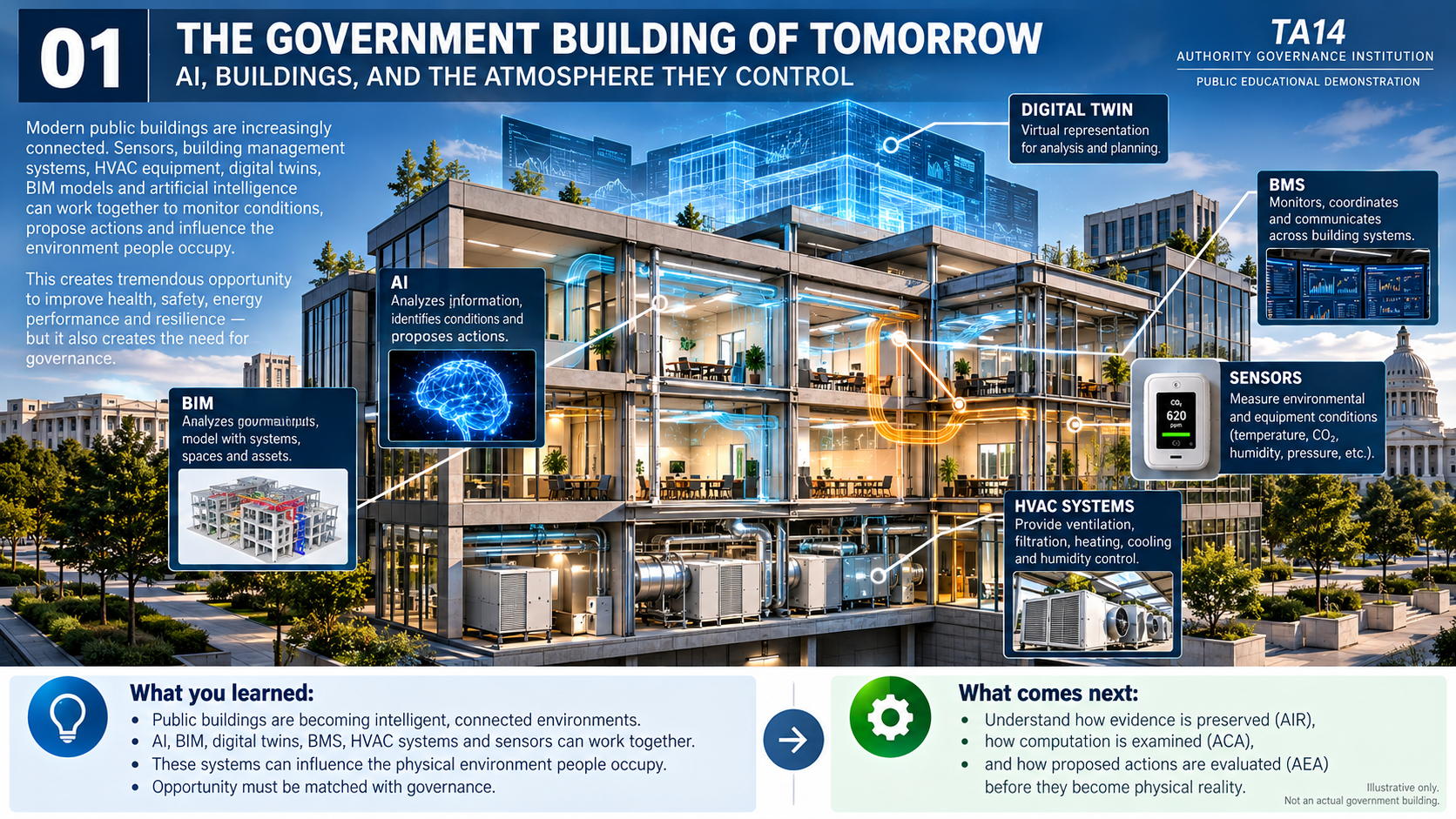
Modern public buildings connect sensors, BIM models, digital twins, building management systems, heating, ventilation and air conditioning equipment, and artificial intelligence. This creates opportunities to understand and improve conditions. Yet a system that can propose an action is not automatically authorized to carry it out. The next lessons examine both what intelligence receives and what it is permitted to do.
LESSON 02 / 08
Intelligence Is Not Authority
Illustrative only · All numerical values and claimed outcomes shown in the artwork are hypothetical.
Samantha · Lesson narration
🎧 SAMANTHA · GUIDED WALKTHROUGH
Follow the numbered teaching sections on the image. The page does not auto-scroll.
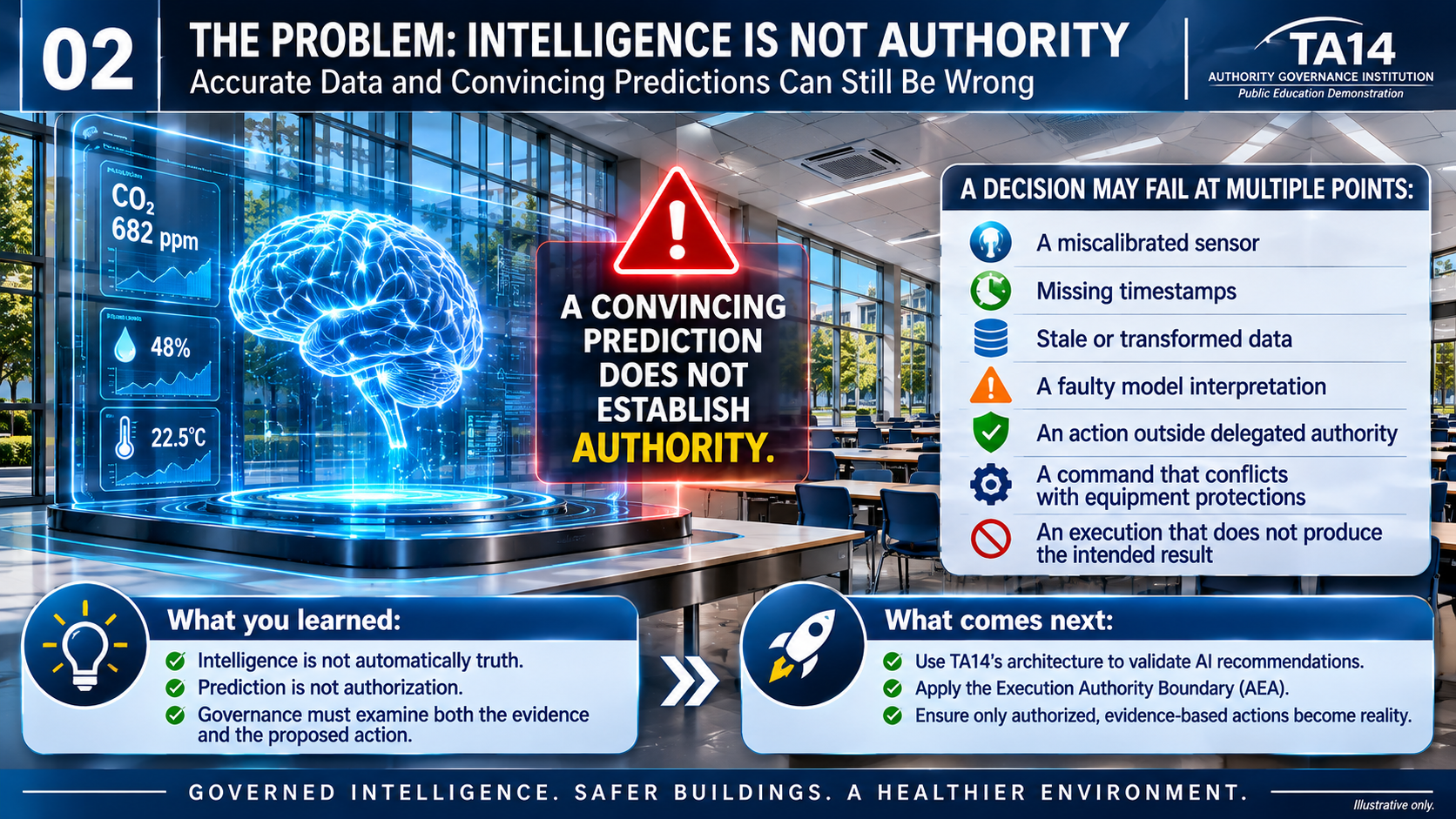
A sensor can be miscalibrated, a timestamp can be missing, or a computational model can reach an incorrect conclusion. Even a convincing recommendation does not establish permission to change a public building. TA14 distinguishes observed conditions from inferred conclusions, and inferred conclusions from authorized action. These examples are illustrative, not findings about any building.
LESSON 03 / 08
Atmospheric Integrity Records
Illustrative only · All numerical values and claimed outcomes shown in the artwork are hypothetical.
Samantha · Lesson narration
🎧 SAMANTHA · GUIDED WALKTHROUGH
Follow the numbered teaching sections on the image. The page does not auto-scroll.
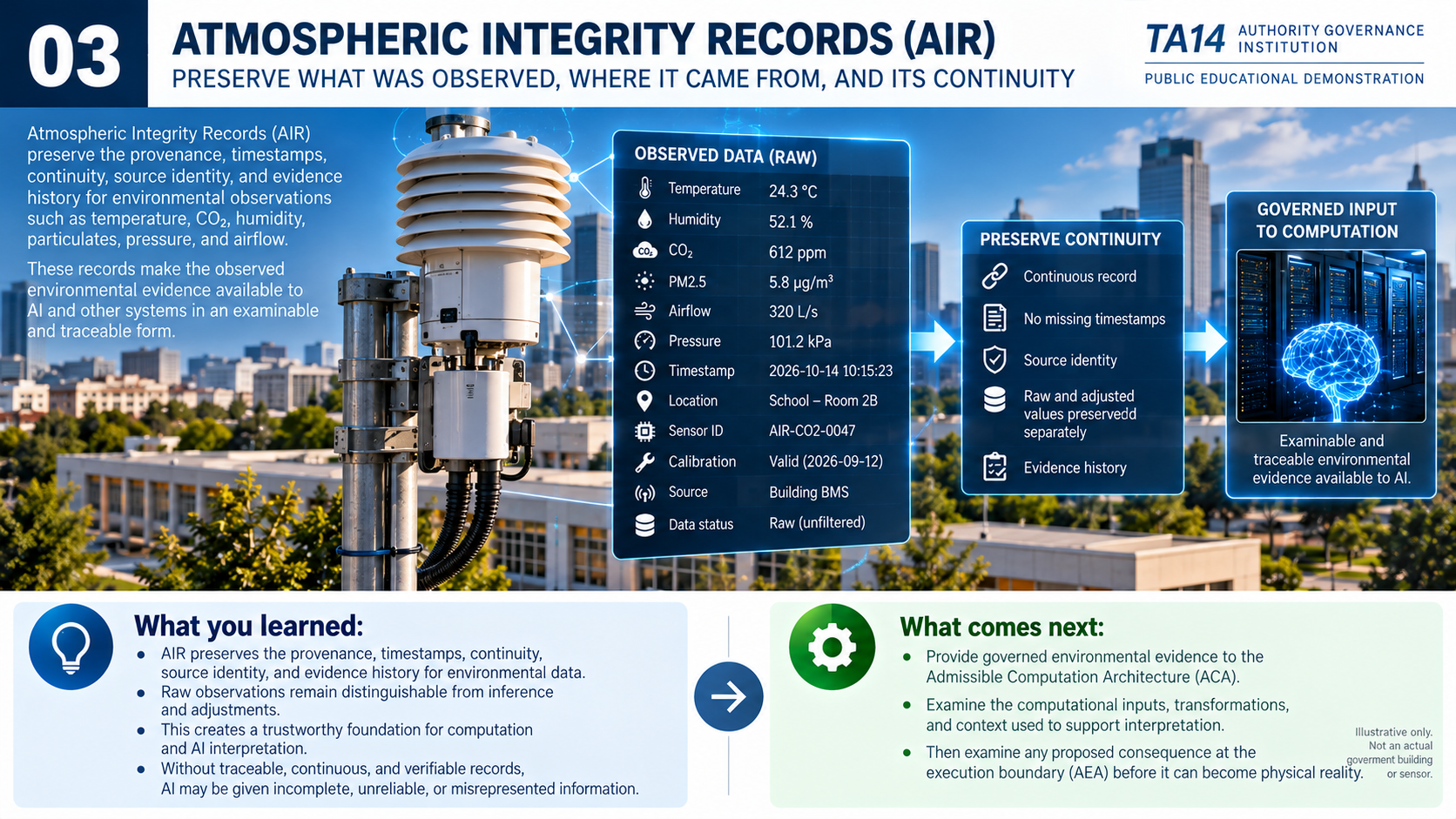
Atmospheric Integrity Records are designed to preserve source identity, timestamp, calibration context, provenance, and continuity for environmental observations. Raw readings remain separate from adjusted or inferred values. A complete-looking record does not automatically become admissible: source trust, custody, relevance, and context still need examination. Next, we examine the computation performed on this evidence.
LESSON 04 / 08
Admissible Computation Architecture
Illustrative only · All numerical values and claimed outcomes shown in the artwork are hypothetical.
Samantha · Lesson narration
🎧 SAMANTHA · GUIDED WALKTHROUGH
Follow the numbered teaching sections on the image. The page does not auto-scroll.
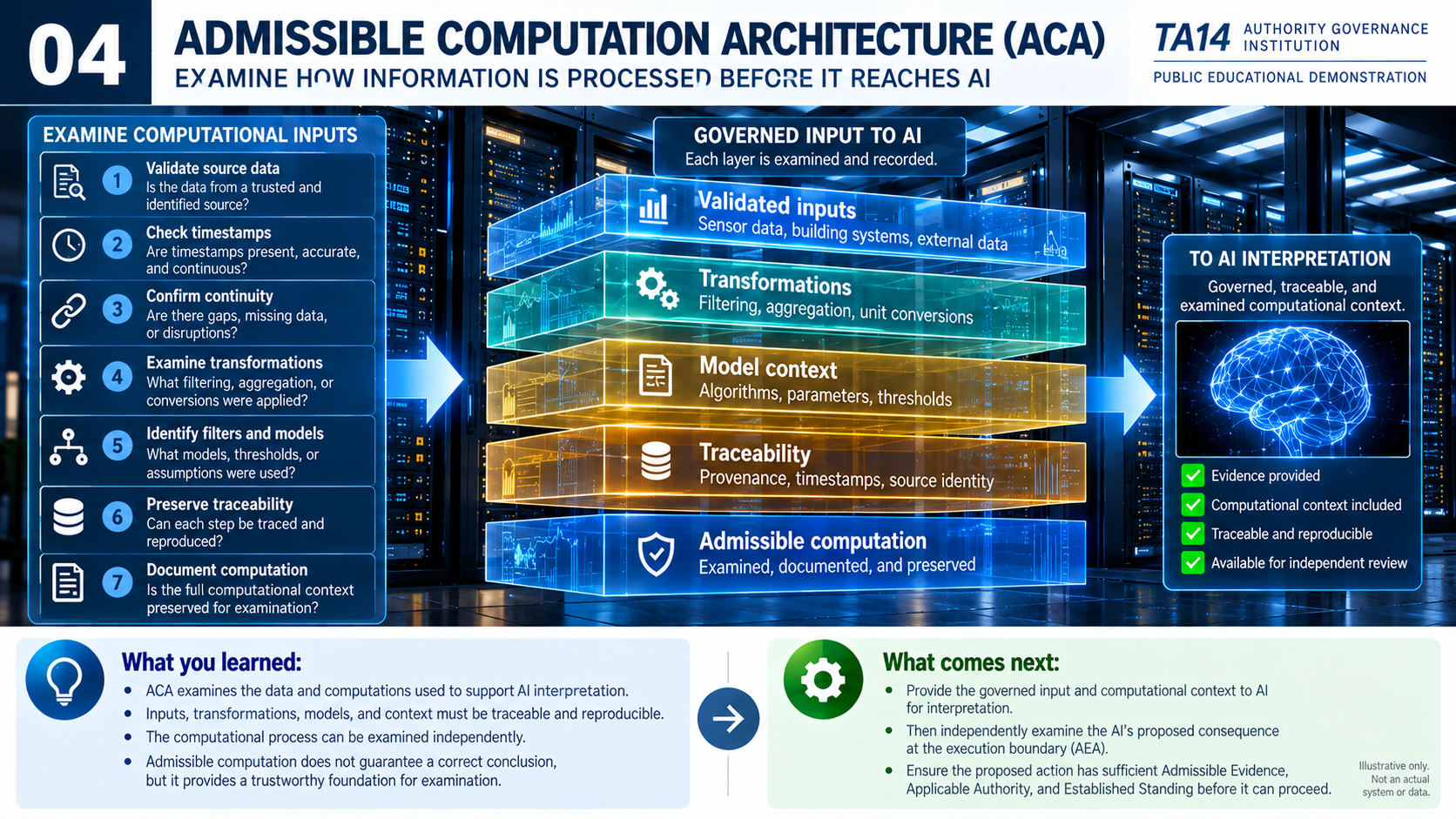
Admissible Computation Architecture makes computational inputs, transformations, model context, and traceability available for examination. Filtering, aggregation, unit conversion, and inference must not silently replace the original observations. Governing computation supports reviewable intelligence inputs; it does not guarantee that a model will interpret them correctly.
LESSON 05 / 08
The AI Interpretation Boundary
Illustrative only · All numerical values and claimed outcomes shown in the artwork are hypothetical.
Samantha · Lesson narration
🎧 SAMANTHA · GUIDED WALKTHROUGH
Follow the numbered teaching sections on the image. The page does not auto-scroll.
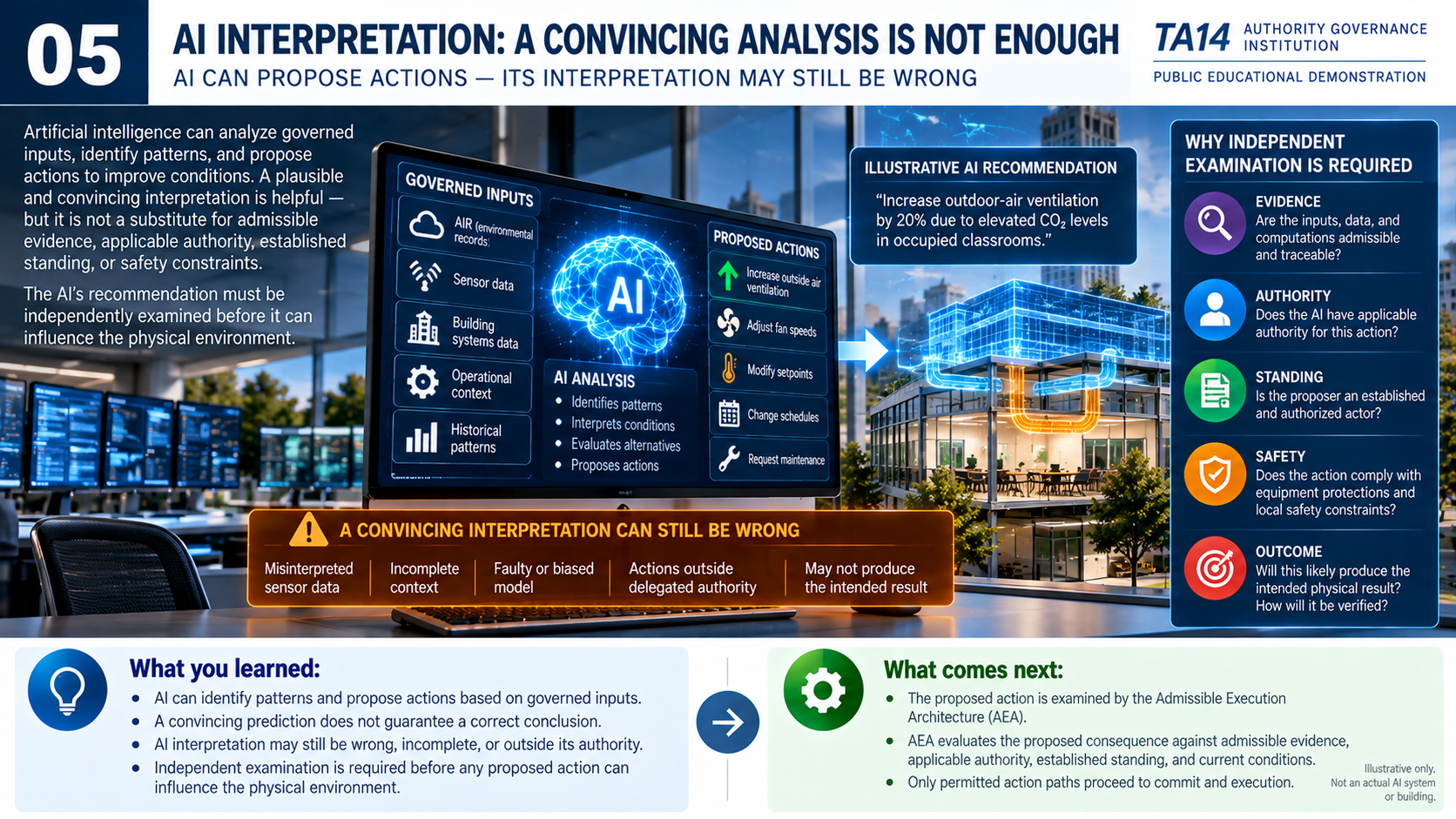
Artificial intelligence may propose a ventilation adjustment based on governed inputs. That recommendation can still be wrong, incomplete, unsafe, or inappropriate for the current conditions. Its proposed consequence must be stated explicitly, including affected assets, action, limits, and time window. Interpretation is not authorization. The next boundary independently examines whether this particular consequence can proceed now.
LESSON 06 / 08
Admissible Execution Architecture
Illustrative only · All numerical values and claimed outcomes shown in the artwork are hypothetical.
Samantha · Lesson narration
🎧 SAMANTHA · GUIDED WALKTHROUGH
Follow the numbered teaching sections on the image. The page does not auto-scroll.
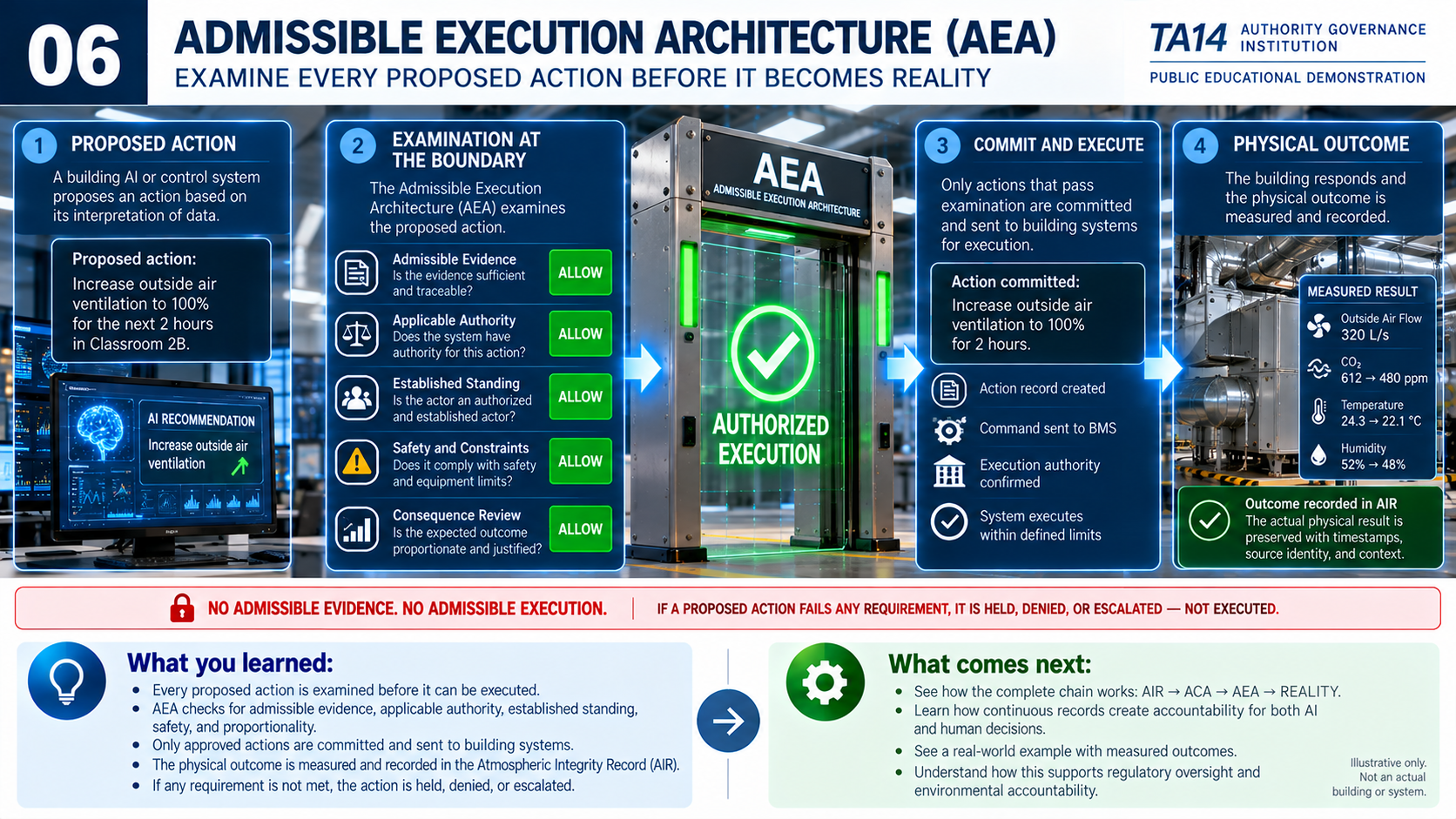
Admissible Execution Architecture examines whether a specific proposed consequence has sufficient Admissible Evidence, Applicable Authority, and Established Standing to become reality NOW. A bounded disposition is ALLOW, HOLD, DENY, or ESCALATE. ALLOW does not itself actuate equipment. Independent local authorization, operating conditions, interlocks, and other safety protections remain required. The green success illustration is hypothetical, not a verified deployment.
LESSON 07 / 08
Physical Reality and Environmental Accountability
Illustrative only · All numerical values and claimed outcomes shown in the artwork are hypothetical.
Samantha · Lesson narration
🎧 SAMANTHA · GUIDED WALKTHROUGH
Follow the numbered teaching sections on the image. The page does not auto-scroll.
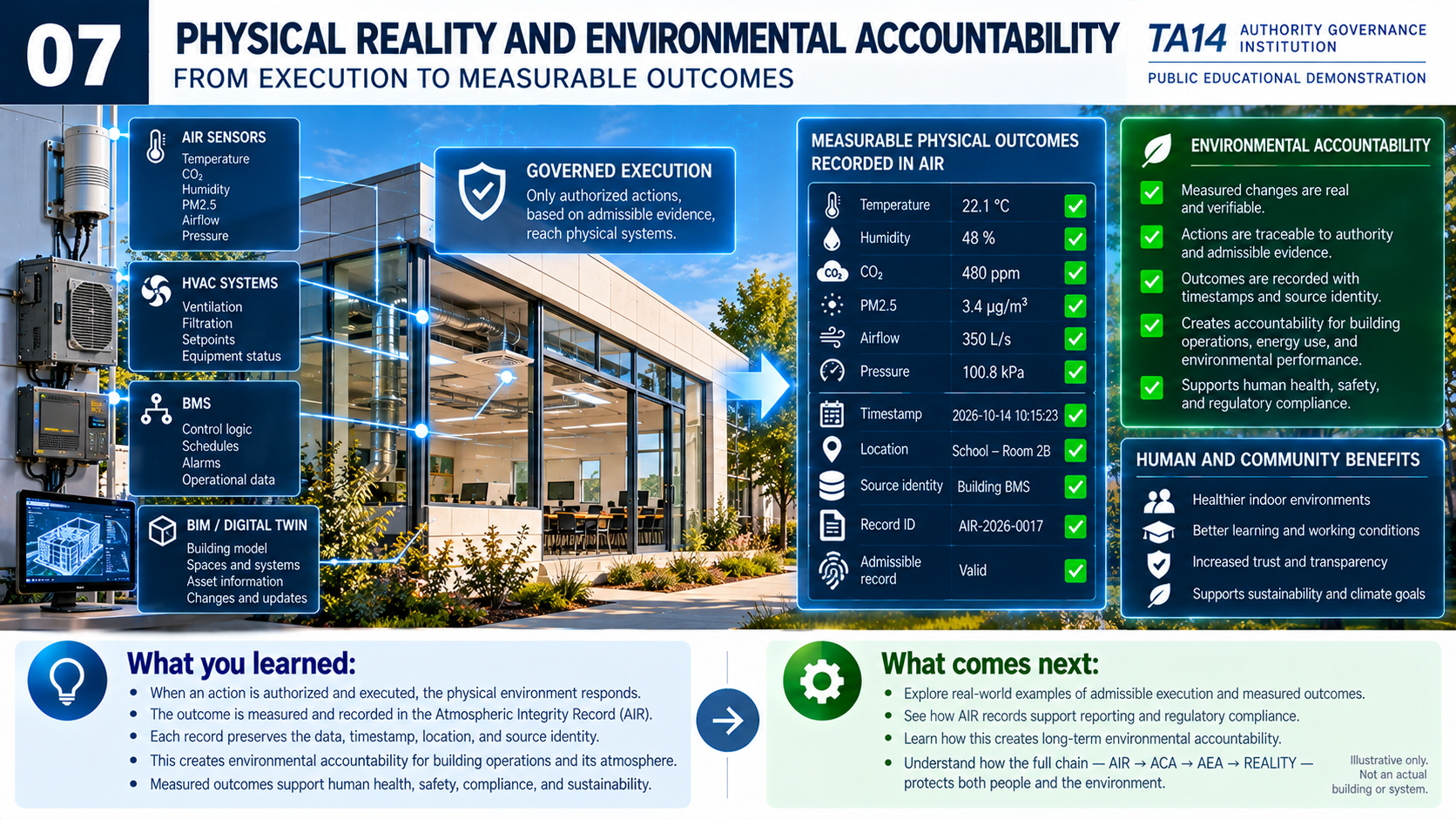
A command, acknowledgement, equipment response, and environmental result are four different things. Preserve each separately. A verified physical outcome requires appropriate measurement, timing, context, and checks for unintended effects. This illustration uses fictional values and must not be interpreted as evidence that TA14 already operates a government building or has achieved the results shown.
LESSON 08 / 08
From Data to Accountability
Illustrative only · All numerical values and claimed outcomes shown in the artwork are hypothetical.
Samantha · Lesson narration
🎧 SAMANTHA · GUIDED WALKTHROUGH
Follow the numbered teaching sections on the image. The page does not auto-scroll.
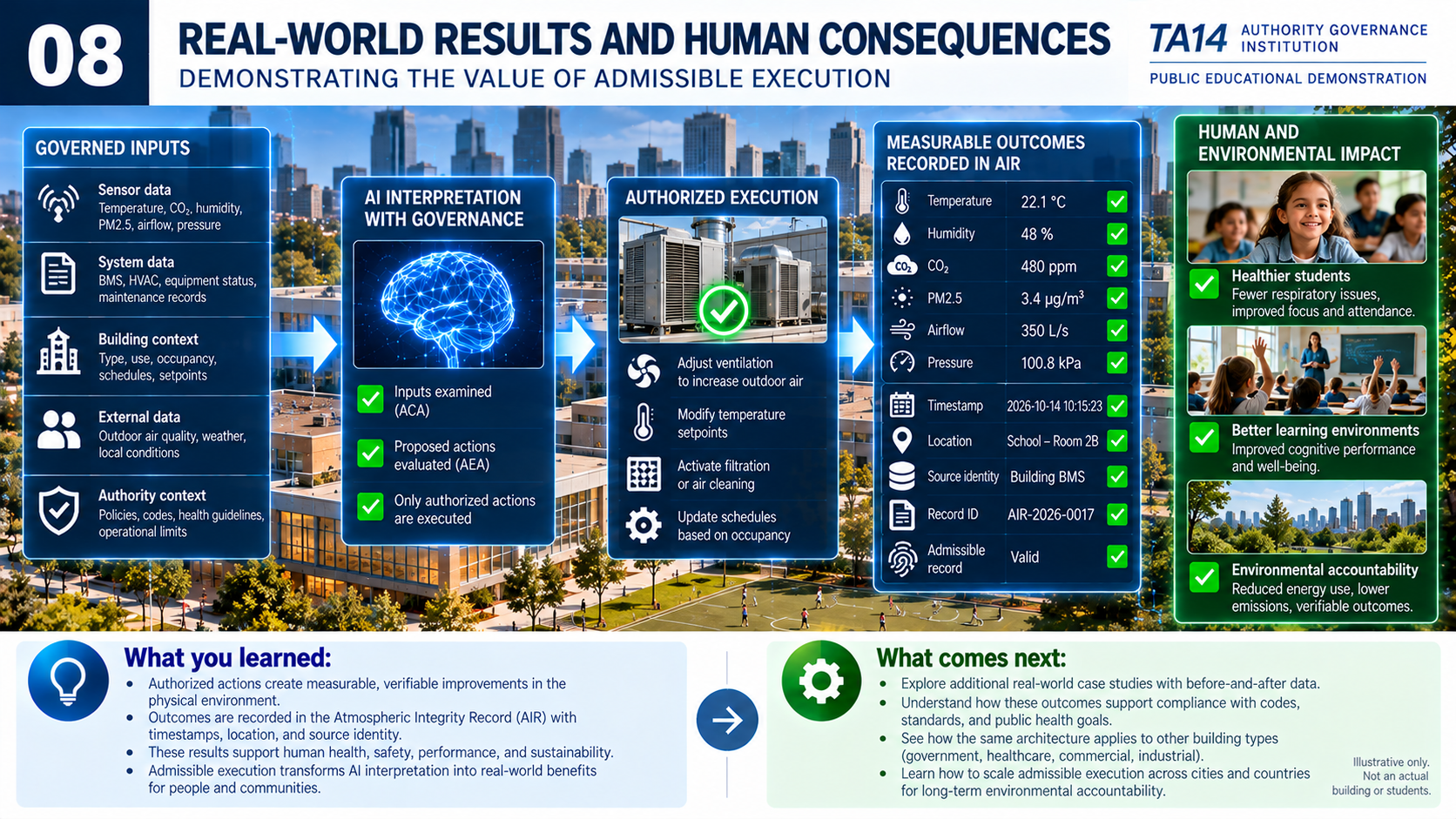
Environmental observations, computation, proposed actions, authority decisions, and verified physical outcomes may together form a defensible record for institutional accountability. Such evidence could support building-performance reviews, standards implementation, and policy work. The depicted student, health, energy, and performance benefits are hypothetical; they are not demonstrated TA14 outcomes or independently verified health claims. Governments retain responsibility for laws and regulatory decisions.
From governance to environmental accountability
The environmental value is not simply another air-quality dashboard. A properly designed record can distinguish what the environment actually showed, what computation transformed, what AI inferred, what action was proposed, who had authority and standing, what the building executed, and what was subsequently measured. Institutions could use validated portions of that chain to evaluate interventions, demonstrate performance against applicable requirements, and inform policy. Legal compliance and regulatory authority remain with the competent institutions.
01 · PRESERVE
AIR retains traceable environmental observations and their original context.
02 · EXAMINE
ACA supports review of computation; AEA examines proposed consequences, authority, and standing.
03 · EXECUTE & VERIFY
Local safety controls govern physical actuation; record commands, responses, and observed outcomes.
04 · SUPPORT ACCOUNTABILITY
Reliable records may inform standards, institutional review, and public policy without creating regulatory powers.
GOVERNMENT TECHNICAL EVALUATION
Examine one bounded AI-to-building-control pathway
TA14 invites public institutions to consider a scoped assessment of evidence provenance, computation, authority, standing, execution boundaries, and outcome verification. An introductory conversation carries no obligation. Detailed technical examination, integration, or licensing would be separately scoped and commercially agreed.
Apply the governance principles to three hypothetical cases relevant to the proposed operational consequence. Choose a determination, then examine the reasoning. These cases teach the distinction between Admissible Evidence, Applicable Authority, and Established Standing; they do not issue real-world authorization.
CASE 01
Evidence is not yet admissible
A proposed consequence is supported by an observation, but the source attribution or record continuity is missing. What should happen before execution? Consider this in the context of the proposed operational consequence.
CASE 02
The actor exceeds authority
The record is current and reliable, but the proposed consequence falls outside the scope of applicable authority. What is the supported determination?
CASE 03
A higher authority is required
The proposed consequence triggers a documented requirement for review by another designated authority. What is the appropriate route?
Independent educational examples only. The questions are hypothetical and do not assess a real institution, building, person, or operating system. Actual governance determinations require case-specific evidence, applicable authority, established standing, and bounded review.