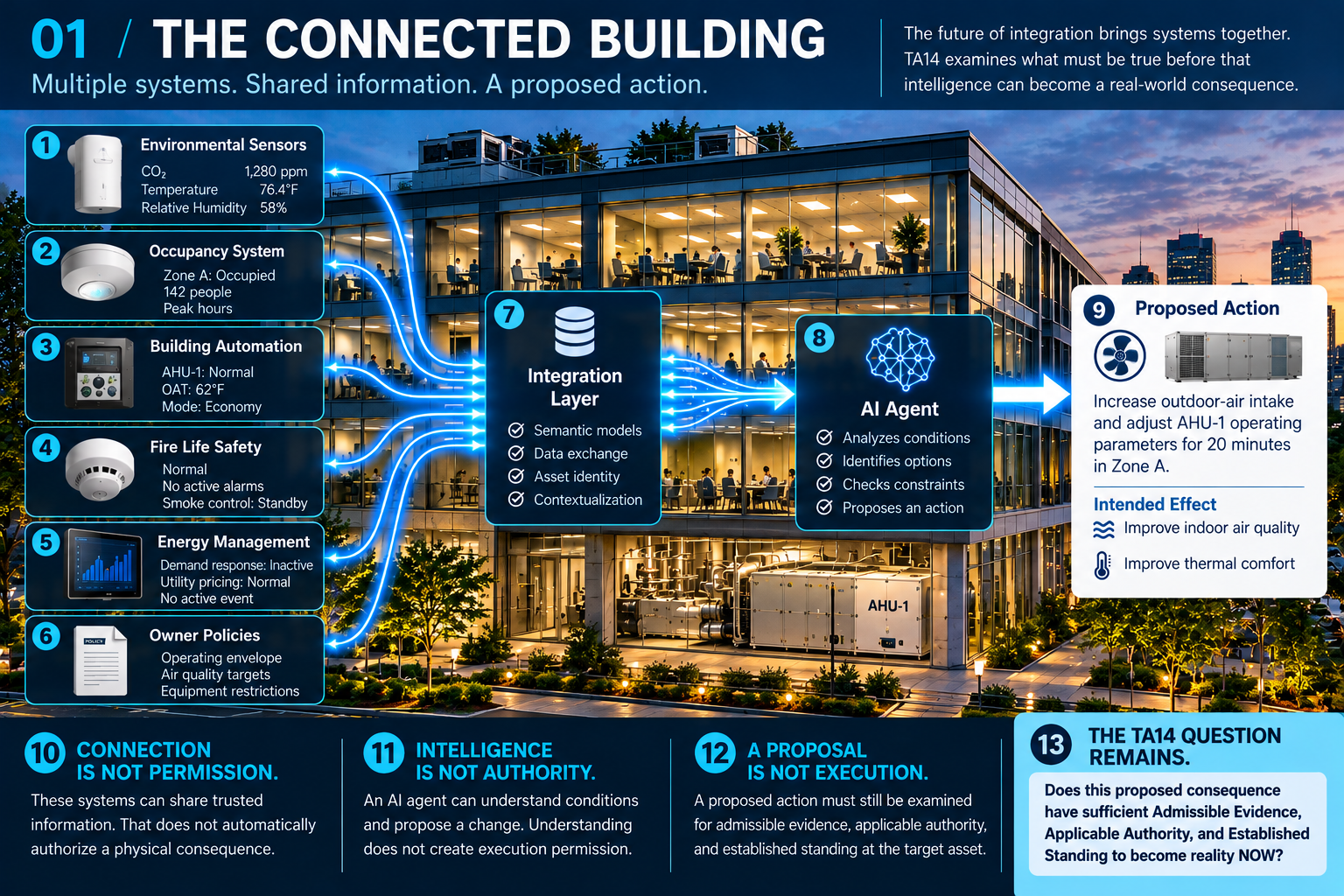
Choose any numbered scene. The image is the visual teaching surface; Samantha's full explanation is provided separately so the image remains unobstructed. When narration finishes, the next image opens automatically without playing its audio or scrolling the page.
01 / THE CONNECTED BUILDING1 OF 8
Six building systems share information through an integration layer. An AI agent can propose an HVAC action, but connectivity does not grant permission.
SAMANTHA · IN-DEPTH AUDIO LESSON
Listen, read, question.
Start with a building full of systems. Sensors measure carbon dioxide and temperature. Occupancy systems estimate how many people are inside. Building automation knows what the air handler is doing. Energy and safety systems carry additional constraints. All of this can be connected and understandable. But notice what has not happened: no one has proved that a physical change is permitted. Connection helps systems communicate. It does not make the decision for the owner. The first lesson is simple: connection is not permission.
LESSON 1 / 8
PRACTITIONER PRESSURE TEST · ILLUSTRATIVE ONLY
Same building. Different evidence. Different result.
Select a condition, then reveal the illustrative TA14 disposition. This is a teaching exercise, not a real authority decision or operational command.
PROPOSED CONSEQUENCE · INCREASE AHU-1 OUTDOOR AIR FOR 20 MINUTES
Bounded ALLOW
Current sensor evidence is traceable; delegated facility authority is documented; safety and equipment limits are checked; the local command is within the approved envelope.
REFERENCE · PROVENANCE · INDEPENDENCE
Read the article. Inspect the teaching. Challenge the boundary.
This showroom is an independent TA14 educational response to the future-of-integration discussion. Ken Sinclair, AutomatedBuildings.com, and other named industry participants are not represented as endorsing this demonstration. All building data and outcomes in these illustrations are hypothetical, not measured field results or a completed formal examination.
Formal challenge or examination requests require registered governance and a defined, frozen baseline. No independent institutional endorsement, certification, operational authorization, or real-world PASS is implied.
TA-14 ACADEMY · INDEPENDENT REVIEW CHALLENGE
Can you defend the determination?
Apply the governance principles to three hypothetical cases relevant to the proposed operational consequence. Choose a determination, then examine the reasoning. These cases teach the distinction between Admissible Evidence, Applicable Authority, and Established Standing; they do not issue real-world authorization.
CASE 01
Evidence is not yet admissible
A proposed consequence is supported by an observation, but the source attribution or record continuity is missing. What should happen before execution? Consider this in the context of the proposed operational consequence.
CASE 02
The actor exceeds authority
The record is current and reliable, but the proposed consequence falls outside the scope of applicable authority. What is the supported determination?
CASE 03
A higher authority is required
The proposed consequence triggers a documented requirement for review by another designated authority. What is the appropriate route?
Independent educational examples only. The questions are hypothetical and do not assess a real institution, building, person, or operating system. Actual governance determinations require case-specific evidence, applicable authority, established standing, and bounded review.