CASE 01
Evidence is not yet admissible
A proposed consequence is supported by an observation, but the source attribution or record continuity is missing. What should happen before execution? Consider this in the context of air-quality intervention.
TA14 AUTHORITY GOVERNANCE INSTITUTION · INDEPENDENT MANUFACTURER TECHNICAL PRE-EXAMINATION
Eight illustrated lessons examining how environmental observations could become source-linked AIR records, bounded governance determinations and independently examined outcomes without replacing the manufacturer's equipment.
INDEPENDENT EDUCATIONAL EXPLORATION · NO HIBOUAIR ENDORSEMENT OR PARTNERSHIP CLAIMED. Illustrative readings, devices, receipts, permissions, actions and outcomes only. The private R1 adapter is simulated, without live credentials or verified manufacturer integration. No field authority, legal admissibility, certification or actual intervention is established.
PRIMARY TECHNICAL REFERENCE · V2.0
Read the technical reference before or alongside the eight lessons. Proposed evaluation only; no agreed commercial arrangement.
Open / Download PDF ↗The technical reference opens in a separate browser tab. Embedded PDF viewing is disabled here because external PDF viewers may render a blank panel. If your browser downloads the file instead, open it in your PDF reader.
THE GOVERNING QUESTION
Reality → Record → Continuity → Admissibility → Binding → Commit → Execution → Outcome
IMAGE 01 / 08
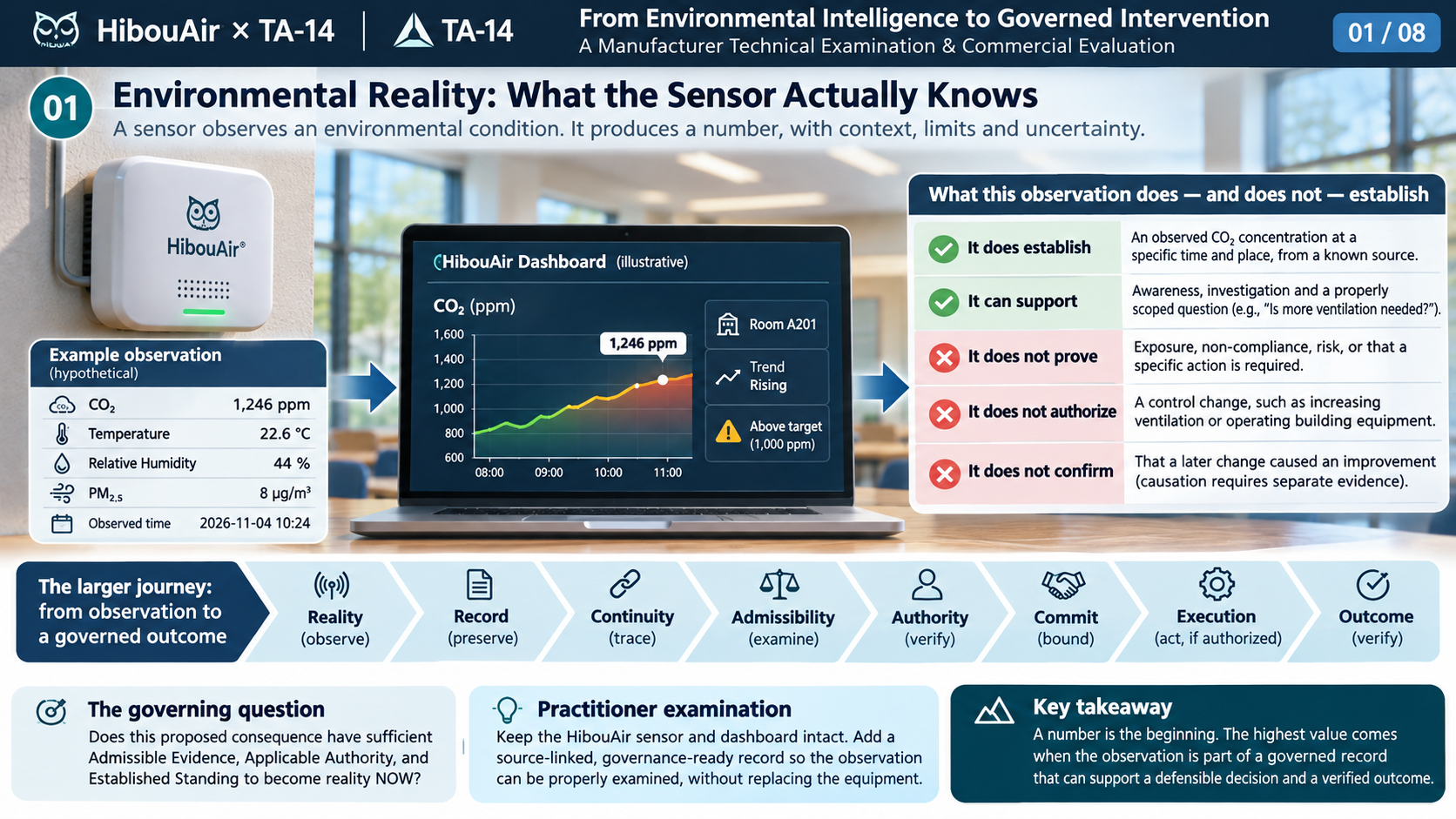
Follow the numbered teaching sections on the image. The page does not auto-scroll.
A sensor measures an environmental condition. Its observation does not by itself establish cause, compliance, exposure or permission to intervene. This independent teaching scenario uses hypothetical HibouAir-format readings, not a live manufacturer feed.
A measurement is an observation, not authorization.
Next, examine where the reading came from.
Continue to next lesson ↓IMAGE 02 / 08
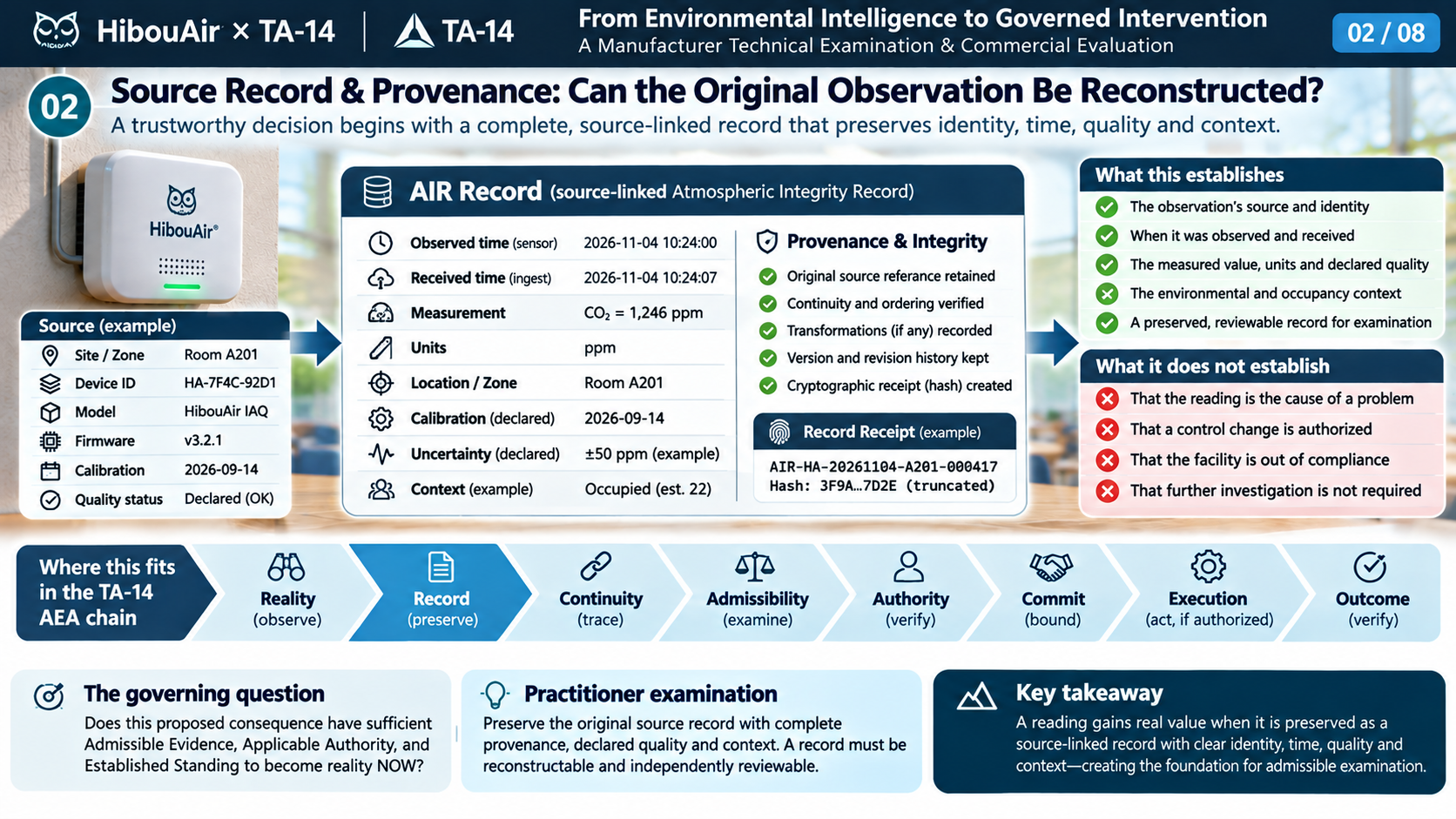
Follow the numbered teaching sections on the image. The page does not auto-scroll.
An examinable source record retains identity, location, original timestamps, units, quality declarations and revisions. Preserve raw observations separately from interpretation. A hash can detect a later change but cannot prove the original measurement was accurate.
Original provenance must survive interpretation.
Next, test whether its chronology remained intact.
Continue to next lesson ↓IMAGE 03 / 08
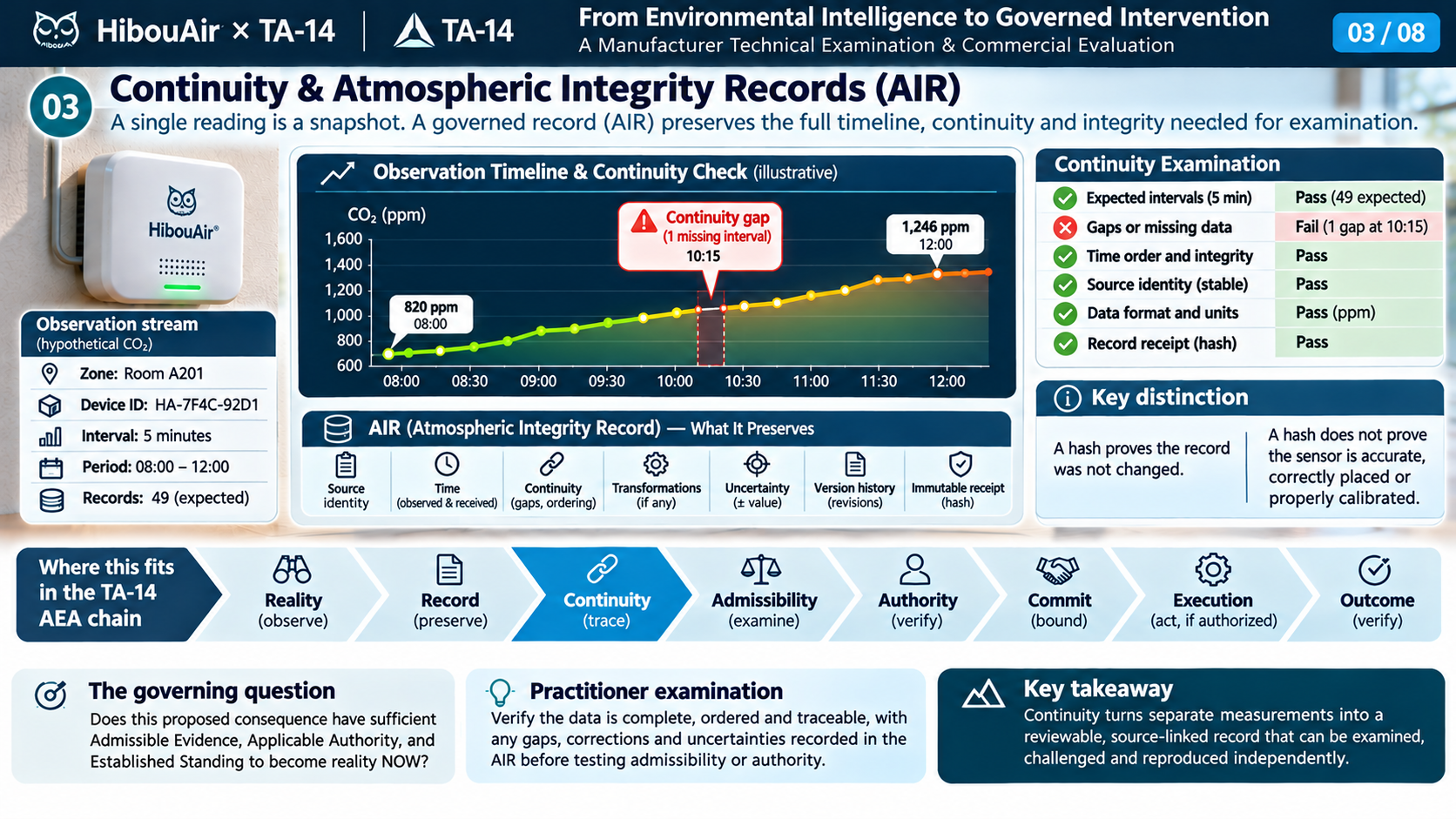
Follow the numbered teaching sections on the image. The page does not auto-scroll.
Atmospheric Integrity Records preserve the sequence, missing intervals, transformations, uncertainty and linked receipts. A missing observation must remain visible. Continuity can be examined, challenged and replayed, but a preserved record does not automatically establish admissibility.
Gaps and revisions must remain examinable.
Next, examine fitness for a particular consequence.
Continue to next lesson ↓IMAGE 04 / 08
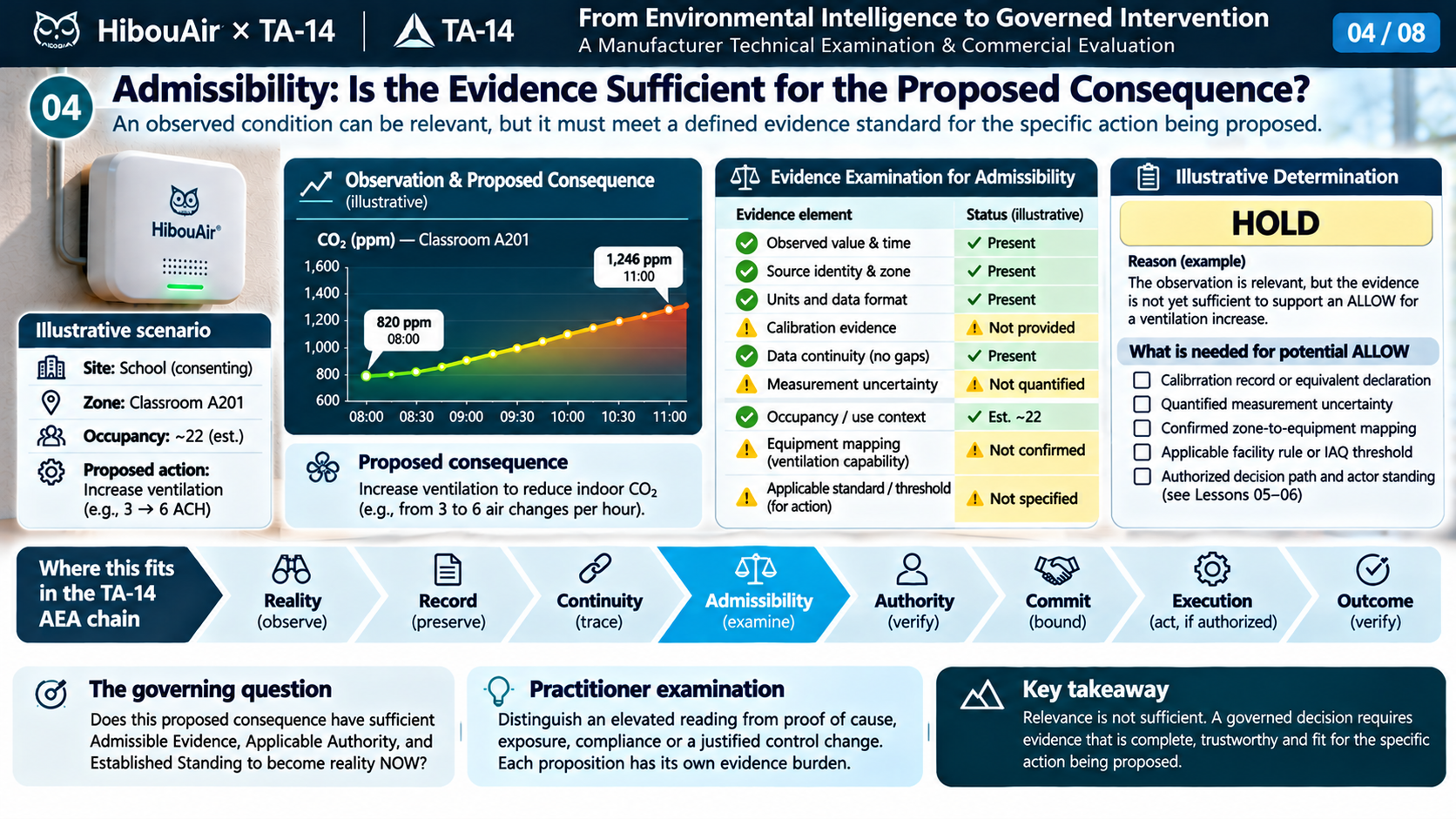
Follow the numbered teaching sections on the image. The page does not auto-scroll.
An elevated classroom carbon dioxide reading may warrant investigation. In this hypothetical case, calibration evidence, quantified uncertainty, equipment mapping and the applicable decision threshold are incomplete. The proposed ventilation change receives HOLD; investigation may continue under separate authority.
Relevant observations can still be insufficient for intervention.
Next, identify who may lawfully invoke a decision.
Continue to next lesson ↓IMAGE 05 / 08
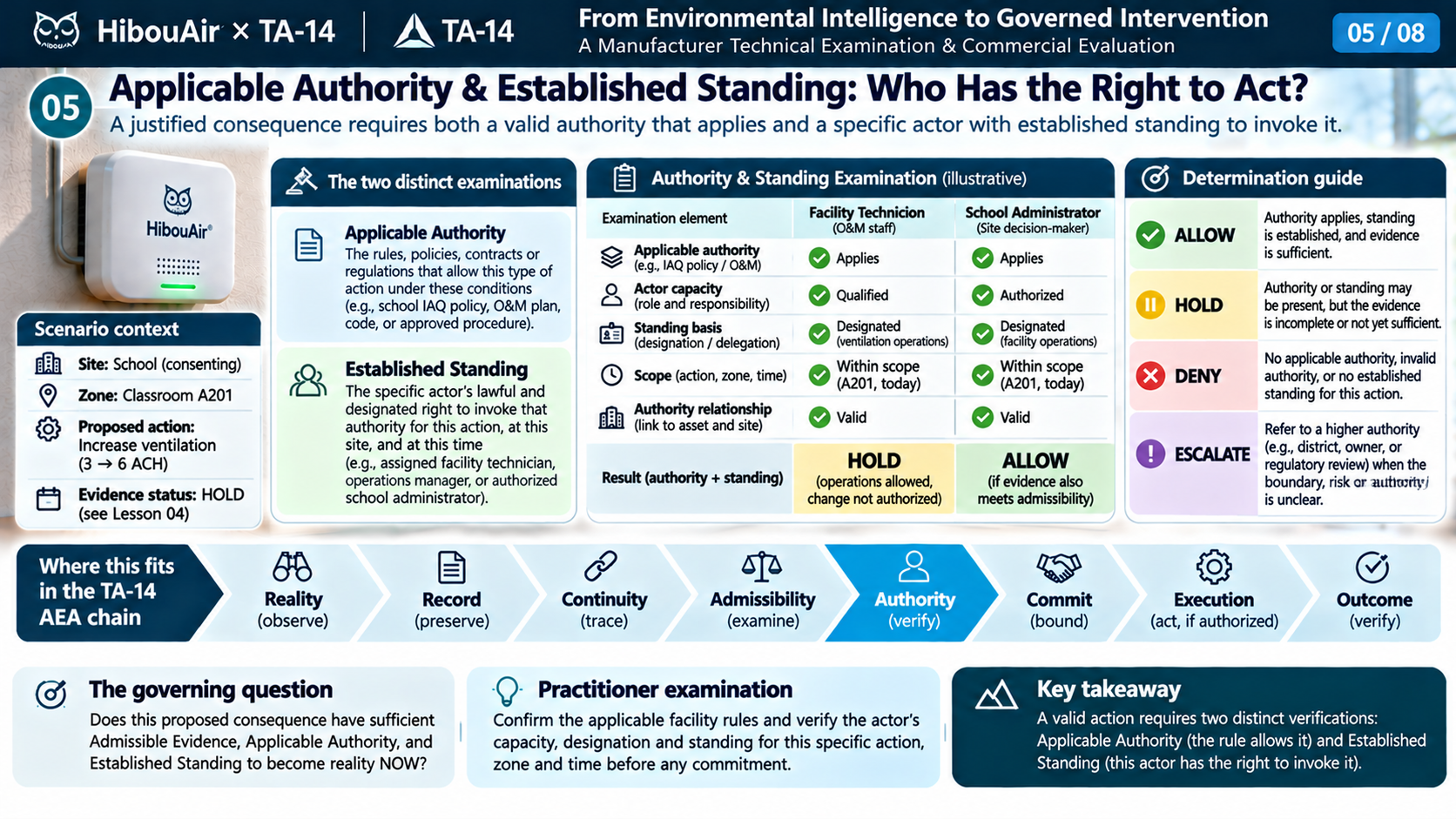
Follow the numbered teaching sections on the image. The page does not auto-scroll.
Applicable Authority asks which governing rule permits this particular action. Established Standing asks whether this specific actor, in a declared capacity, may invoke that authority for this asset, place and time. Neither is inferred from possession of a sensor or access to a dashboard. The evidence HOLD still applies.
Authority and standing are separate, actor-specific gates.
Next, see how a bounded disposition is issued.
Continue to next lesson ↓IMAGE 06 / 08
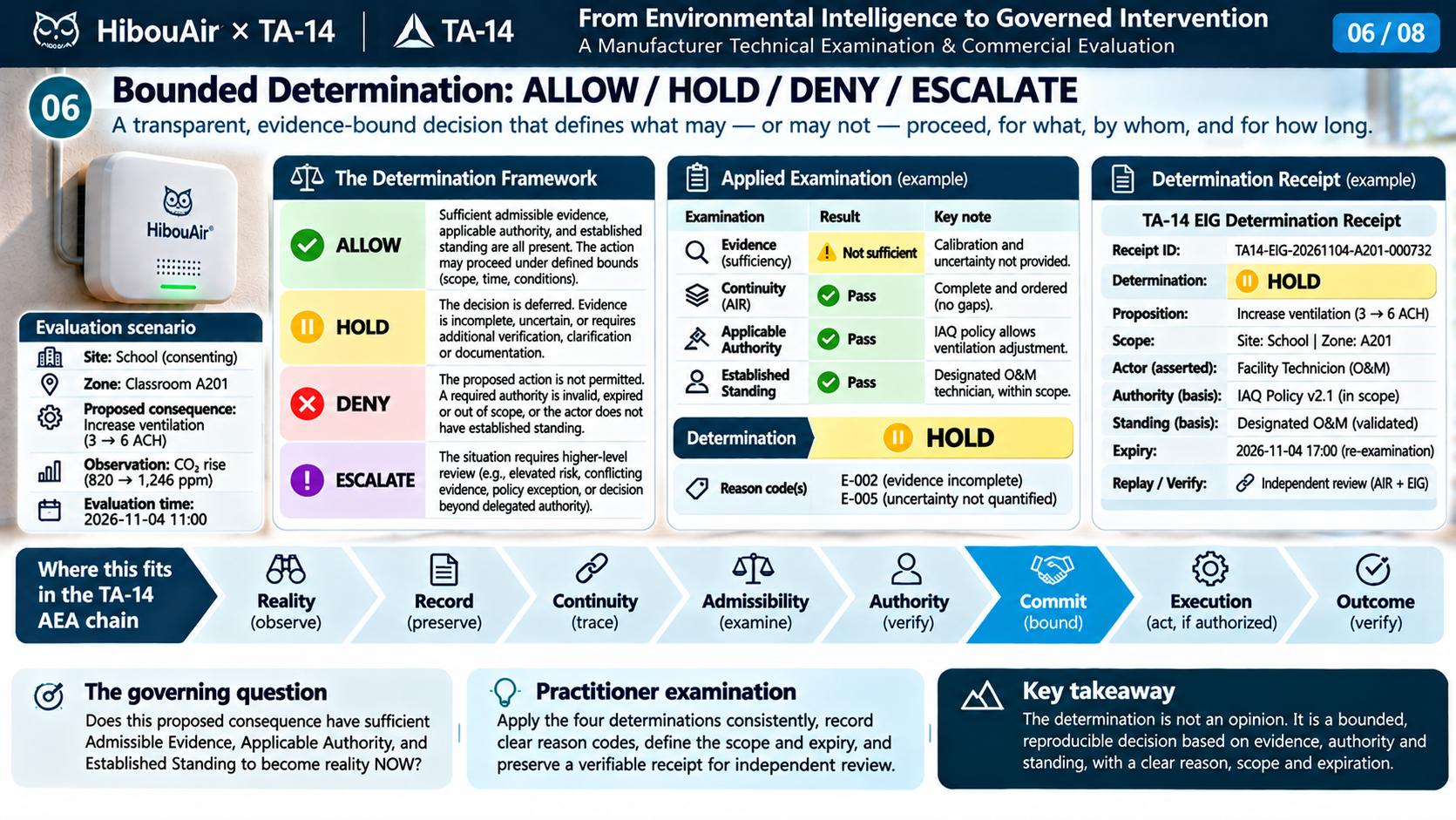
Follow the numbered teaching sections on the image. The page does not auto-scroll.
TA-14 examines a precise proposed consequence and issues ALLOW, HOLD, DENY or ESCALATE with reason codes, scope and expiry. In our running scenario, incomplete evidence produces HOLD even if authority and standing are otherwise established. Illustrative receipts are not actual operational determinations.
A bounded determination is not a controller command.
Next, separate permission from physical actuation.
Continue to next lesson ↓IMAGE 07 / 08
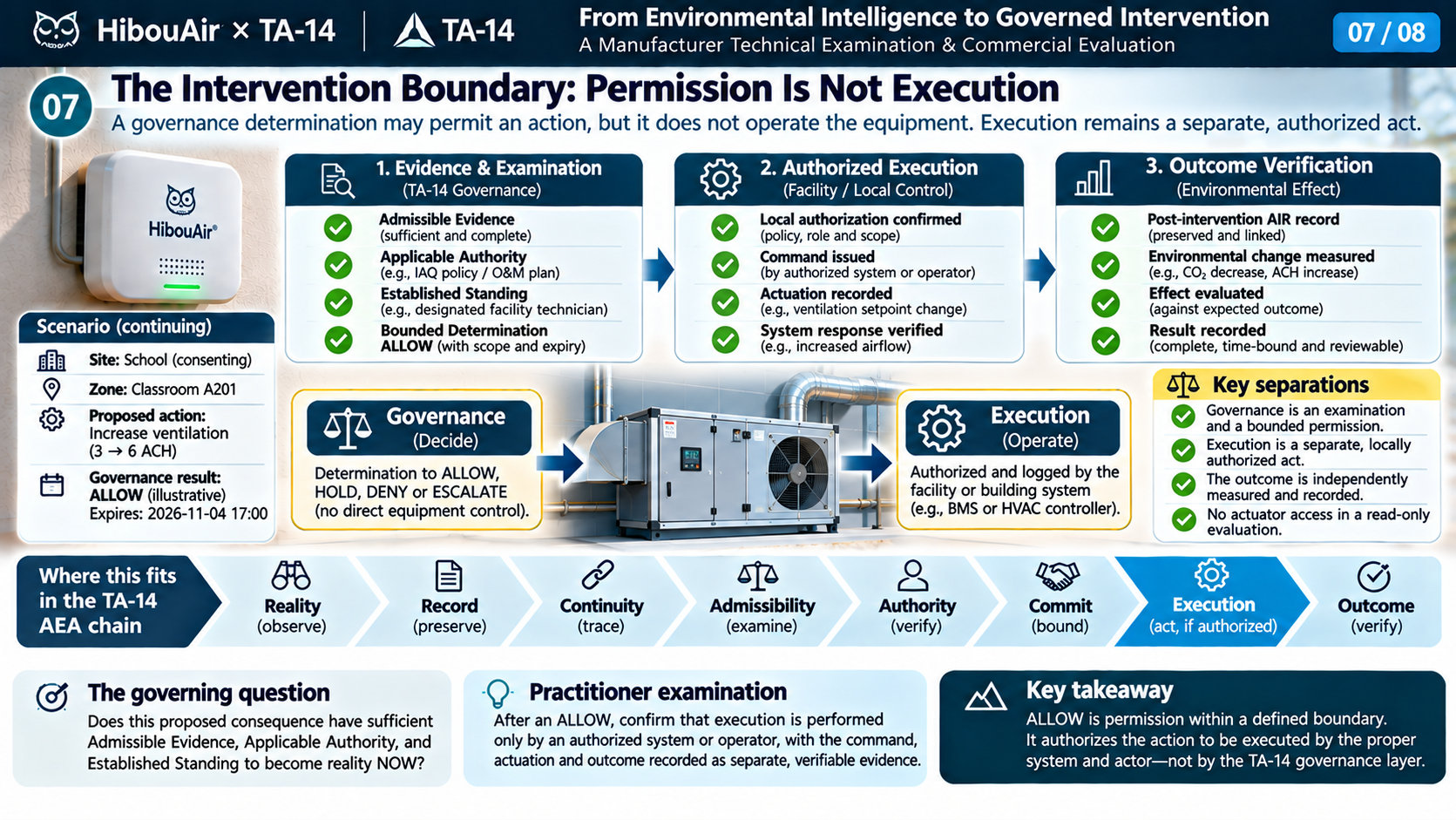
Follow the numbered teaching sections on the image. The page does not auto-scroll.
Permission is not execution. This image illustrates a separate hypothetical future in which deficiencies have been remedied and authorization re-examined. Even then, the local facility system or authorized operator must execute and log any change. Phase one of the proposed HibouAir evaluation remains read-only.
Only separately authorized local systems or operators execute.
Next, verify whether an authorized action achieved its intended result.
Continue to next lesson ↓IMAGE 08 / 08
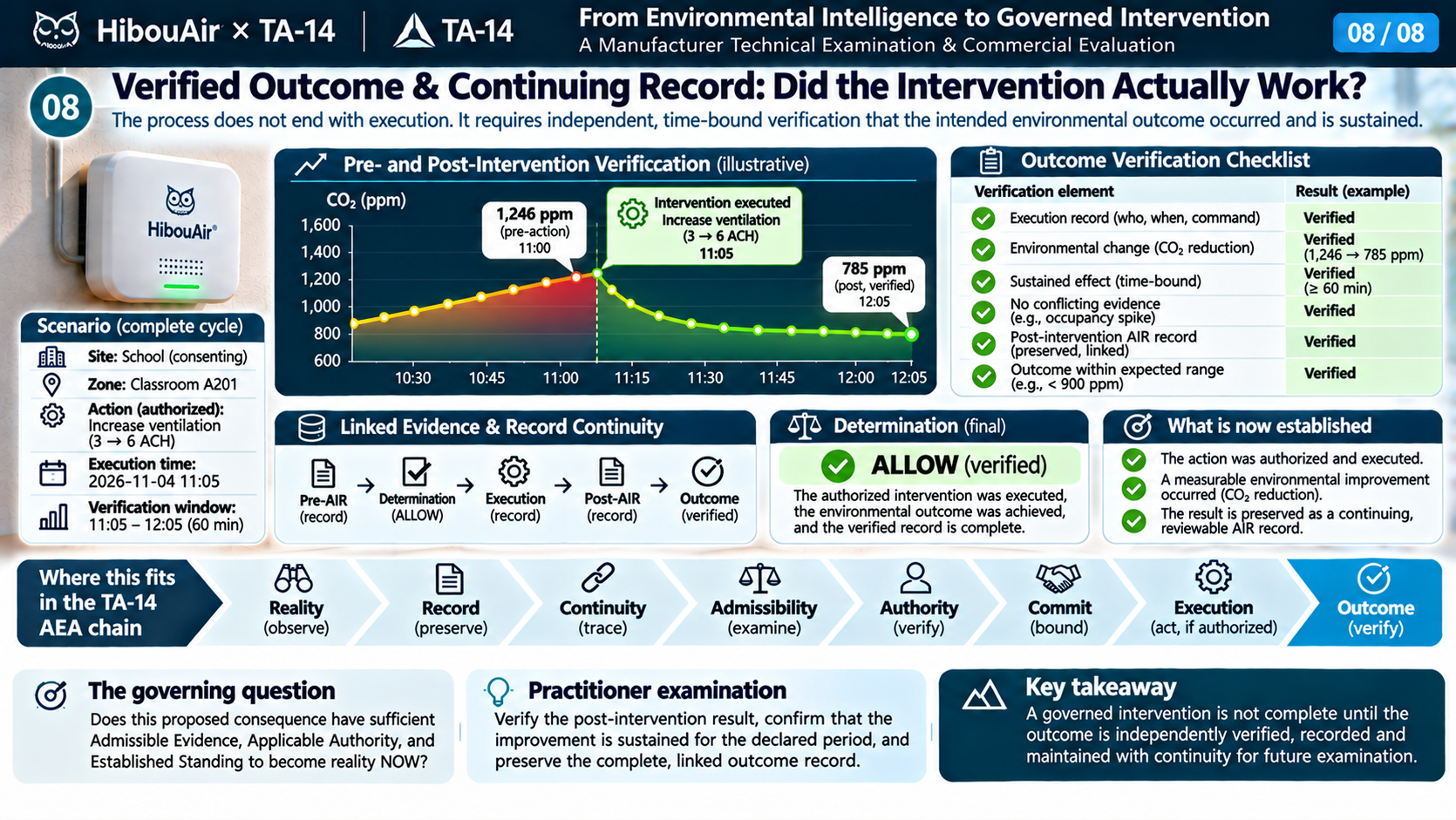
Follow the numbered teaching sections on the image. The page does not auto-scroll.
Execution is not proof of success. This final panel illustrates a hypothetical post-intervention improvement, not measured HibouAir results. A reviewer would need linked pre- and post-action records, context, independent verification and sustained observations. The earlier HOLD is not automatically converted to ALLOW.
Outcome claims require independent examination and continuing evidence.
You have completed the eight lessons. Review the pilot charter and challenge the proposed architecture.
Challenge the evidence and proposed decision: remove calibration evidence; insert a missing observation; revoke an actor's authority; substitute an out-of-scope asset; or present an unverified actuation log. Expected outcomes include HOLD for unsupported evidence and DENY for invalid authority or standing. Any proposed ALLOW must be re-examined at the actual commitment boundary.
Begin with one consenting site, one authorized source stream and one specified environmental claim. Confirm API rights, preservation and uncertainty requirements, acceptance tests, independent review, responsibilities and commercial terms in writing. The initial phase is read-only and has no actuator access.
Read the full technical reference ↗TA-14 ACADEMY · INDEPENDENT REVIEW CHALLENGE
Apply the governance principles to three hypothetical cases relevant to air-quality intervention. Choose a determination, then examine the reasoning. These cases teach the distinction between Admissible Evidence, Applicable Authority, and Established Standing; they do not issue real-world authorization.
CASE 01
A proposed consequence is supported by an observation, but the source attribution or record continuity is missing. What should happen before execution? Consider this in the context of air-quality intervention.
CASE 02
The record is current and reliable, but the proposed consequence falls outside the scope of applicable authority. What is the supported determination?
CASE 03
The proposed consequence triggers a documented requirement for review by another designated authority. What is the appropriate route?
Independent educational examples only. The questions are hypothetical and do not assess a real institution, building, person, or operating system. Actual governance determinations require case-specific evidence, applicable authority, established standing, and bounded review.