Imagine an HVAC system whose installation, operating condition, service history and proposed interventions can be reconstructed years later—from original measurements, not memories or assurances. TA-14 proposes the governed evidence architecture to make that possible.
Educational concepts and illustrations. Physical refrigerant governance, lifetime cloud custody, and warranty integrations are proposed capabilities requiring independent validation. This page does not issue a real DDD, authorization or warranty determination.
LIFETIME SYSTEM ARCHITECTURE · ARTICLE COMPANION VISUAL
The machine remembers. The evidence remains examinable.
From commissioning and measurement to governed interpretation, bounded intervention and the preserved lifetime record.
Conceptual illustration, not a validated device diagram or certification. AEA evaluates execution authorization; the proposed Refrigerant Governor only enforces a currently authorized boundary. Cryptographic sealing protects stored-record integrity, not original measurement accuracy.
Four distinct lanes. One preserved equipment history.
01 · REALITY & RECORD
Preserve measurements, inspection evidence, equipment identity and provenance.
02 · INTERPRETATION & DDD
Establish evidence-supported operating conditions and uncertainty.
03 · OPTIMIZATION & PROPOSAL
Propose corrections without self-authorizing intervention.
04 · OUTCOME UNDERSTANDING
Measure the resulting reality; preserve the earlier baseline.
Execution boundary: Admissible Evidence + Applicable Authority + Established Standing → NOW
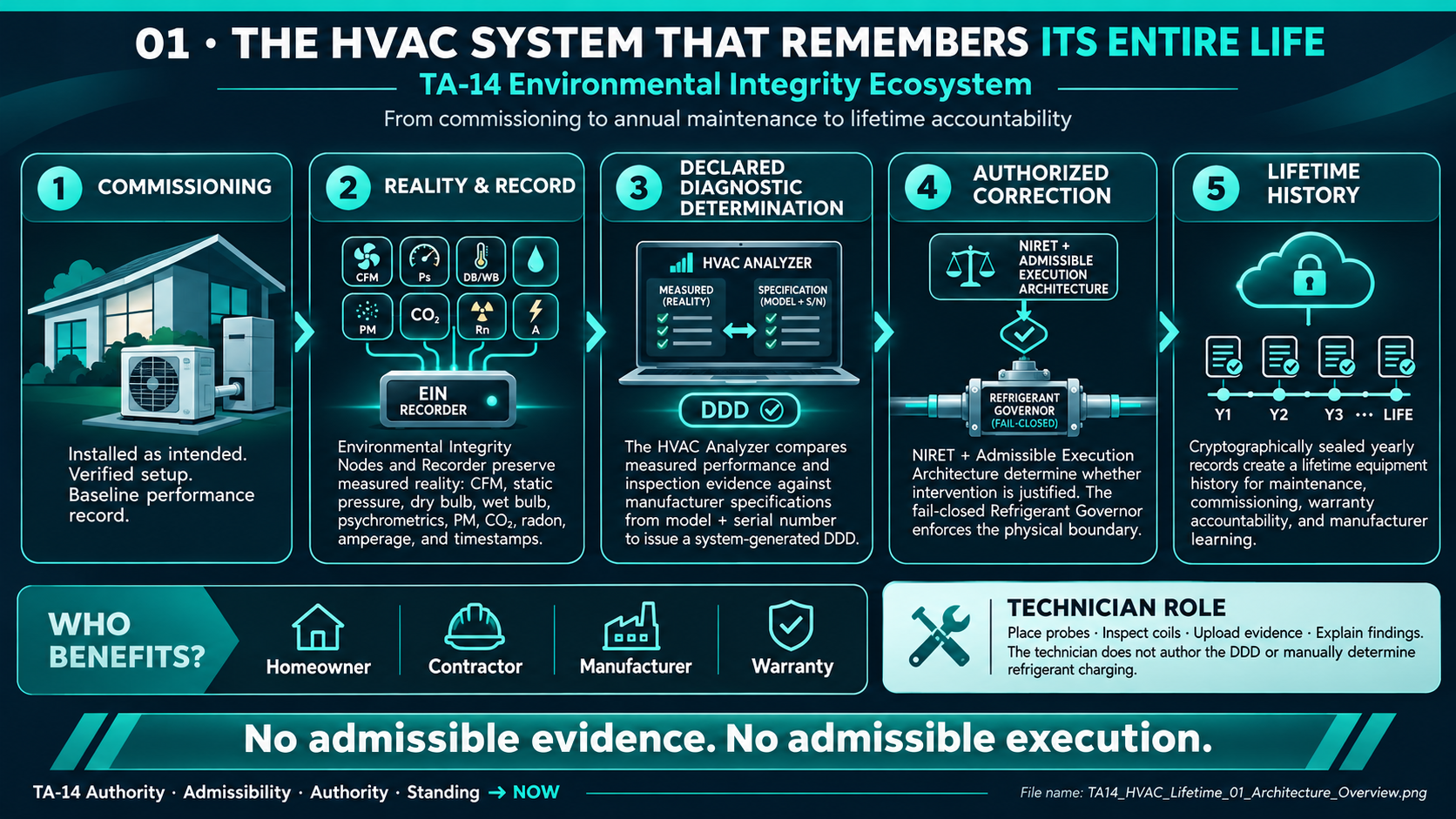
AEA is the foundational execution architecture. The Nodes, Recorder, AIR, ACA, Analyzer, NIRET and Refrigerant Governor fulfill different responsibilities; none may convert technical capability into permission on its own.
01
NODES + RECORDER
Capture physical observations and maintain source lineage.
02
AIR
Preserve provenance, timestamps, continuity, uncertainty and admissibility context.
03
ACA
Trace calculations, assumptions, model boundaries and proposed consequences.
04
HVAC ANALYZER
Compare operating evidence with verified manufacturer specifications.
05
AEA
Check admissible evidence, applicable authority and established standing NOW.
06
GOVERNOR + OUTCOME
Enforce only a current authorized command; record the resulting reality.
No admissible evidence. No admissible execution. Commissioned once does not mean authorized forever.
THE FIELD SERVICE SEQUENCE
What happens on an actual service visit?
The showroom's teaching-image numbering is educational, not a replacement for the operational sequence. The proposed workflow keeps these steps in order:
01 · HPR-BL
Complete all required baseline steps and freeze the authentic evidence.
02 · NIRET
Decide whether refrigerant-system entry is justified using non-invasive evidence.
03 · DDD
The governed Analyzer issues the evidence-bound operating determination.
04 · INTERVENTION
Execute only an appropriately justified, currently authorized correction.
05 · HPR-V
Document and verify the post-intervention performance and outcome.
The technician documents the reality
Identifies model and serial information, positions probes, observes equipment, photographs coils and components, records installed-part differences, completes guided steps, performs authorized physical work and explains findings to the homeowner.
The governed system issues the determination
Verifies the evidence, checks applicable manufacturer specifications, preserves computational lineage, issues the DDD after the frozen baseline, evaluates proposed corrections and tests admissibility, authority and standing before execution.
The technician is essential to authentic evidence collection—but does not author or alter the formal DDD, or override the independent fail-closed Governor.
ILLUSTRATIVE ENGINEERING EXAMINATION · NOT FIELD DATA
What can two air-side nodes actually establish?
Consider a hypothetical cooling system operating at 1,600 CFM. If properly measured return-air enthalpy is 31 Btu/lb of dry air and supply-air enthalpy is 23 Btu/lb, the difference is 8 Btu/lb. Using the conventional approximate standard-air factor:
AIRFLOW
1,600 CFM
Hypothetical, measured at appropriate conditions
ENTHALPY DIFFERENCE
8 Btu/lb
Return 31 − supply 23
ESTIMATED AIR-SIDE TOTAL CAPACITY
57,600 Btu/h
4.5 × CFM × Δh ≈ 4.8 tons
This estimate depends on air density, reliable flow and psychrometric measurements, sensor placement, mixing and uncertainty. It can help evaluate heat transfer; it cannot alone determine refrigerant charge, distinguish every fault, establish warranty coverage or authorize an intervention. The Analyzer must also examine electrical consumption, static pressure, coil and component inspections, operating context and the applicable manufacturer requirements.
HYPOTHETICAL DDD · ILLUSTRATIVE VALUES ONLY
A real operating determination is not a repair suggestion.
Suppose a fictional four-ton unit has been identified by model and serial number. In this teaching example, the manufacturer dataset is stipulated as verified and applicable; the measurements below are invented to illustrate the separation of evidence, determination, proposal and authorization. They are not real manufacturer specifications, certified measurements, or a validated TA-14 output.
Evidence field
Fictional applicable requirement
Fictional observed condition
Interpretation
Equipment identity
Matched model, serial and configuration
Identity and installed configuration documented
Applicable specification basis established
Airflow
1,500–1,700 CFM for stated mode
1,280 CFM
Below illustrative target
External static pressure
Maximum 0.50 in. w.c. at specified test point
0.83 in. w.c.
Elevated; inspect actual restrictions and measurement context
Blower capacitor
7.5 µF ± 5% for matched component
6.4 µF
Outside illustrative component tolerance
Coil inspection
Authentic image and condition report required
Image received; fouling not yet confirmed
Do not infer fouling from airflow alone
Refrigerant evidence
NIRET prerequisites and applicable methods
Airflow and electrical deviations unresolved
Refrigerant entry not justified on this record
01 · RECORD
Preserve original airflow, static-pressure and capacitance measurements; equipment identity, photos, timestamps and uncertainty.
02 · DDD
After the complete 14-step baseline is frozen, the governed Analyzer may determine documented airflow and component deviations.
03 · PROPOSED CORRECTION
Inspect the actual airflow restriction and evaluate the out-of-tolerance capacitor for replacement. No refrigerant charging is proposed.
04 · AEA DISPOSITION
Illustrative HOLD on execution until the specific correction, qualified actor, authorization, standing and current conditions are established.
05 · OUTCOME
No corrected performance is claimed until an authorized repair occurs and HPR-V documents a new measurement event.
Teaching conclusion: the DDD identifies supported equipment conditions; NIRET evaluates refrigerant entry; optimization proposes a correction; AEA governs whether that specific correction may be executed NOW. These are separate events with distinct evidence and authority.
COMPLETE · SCROLLABLE · EIGHT-LESSON EXAMINATION
Every lesson and every visual, in sequence
All eight main teaching images and both additional architecture references are displayed below. Scroll normally to read the whole experience. No image must be unlocked, selected, or advanced to appear.
LESSON 01 / 08
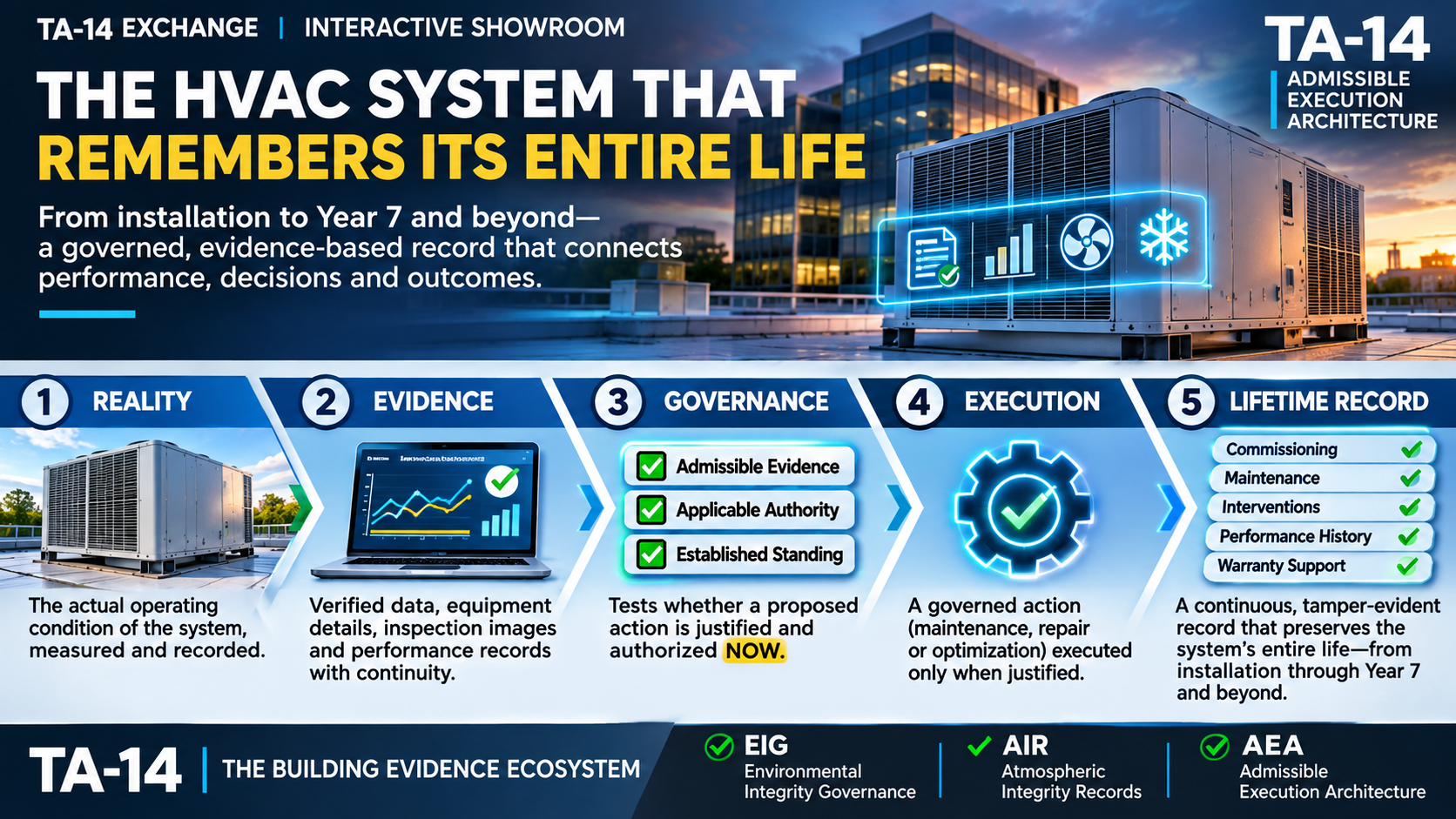
The HVAC System That Remembers Its Entire Life
Commissioning becomes the first attributable operating reference.
Ecosystem architecture reference
The wider lifetime equipment evidence architecture, from measurement through governed service and outcome.
▶ SAMANTHA — EXPLAIN · LESSON 01
Samantha is selected when available on the device; another English voice is used otherwise. Audio is optional. The complete explanation is always open below.
FULL NARRATION TRANSCRIPT
An HVAC system should not lose its operating history whenever a technician leaves. TA-14 proposes a lifecycle evidence record that starts with commissioning and follows the equipment through inspections, maintenance, interventions and verified outcomes. A cryptographic seal can help reveal changes after recording, but does not alone prove that a reading was accurate. Establish source, context, calibration, installation quality and verified manufacturer specifications before treating a claim as proven.
LESSON 02 / 08
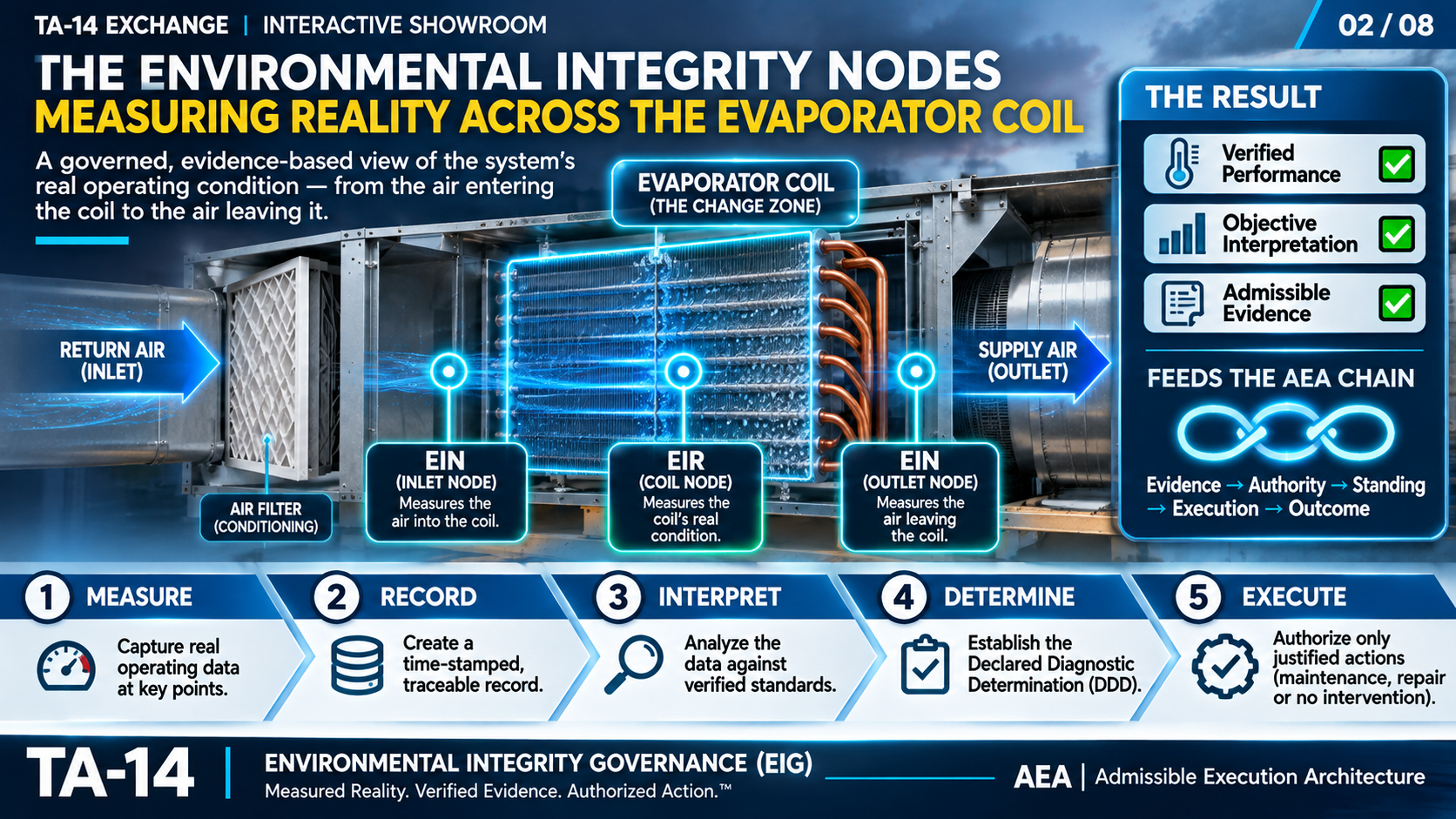
The Environmental Integrity Nodes
Measure physical conditions; preserve measurements apart from interpretations.
▶ SAMANTHA — EXPLAIN · LESSON 02
Samantha is selected when available on the device; another English voice is used otherwise. Audio is optional. The complete explanation is always open below.
FULL NARRATION TRANSCRIPT
Environmental Integrity Nodes capture return-air and supply-air conditions around the evaporator. Available measurements include airflow, static pressure, dry bulb, wet bulb or humidity, electrical data and other relevant environmental observations. The Environmental Integrity Recorder preserves timestamps, uncertainty, source and continuity as Atmospheric Integrity Records. Comparing airflow and air-side enthalpy can inform capacity analysis, but a calculation or inferred fault must not overwrite the original observation.
LESSON 03 / 08
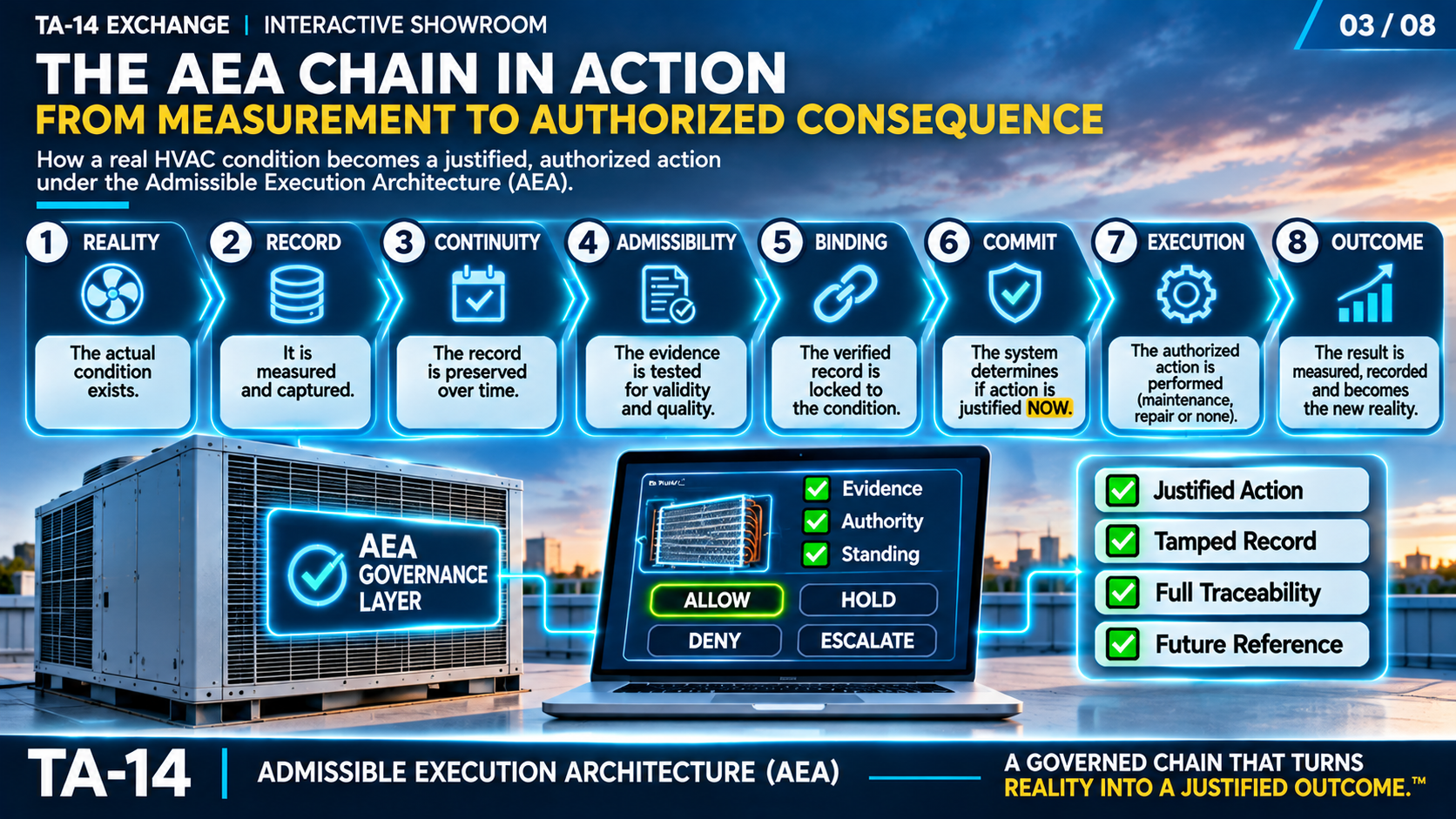
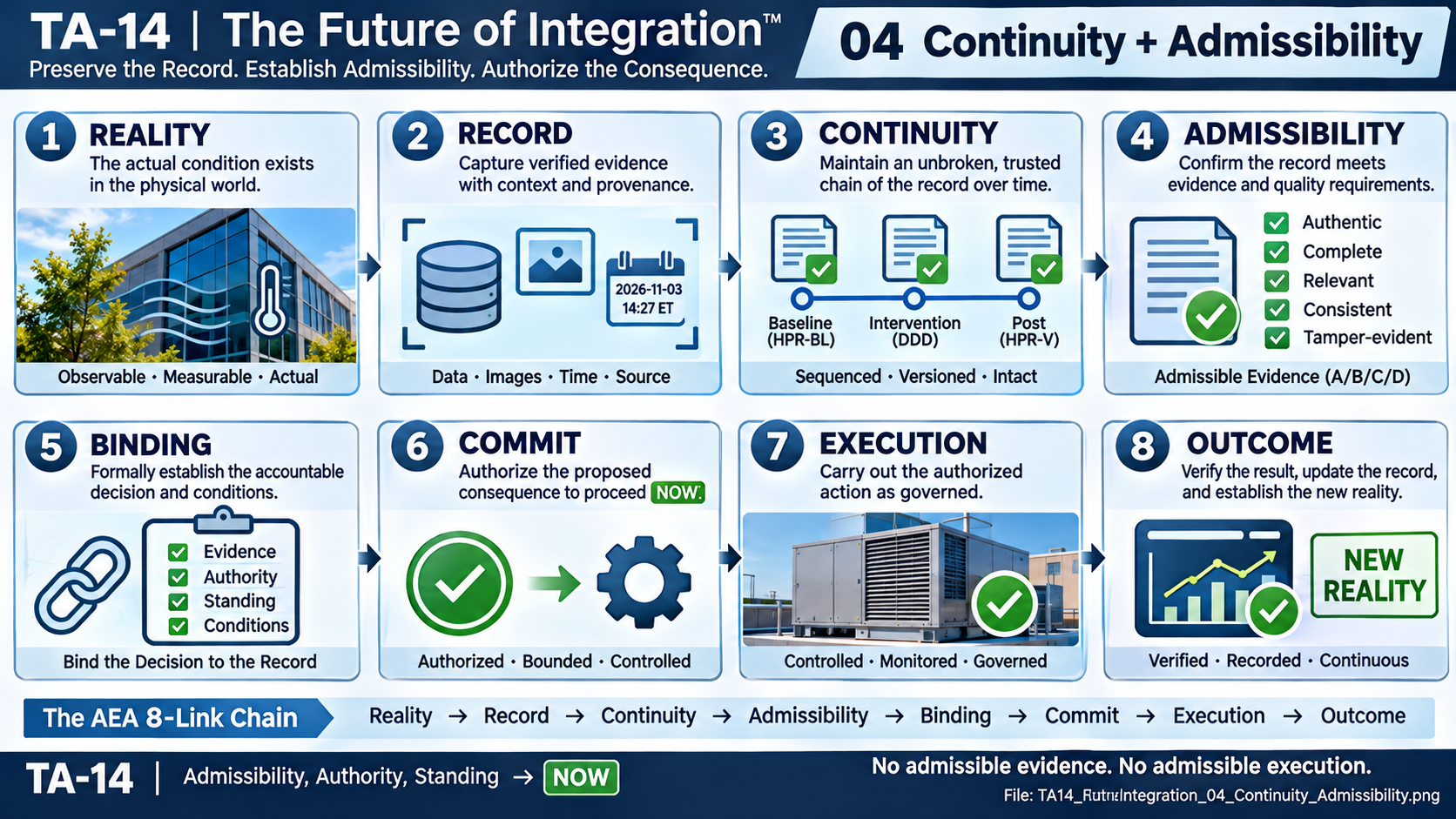
The AEA Chain in Action
Admissible Execution Architecture is foundational, not an optional downstream wrapper.
The eight-link chain reference
The AEA sequence, shown in a second teaching visual for independent examination.
▶ SAMANTHA — EXPLAIN · LESSON 03
Samantha is selected when available on the device; another English voice is used otherwise. Audio is optional. The complete explanation is always open below.
FULL NARRATION TRANSCRIPT
Reality, Record, Continuity, Admissibility, Binding, Commit, Execution and Outcome form the Admissible Execution Architecture chain. Admissible Computation Architecture preserves assumptions, transformation lineage and model constraints. A controller or HVAC Analyzer can propose an intervention, but it cannot grant itself permission. AEA tests Admissible Evidence, Applicable Authority and Established Standing, and revalidates at the commitment boundary now. The resulting outcome enters the next record of reality.
LESSON 04 / 08
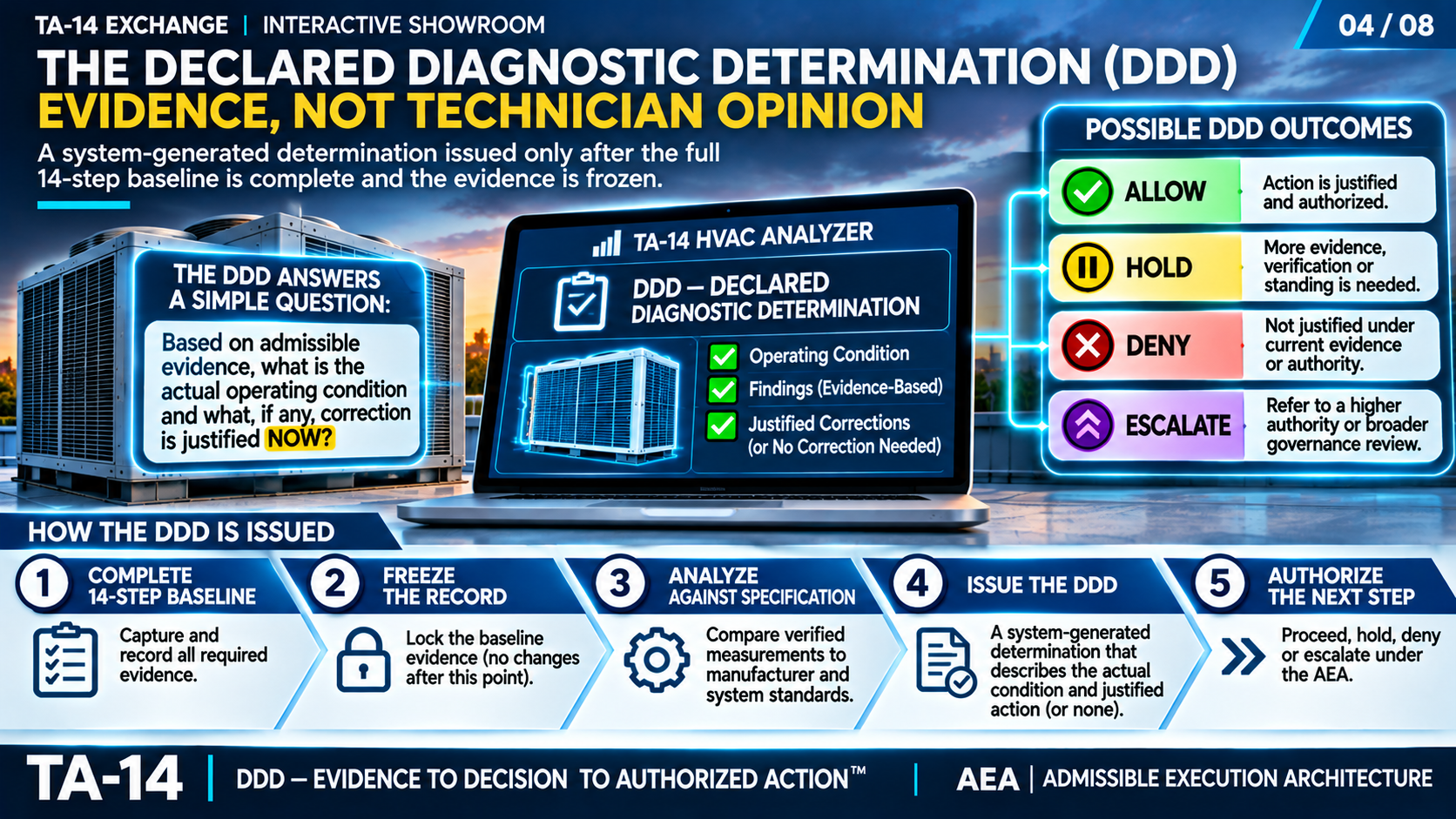
The Declared Diagnostic Determination
A system-issued DDD requires a completed, frozen 14-step baseline.
▶ SAMANTHA — EXPLAIN · LESSON 04
Samantha is selected when available on the device; another English voice is used otherwise. Audio is optional. The complete explanation is always open below.
FULL NARRATION TRANSCRIPT
The technician gathers evidence, places probes, inspects equipment and explains findings, but does not author or change the formal Declared Diagnostic Determination. The HVAC Analyzer uses verified model and serial identification, applicable manufacturer specifications, measured operation and required physical inspections. After the fourteen-step baseline is completed and frozen, it determines what the admissible evidence establishes, including uncertainty and whether no correction is needed. Diagnostic interpretation must remain separate from later optimization proposals.
LESSON 05 / 08
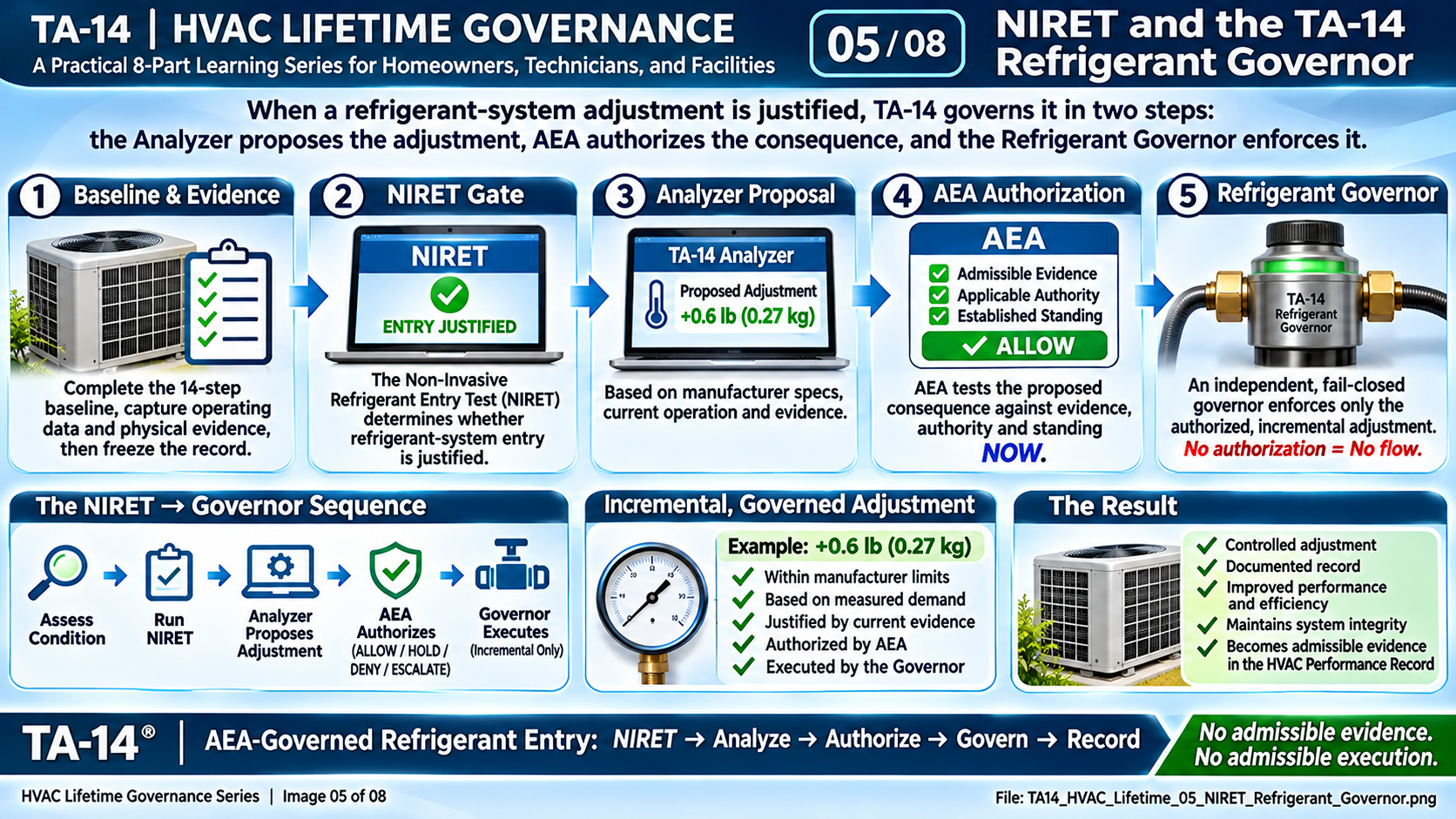
NIRET and the Refrigerant Governor
The Analyzer proposes, AEA authorizes, and the Governor enforces only the approved boundary.
▶ SAMANTHA — EXPLAIN · LESSON 05
Samantha is selected when available on the device; another English voice is used otherwise. Audio is optional. The complete explanation is always open below.
FULL NARRATION TRANSCRIPT
NIRET, the Non-Invasive Refrigerant Entry Threshold, examines whether refrigerant-system entry is justified rather than assuming poor performance means incorrect charge. Airflow, coil condition, electrical faults, metering-device configuration and other explanations must be considered. The proposed HVAC Analyzer computes bounded adjustments; Admissible Execution Architecture authorizes or refuses them. The independent fail-closed Refrigerant Governor enforces only the current authorization. Automated refrigerant charging remains a proposed physical capability requiring validation and applicable compliance, not an established replacement for manufacturer charging procedures.
LESSON 06 / 08
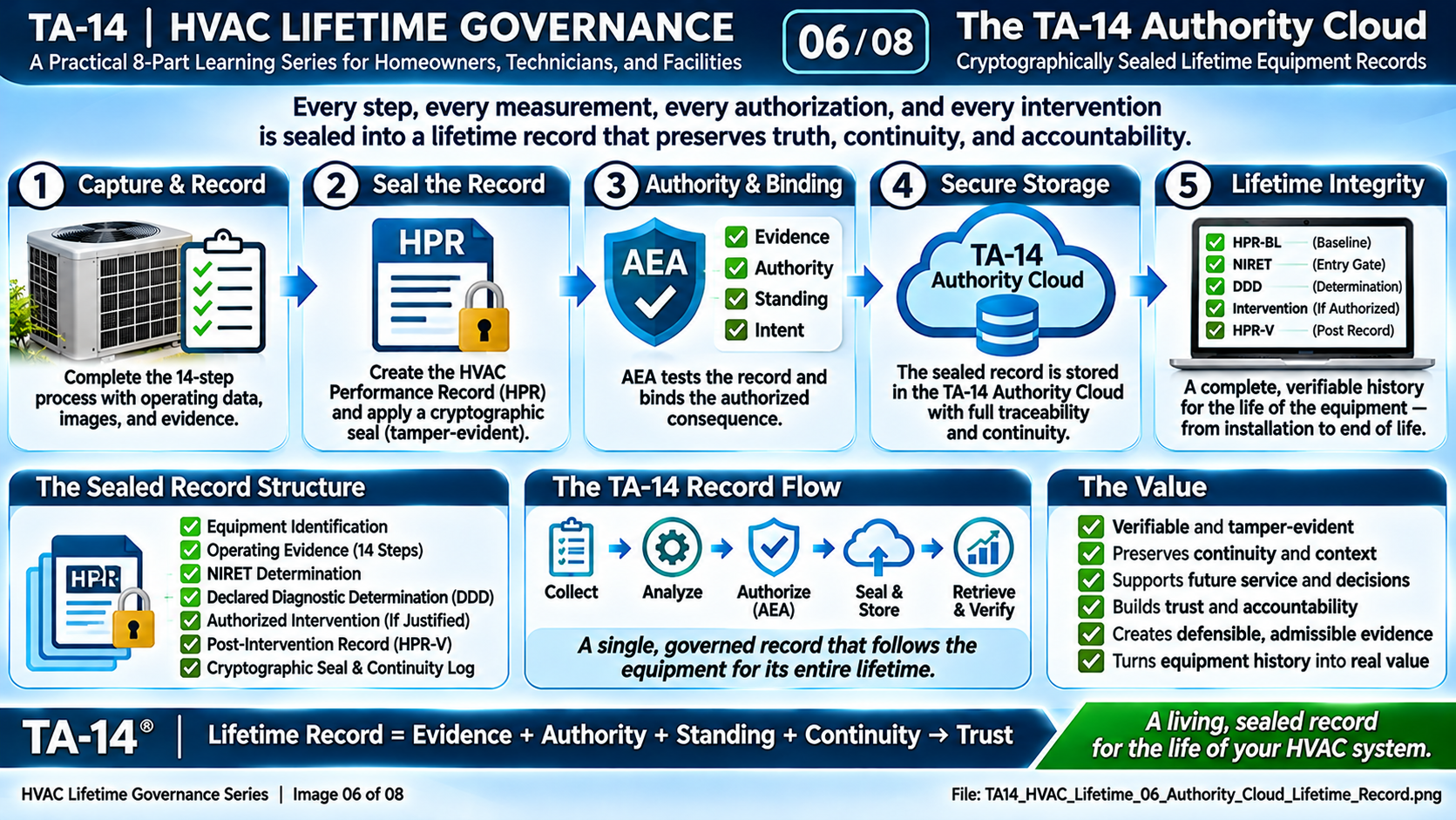
The TA-14 Authority Cloud
The original baseline remains intact as new annual records are added.
▶ SAMANTHA — EXPLAIN · LESSON 06
Samantha is selected when available on the device; another English voice is used otherwise. Audio is optional. The complete explanation is always open below.
FULL NARRATION TRANSCRIPT
The proposed TA-14 Authority Cloud would preserve equipment-specific commissioning, inspection, diagnostic, intervention and post-intervention records. Each event carries provenance, timestamp, integrity evidence and access controls. Homeowners could see their equipment history, contractors could access records needed for authorized service, and manufacturers or warranty administrators could receive permissioned or de-identified information appropriate to their purpose. Cryptographic integrity protects the recorded bytes after sealing; it does not independently validate sensor placement or diagnostic conclusions.
LESSON 07 / 08
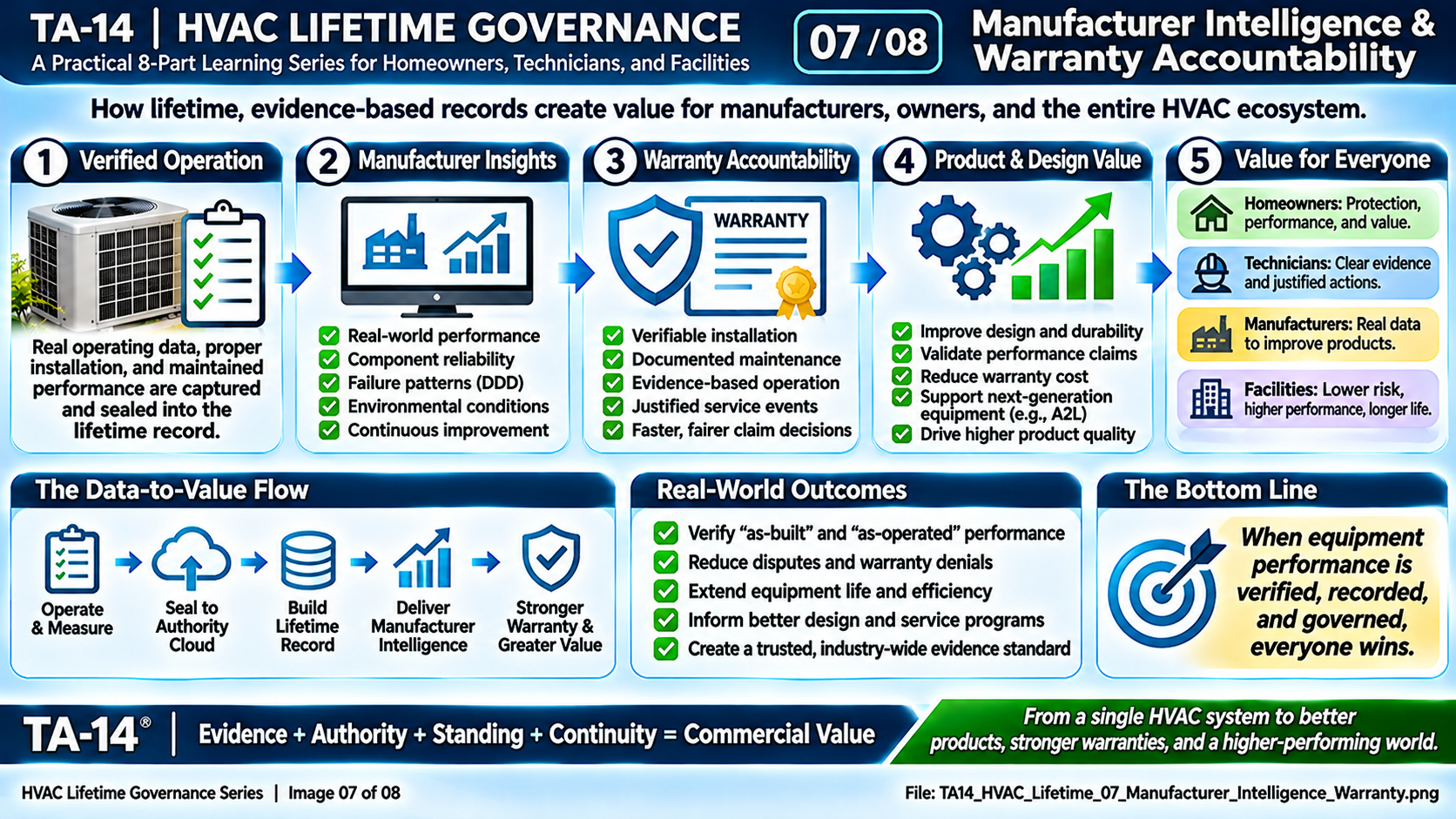
Manufacturer Intelligence and Warranty Accountability
A verified operating history can improve reliability investigation without predetermining warranty outcomes.
▶ SAMANTHA — EXPLAIN · LESSON 07
Samantha is selected when available on the device; another English voice is used otherwise. Audio is optional. The complete explanation is always open below.
FULL NARRATION TRANSCRIPT
With appropriate permissions, manufacturers could examine year-by-year performance patterns across equipment models, climates and installation conditions. Warranty reviewers could evaluate documented commissioning, maintenance and pre-existing conditions against later failures. These records can help explain what was known and when; they do not automatically establish causation, homeowner responsibility or claim denial. Warranty decisions remain subject to actual contracts and consumer law. The commercial opportunity is better evidence, fairer claims, more informed engineering and reduced uncertainty.
LESSON 08 / 08
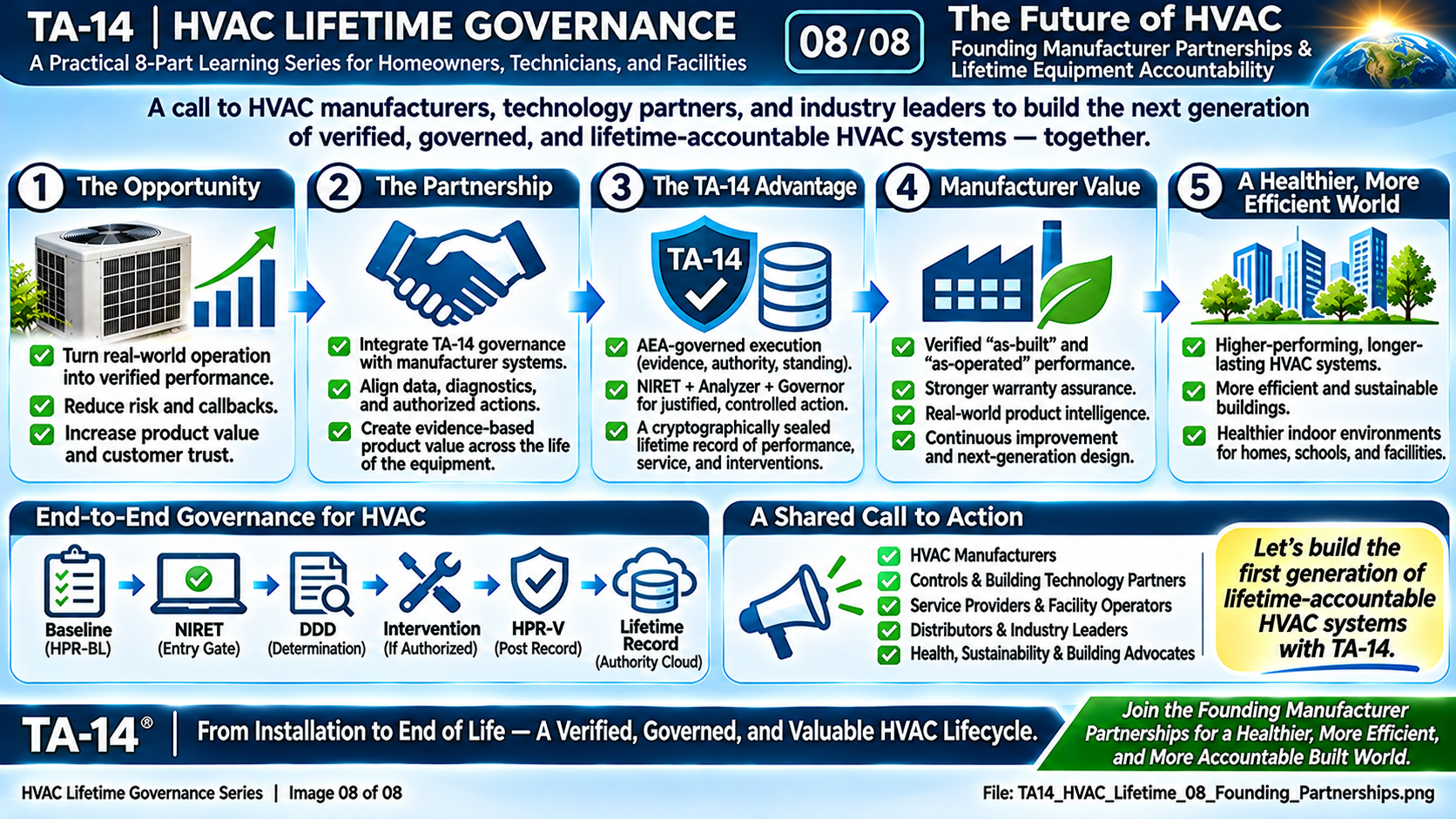
The Future of HVAC: Founding Evaluation Partners
Move from architectural demonstration to a bounded, independently reviewed pilot.
▶ SAMANTHA — EXPLAIN · LESSON 08
Samantha is selected when available on the device; another English voice is used otherwise. Audio is optional. The complete explanation is always open below.
FULL NARRATION TRANSCRIPT
TA-14 invites manufacturers, warranty organizations and qualified service partners to evaluate lifetime evidence records through a defined pilot. Agree on sensor validation, commissioning requirements, baseline integrity, consent, privacy, diagnostic reproducibility, intervention safety, claim review procedures and independent acceptance criteria. Distinguish implemented software, proposed hardware and cloud integrations, and actual independently demonstrated performance. No institutional endorsement, certification, warranty approval or proven cost savings is implied by this educational showroom.
THE LIFETIME EQUIPMENT RECORD
One machine. Many evidence events. No overwritten history.
INSTALLATION
Commissioning baseline
Installed configuration, manufacturer match, original operating measurements and attributable inspection evidence.
YEAR 01
Annual operating record
Frozen measurements, observed changes, required maintenance and a current evidence-based determination.
YEAR 03
Component change
Original part identity, replacement justification, authorized repair, and independently verifiable post-record.
YEAR 07
Warranty investigation
Reconstruct historical conditions, compare actual policy terms, and examine the evidence without automatically assigning fault.
Illustrative chronology. The design proposes permissioned, auditable records for homeowners, contractors, manufacturers and warranty administrators; it does not imply a deployed cloud service or automatic warranty entitlement.
INSTITUTIONAL EVALUATION INVITATION
Manufacturer and warranty evaluation
A proposed paid evaluation would test how equipment-specific evidence can improve engineering decisions, field service, product reliability and fair warranty review—not ask an institution to accept an unvalidated claim.
PHASE 01
Define and verify
Agree on equipment models, authentic specs, sensor calibration, privacy and ownership, commissioning criteria, scope and independent review.
PHASE 02
Collect and challenge
Run bounded commissioning and maintenance cases; test gaps, changes in context, incorrect parts, intervention refusal and record integrity.
PHASE 03
Report measured value
Evaluate reproducibility, diagnostic agreement, record completeness, technician time, fault attribution limitations and warranty-review usability.
What an evaluation partner receives
Architecture mapping
An equipment-specific map of evidence acquisition, ACA computation, DDD issuance, AEA authorization and outcome custody.
Documented demonstration
A bounded set of commissioning and service scenarios, with source-to-conclusion traceability and explicit unsupported conditions.
Pilot evaluation report
Defined results, limitations, open risks, repeatability checks and potential next steps—not an automatically favorable determination.
Evaluation scope, data access, cost, deliverables and technical acceptance criteria are agreed in writing. Success is not assumed. Warranty eligibility remains subject to the actual contract and applicable consumer law.
Apply the governance principles to three hypothetical cases relevant to HVAC intervention. Choose a determination, then examine the reasoning. These cases teach the distinction between Admissible Evidence, Applicable Authority, and Established Standing; they do not issue real-world authorization.
CASE 01
Incomplete fourteen-step baseline
A technician proposes refrigerant adjustment before the required HVAC baseline is complete and frozen, and before the system-issued DDD. What is supported?
CASE 02
Unauthorized refrigerant entry
A refrigerant intervention is proposed despite a failed non-invasive entry threshold and no authorization from the independent Refrigerant Governor. What is supported?
CASE 03
Unresolved safety condition
The analyzer flags a condition that requires an appropriately authorized specialist before intervention. What is supported?
Independent educational examples only. The questions are hypothetical and do not assess a real institution, building, person, or operating system. Actual governance determinations require case-specific evidence, applicable authority, established standing, and bounded review.