2017–2021
Communications + convening
As ALN Communications Director, Michael helped turn asset-management practice into public conversations, papers, webinars and repeatable examples.
MICHAEL BORDENARO · ASSET LEADERSHIP NETWORK · EXECUTIVE DIRECTOR
Michael Bordenaro's work sits at the meeting point of asset leadership, organizational learning, standards, technology and people — helping useful practices travel farther than the room where they first worked.
THE THROUGH-LINE
Across years of Asset Leadership Network programs, papers, labs and public conversations, a recurring pattern is visible: connect people who know different parts of the problem, make the practice understandable, and help organizations apply what others have already learned.
THE STORY
As ALN Communications Director, Michael helped turn asset-management practice into public conversations, papers, webinars and repeatable examples.
ALN's ISO 55000 work framed asset management as a management-system discipline connecting assets to organizational performance.
Michael's message to participants was simple: interact, share asset-management successes, and make those successes repeatable.
Public records identify Michael as a leader in the DC Asset Management Lab, connecting government problems with structured asset-management and visualization practices.
Michael became Executive Director of the Asset Leadership Network, continuing its mission to help organizations take a strategic, structured approach to asset management.
Michael was a principal author of the IAM × ALN Asset Management Leadership white paper on leadership at every level of an organization.
At NIBS Building Innovation 2024, Michael co-organized the Brains & Bytes workshop and interviewed practitioners working at the intersection of AI and the built environment.
Michael's ALN work is now helping convene a live collaboration across owner need, semantic building context, asset-data readiness and consequence governance.
ASSET LEADERSHIP NETWORK · VISUAL GUIDE
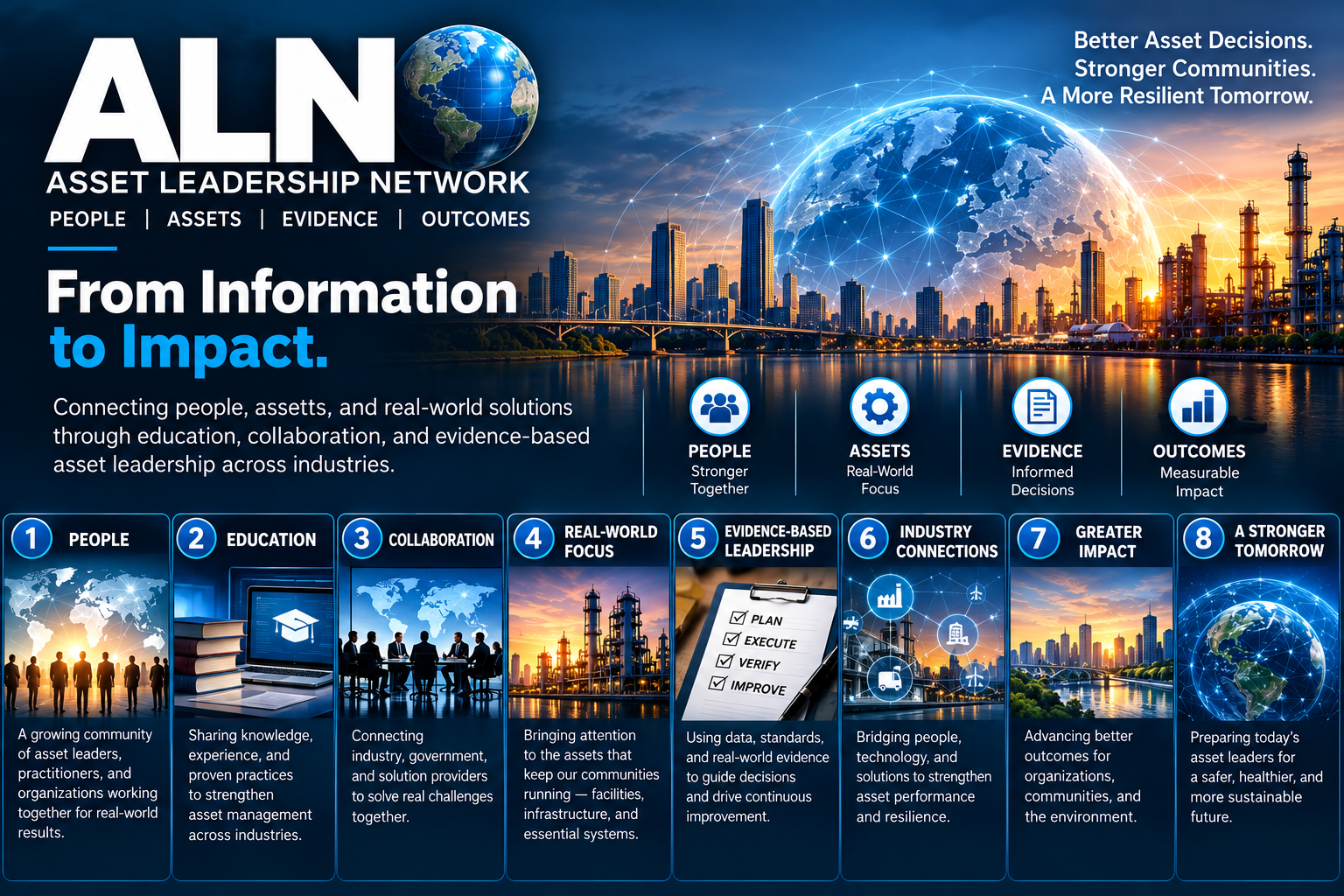
A visual guide to the Asset Leadership Network through people, education, collaboration, real-world focus, evidence-based leadership, industry connections, greater impact and a stronger tomorrow.
THE PRACTICE
The ALN mission is strategic and structured asset management: connect organizational objectives, leadership, information, risk, technology and physical assets so decisions can support mission success.
Bring owners, practitioners, standards people and technologists into the same working conversation.
Use asset-management systems to connect organizational purpose with assets, information, risk and decisions.
Make useful practices visible so another organization does not have to start from zero.
A success becomes more valuable when its method can be understood and repeated.
Bridge leadership, facilities, infrastructure, BIM, digital twins, real-time data and emerging technology.
Push promising ideas beyond the sandbox and toward real owner problems, real assets and inspectable outcomes.
THE CURRENT COLLABORATION
In the current owner-to-consequence collaboration, Michael and the Asset Leadership Network occupy the owner / asset-leadership side of a deliberately distributed chain. Each participant keeps responsibility for a different boundary.
This collaboration does not merge the participating organizations or imply endorsement, certification, transferred authority, or ownership of another participant's architecture. The value is in making the handoffs inspectable.
PUBLIC WORK SURFACE
Public profile showroom assembled from Asset Leadership Network materials, institutional records and Michael Bordenaro's public professional record. It presents independent work and is open for correction.
TA-14 ACADEMY · INDEPENDENT REVIEW CHALLENGE
Apply the governance principles to three hypothetical cases relevant to the proposed operational consequence. Choose a determination, then examine the reasoning. These cases teach the distinction between Admissible Evidence, Applicable Authority, and Established Standing; they do not issue real-world authorization.
CASE 01
A proposed consequence is supported by an observation, but the source attribution or record continuity is missing. What should happen before execution? Consider this in the context of the proposed operational consequence.
CASE 02
The record is current and reliable, but the proposed consequence falls outside the scope of applicable authority. What is the supported determination?
CASE 03
The proposed consequence triggers a documented requirement for review by another designated authority. What is the appropriate route?
Independent educational examples only. The questions are hypothetical and do not assess a real institution, building, person, or operating system. Actual governance determinations require case-specific evidence, applicable authority, established standing, and bounded review.