TA14 AUTHORITY GOVERNANCE INSTITUTION · SOURCE-LINKED SESSION RECORD · OCTOBER 16, 2026
The Graph Can Know. Who Authorizes the Action?
ONUMA's Semantic Bridge graph-of-graphs meets the TA14 execution boundary. An October 16 session reference connecting interoperable building knowledge with accountable physical consequence.
ORIGINAL SESSION LINKEDRECOGNITION REPORTEDTECHNICAL INTERPRETATION · NOT ENDORSEMENT
01 · PRIMARY SOURCE
ONUMA: Back from Tokyo
October 16, 2026 · Kimon Onuma, FAIA · buildingSMART, IFCx, semantic buildings, and connected operational intelligence.
Kimon publicly told Greggory Don Butler on LinkedIn: “Thanks for the entry you made today! I highlighted it in the session, recording here.” The external recording—not this interpretation—is the controlling source for the session's content.
According to Greggory Don Butler's account of the Asset Leadership Network discussion, Kimon navigated the Semantic Bridge graph-of-graphs, searched for Butler and TA14, and described their work and progress. Butler reports that Michael Bordenaro then praised his work; his reading of the 49:48–50:35 segment appears below.
PARTICIPANT-TRANSCRIBED RECORD · 49:48–50:35
In Butler's reading of the session, Michael Bordenaro says: “Gregory is doing amazing things.” Kimon Onuma identifies TA14 in the Semantic Bridge graph and describes Butler's same-morning contribution on authority, governance, and the owner's perspective. Onuma connects that entry to the overheating-floor building example and asks whether the proposed action can be trusted. He also mentions Butler's involvement in a presentation Butler heard as “Bopping Your BIM.”
Butler supplied this reading from the recording. It has not been independently transcribed; exact phrasing, speaker attribution, and the presentation title remain subject to audio verification. This does not establish ONUMA or ALN endorsement or adoption.
Kimon's public LinkedIn response confirms that he highlighted Butler's contribution during the session.
PARTICIPANT ACCOUNT
Butler identifies 49:48–50:35 as the relevant recording segment and has supplied his reading of it. The timestamp is now documented; the precise dialogue still awaits independent audio verification.
No formal endorsement, institutional partnership, independent technical validation, or adoption is asserted. The time-linked source is provided above. This record can be further updated with an independently checked transcript and precise quotation.
GREENBUILD AI SUMMIT · OCTOBER 20, 2026 · PRESENTATION COMPANION
From the graph demonstration to Become the Building
The October 16 ONUMA session provides context for the subsequent Become the Building exercise at Greenbuild. Its PAE Living Building reference invites contributions from people, assets, sensors, and AI agents, revealing the difference between a participant's claim, an AI interpretation, human judgment, and authority to execute. TA14's illustrated Greenbuild companion is an independent conceptual interpretation, not a deployed integration or ONUMA endorsement.
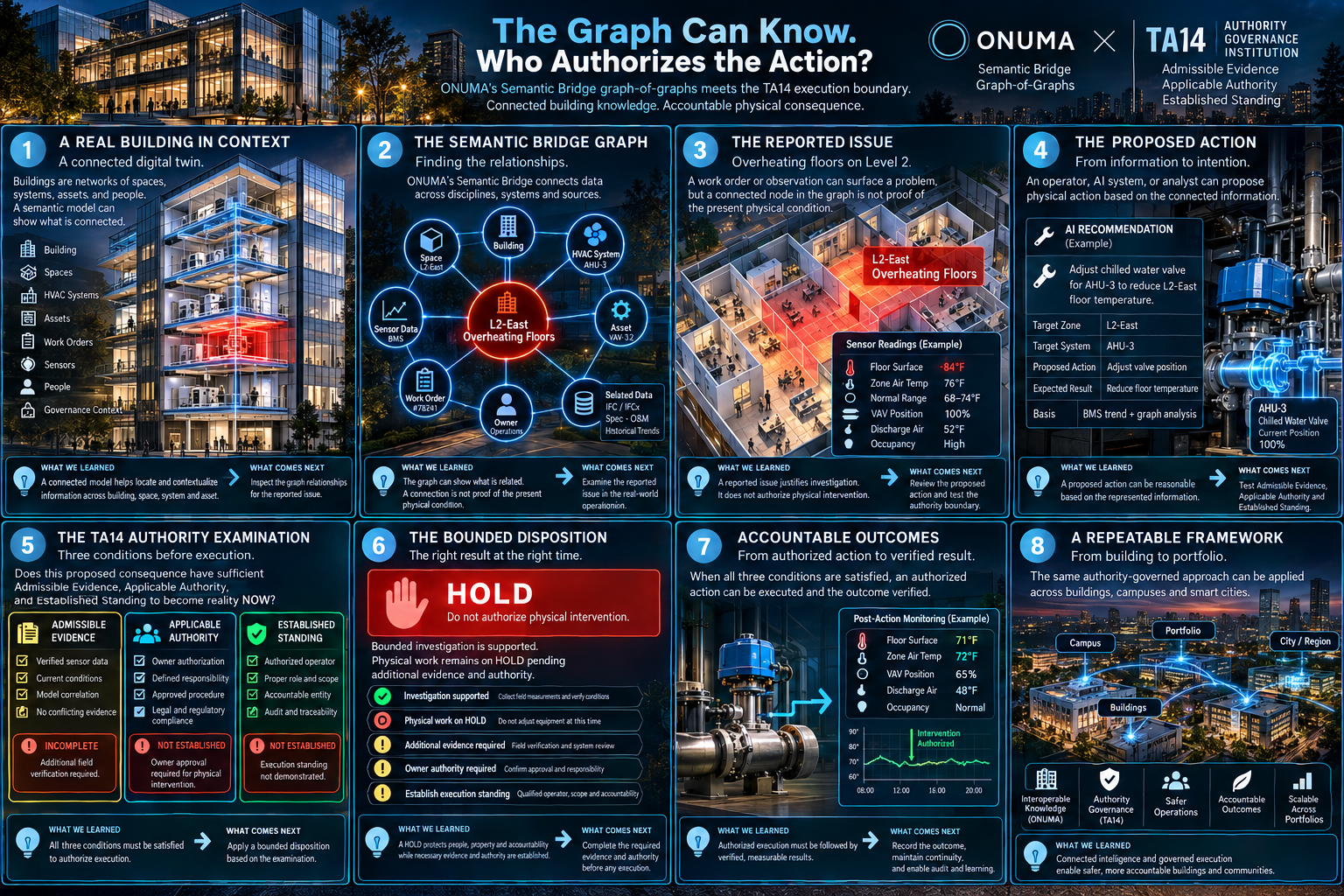
Explore the graph-to-consequence journey. All graphics are original conceptual artwork, not ONUMA screenshots, project evidence, real sensor readings, verified system associations, or an implemented ONUMA–TA14 integration. Details embedded inside the illustrations are hypothetical and may be visually simplified.
Lesson 1 of 8 · Conceptual graphic. All numerical readings and depicted operations are illustrative and not operational data.
SAMANTHA TEACHING SCRIPT · TEXT REFERENCE
What does a digital building model actually establish?
The model can describe spaces, equipment, relationships, and reported operational signals. This is represented knowledge. Physical conditions, identity, and record continuity still need their own evidence.
Teaching checkpoint: Locate the building and affected space before drawing a conclusion.
Narration text is provided for editorial review; no audio narration is claimed or activated here.
INTERACTIVE TEACHING MISSION · ORIGINAL TA14 SIMULATION
Follow the overheating-floor decision
Explore a hypothetical building case inspired by the session's discussion. These original illustrations and outcomes are educational, not footage or evidence of an ONUMA–TA14 integration.
ILLUSTRATIVE DIGITAL BUILDINGREPRESENTED
01 · CONNECTED BUILDING
The building is represented
A semantic model connects spaces, floors, sensors, equipment, and work orders. That relationship provides context—not proof of current field conditions.
The graph can identify the floor and associated systems, but an asset link does not establish the actual fault.
Try the authority examination
Select which conditions have actually been established for a proposed physical adjustment. The simulation cannot issue a real ALLOW disposition: the toggles are declarations, not admissible records.
03 · VISUAL FIELD GUIDE · ORIGINAL TA14 ILLUSTRATIONS
See the connection, then examine the boundary
These diagrams are original explanatory graphics, not ONUMA screenshots, verified session frames, or representations of an implemented ONUMA–TA14 integration. The source links below let readers inspect ONUMA's work directly.
A · SEMANTIC RELATIONSHIPS
Relationships help locate and contextualize information. A connected node is not proof of the present physical condition.
04 · CONCEPTUAL ARCHITECTURE · NOT A DEPLOYMENT DIAGRAM
From connected knowledge to governed consequence
The following is a TA14 teaching interpretation of complementary functions. It does not claim that ONUMA implemented, approved, or adopted this architecture.
01 / INTELLIGENCE
Represented knowledge
IFC · IFCx · BIM · semantic relationships
02 / INTELLIGENCE
Operational context
Assets · work orders · observations · graph connections
03 / INTELLIGENCE
Proposed consequence
AI recommendation · operator request · physical action
04 / AUTHORITY CHECK
TA14 authority boundary
Admissible Evidence · Applicable Authority · Established Standing
05 / CONSEQUENCE
Bounded disposition
ALLOW · HOLD · DENY · ESCALATE
06 / CONSEQUENCE
Accountable outcome
Local commit · authorized execution · verified result
Represented is not observed. Inferred is not authorized. Capability is not authority.
05 · EXAMINE THE BOUNDARY
The RE1 work-order example
The existing ONUMA × TA14 RE1 examination illustrates the difference between finding a represented operational relationship and establishing sufficient evidence and authority for physical electrical intervention. Bounded investigation is supported; unsupported physical work remains on HOLD.
Does this proposed consequence have sufficient Admissible Evidence, Applicable Authority, and Established Standing to become reality NOW?
Apply the governance principles to three hypothetical cases relevant to the proposed operational consequence. Choose a determination, then examine the reasoning. These cases teach the distinction between Admissible Evidence, Applicable Authority, and Established Standing; they do not issue real-world authorization.
CASE 01
Evidence is not yet admissible
A proposed consequence is supported by an observation, but the source attribution or record continuity is missing. What should happen before execution? Consider this in the context of the proposed operational consequence.
CASE 02
The actor exceeds authority
The record is current and reliable, but the proposed consequence falls outside the scope of applicable authority. What is the supported determination?
CASE 03
A higher authority is required
The proposed consequence triggers a documented requirement for review by another designated authority. What is the appropriate route?
Independent educational examples only. The questions are hypothetical and do not assess a real institution, building, person, or operating system. Actual governance determinations require case-specific evidence, applicable authority, established standing, and bounded review.