Public money is a consequence. Explore the proposed TA14 decision boundary between an invoice, a lawful release and a verifiable public outcome.
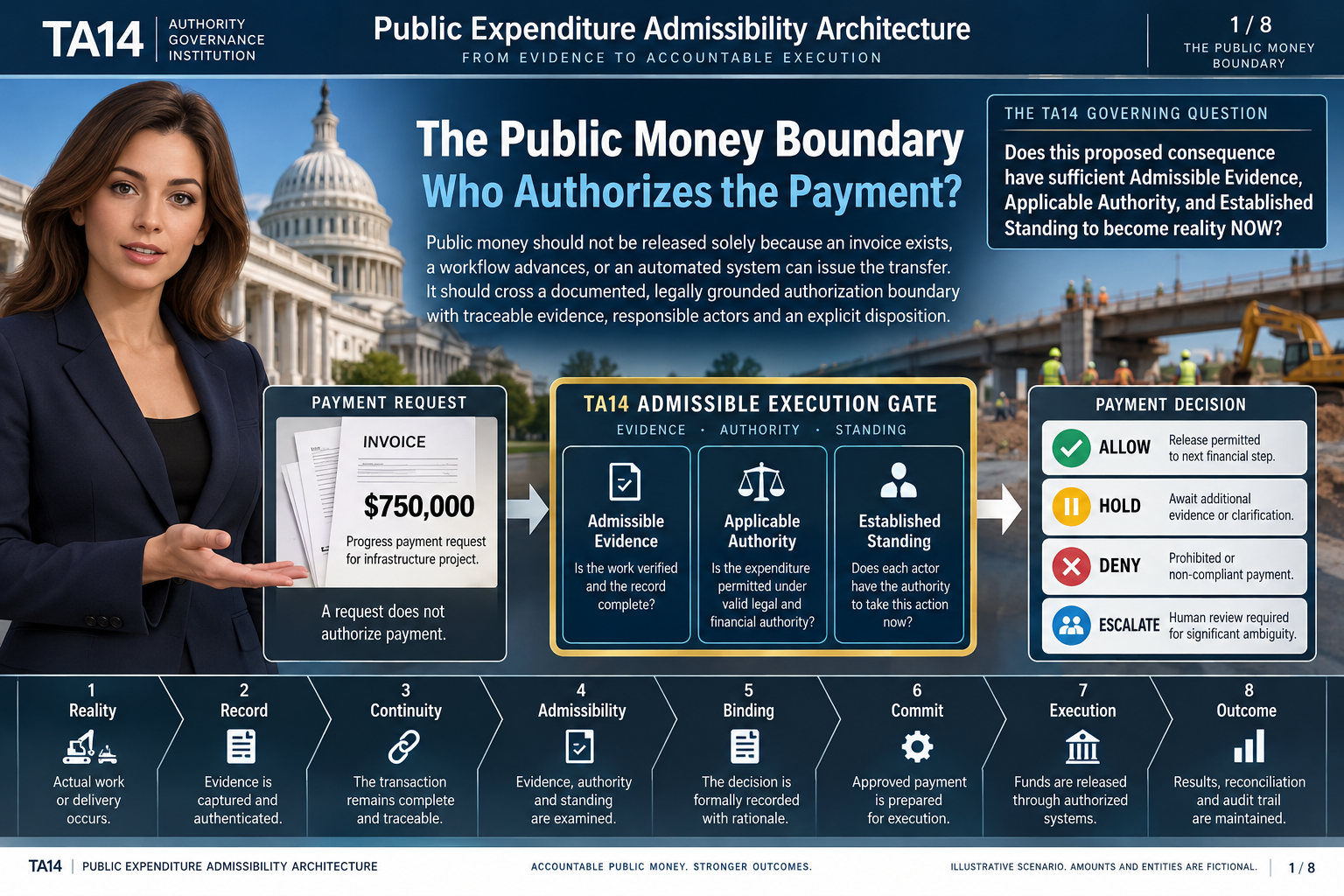
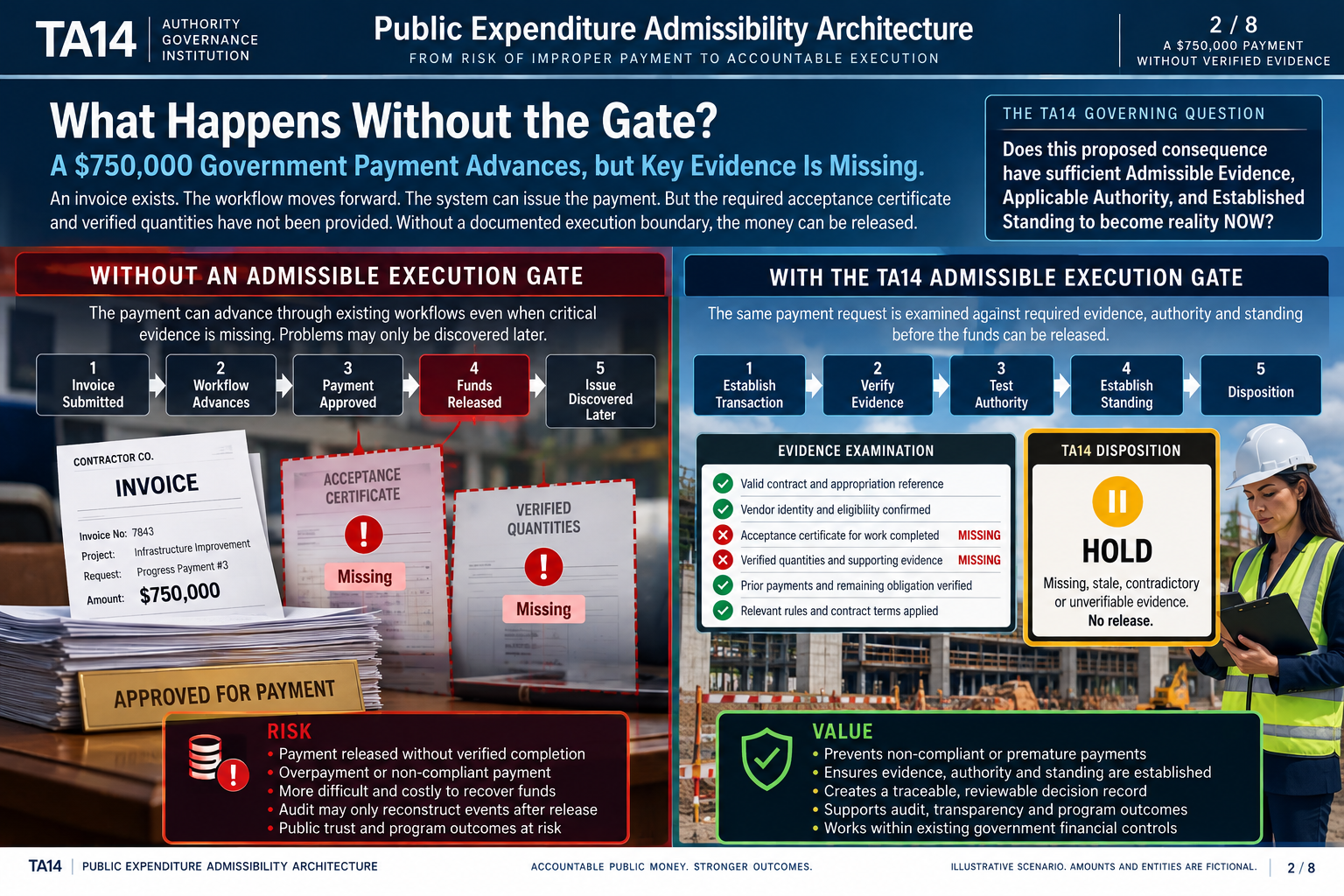
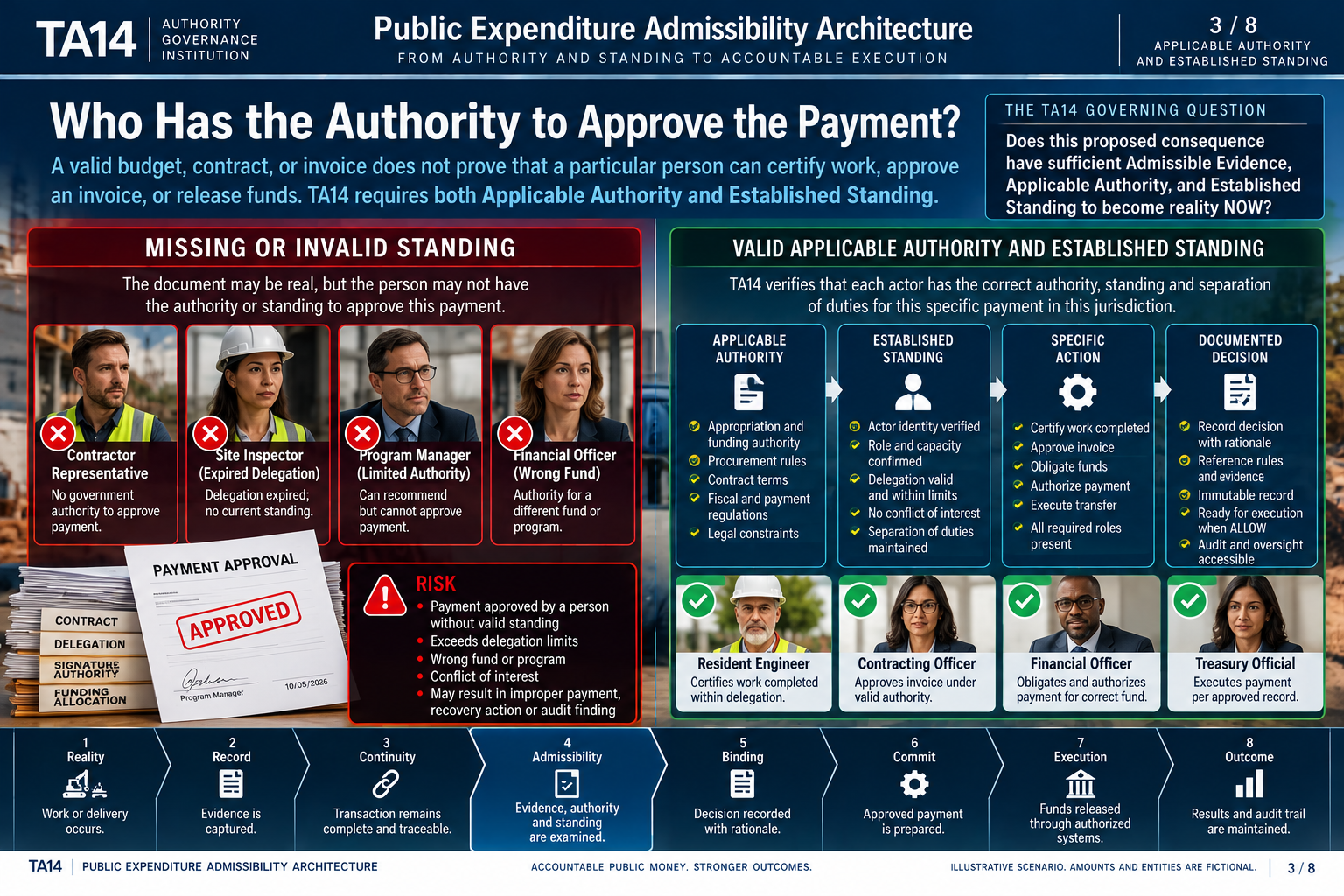
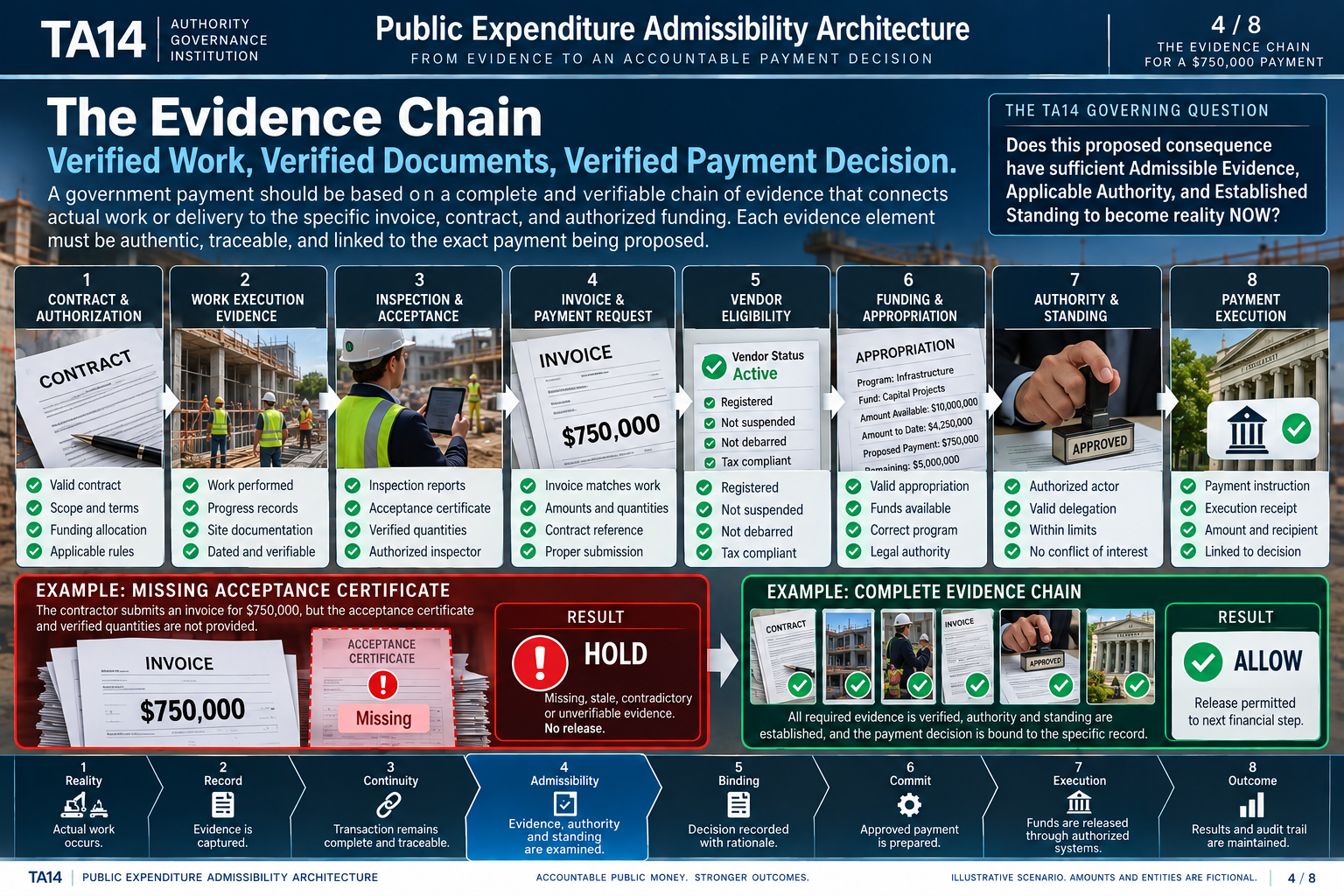
Does this proposed consequence have sufficient Admissible Evidence, Applicable Authority, and Established Standing to become reality NOW?
Educational concept only. All amounts, people, documents and illustrated outcomes are fictional. No government deployment, certification, legal opinion, fraud reduction or validated savings are claimed. Existing agency controls and lawful payment authorities remain in control.
All eight lessons appear below. Scroll freely; no next button is required.
1 / 8 · The Public Money Boundary
Samantha's lesson transcript
A proposed seven hundred and fifty thousand dollar construction payment is a real-world consequence, not merely a document moving through software. The invoice tells us what a contractor requests. It does not itself establish completion, entitlement, lawful funding, or who can approve release. TA14 asks the governing question: does this proposed consequence have sufficient Admissible Evidence, Applicable Authority, and Established Standing to become reality NOW? Existing public financial controls remain legally controlling. This concept places a reviewable decision boundary beside them and preserves the exact transaction, reviewer, sources and rationale. Our example is fictional and demonstrates a proposed approach, not a deployed government system.
2 / 8 · The Missing Evidence
Samantha's lesson transcript
At this point the contractor has submitted an invoice for seven hundred and fifty thousand dollars, but an acceptance certificate and independently verified quantities are absent. A conventional workflow might already identify that gap; TA14 is not assuming otherwise. The important teaching moment is that no valid decision can be inferred from the presence of an invoice alone. The proposed gate issues HOLD for this defined request, records each missing item, identifies its accountable source, and prevents the teaching scenario from treating the payment as ready. HOLD is not an allegation of fraud and not a permanent rejection. It is a request for material evidence that can be examined before a lawful payment decision.
3 / 8 · Authority Is Not Standing
Samantha's lesson transcript
Even where funds were appropriated and a contract exists, those facts do not establish that a particular official has standing to certify work or release money. Applicable Authority concerns the jurisdiction-specific law, funding purpose, fiscal limits, procurement rules and contract. Established Standing concerns the actor, capacity, standing basis and authority relationship. An inspector with an expired delegation may have technical knowledge but no present authority to make a particular certification. A contracting officer and treasury official may have different powers. The proposed record checks role boundaries, delegation dates, amount ceilings and separation of duties, using the agency's real rules rather than invented universal permissions.
4 / 8 · The Evidence Chain
Samantha's lesson transcript
The fourth lesson joins physical performance to the financial request. Did the work actually occur? Is there a dated inspection? Are quantities verified? Does the invoice match the authorized contract, draw schedule and remaining balance? Is the vendor eligible? Do funding and required signatures remain valid? Each item needs an identified source, timing and provenance. Missing or inconsistent acceptance evidence calls for HOLD in this fictional case. If the acceptance record later arrives, it must be authenticated and matched to this particular draw; a green checkmark on a screen is not proof by itself. Preserve raw records and any later adjustments separately so that an independent reviewer can reconstruct the reasoning.
5 / 8 · The Decision Boundary
Samantha's lesson transcript
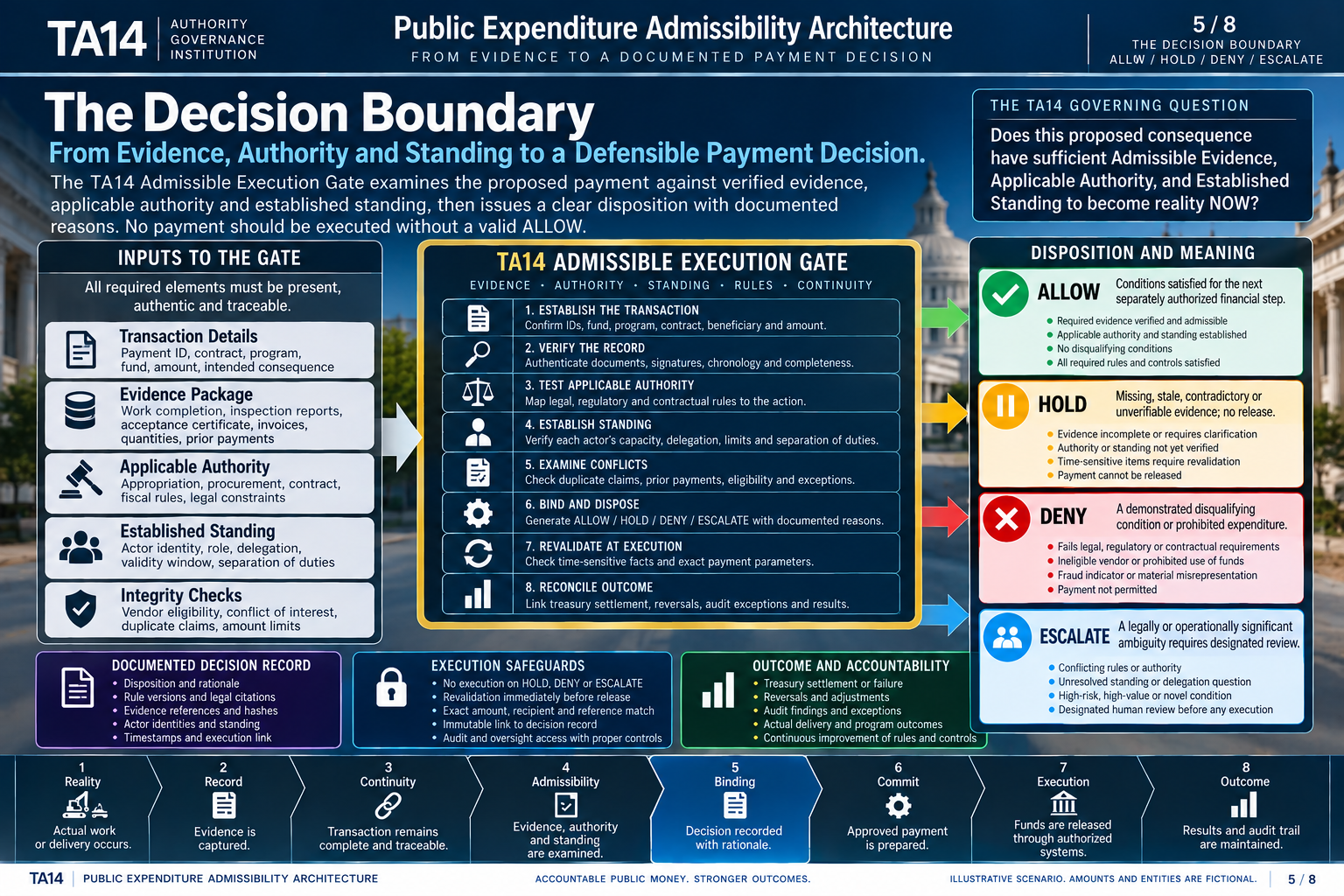
The TA14 reference disposition set is ALLOW, HOLD, DENY and ESCALATE. ALLOW indicates that the simplified requirements for the next separately authorized financial step have been established; it is not itself a treasury payment order. HOLD means a material fact is missing, stale or contradictory. DENY requires a substantiated disqualifying rule or prohibited expenditure, not mere uncertainty. ESCALATE sends a legally or operationally significant ambiguity to a designated lawful reviewer. Each outcome should preserve the exact amount, beneficiary, authority source, evidence manifest, reviewer, rule version and time. That makes an accountable no just as inspectable as an accountable yes.
INTERACTIVE EXAMINATION · FICTIONAL DATA
Can the $750,000 draw proceed?
Set the conditions and run a simulated TA14 gate. This is an educational model, not a legal decision, payment authorization or connected financial system.
6 / 8 · The Execution Safeguard
Samantha's lesson transcript
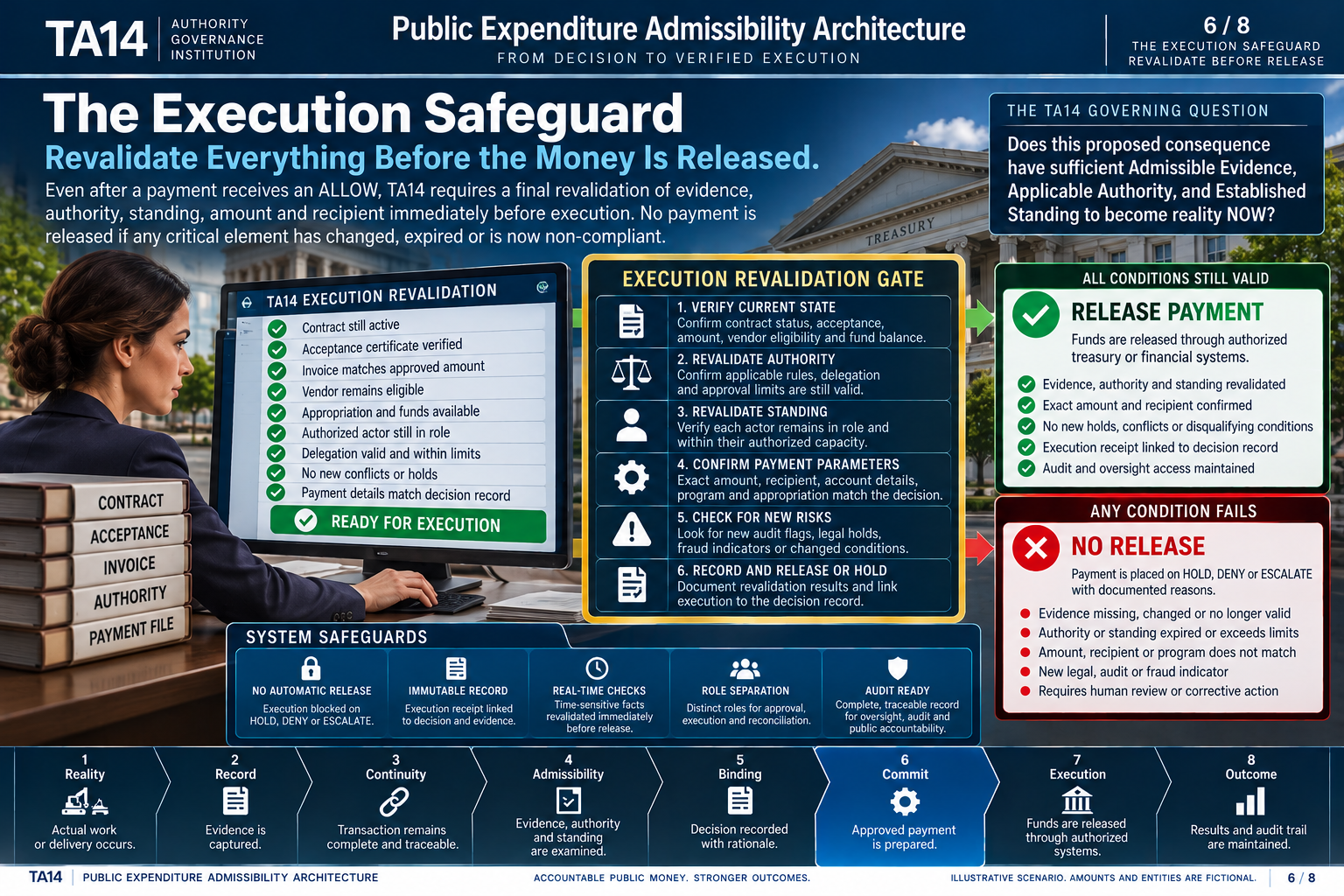
An earlier ALLOW cannot act as a permanent blank check. At execution, a system must recheck material facts and the exact payment instructions. Has the beneficiary or bank account changed? Has the approving official's delegation expired? Did another payment consume the available obligation? Has a legal hold appeared? Has the evidence package changed or become stale? If so, a prior decision cannot silently authorize different conditions. The proposed TA14 layer records the new result and passes a bounded decision to existing lawful approval and treasury systems. In this concept, TA14 itself neither transfers funds nor overrides fiscal controls or statutory officers.
7 / 8 · The Outcome and Audit Trail
Samantha's lesson transcript
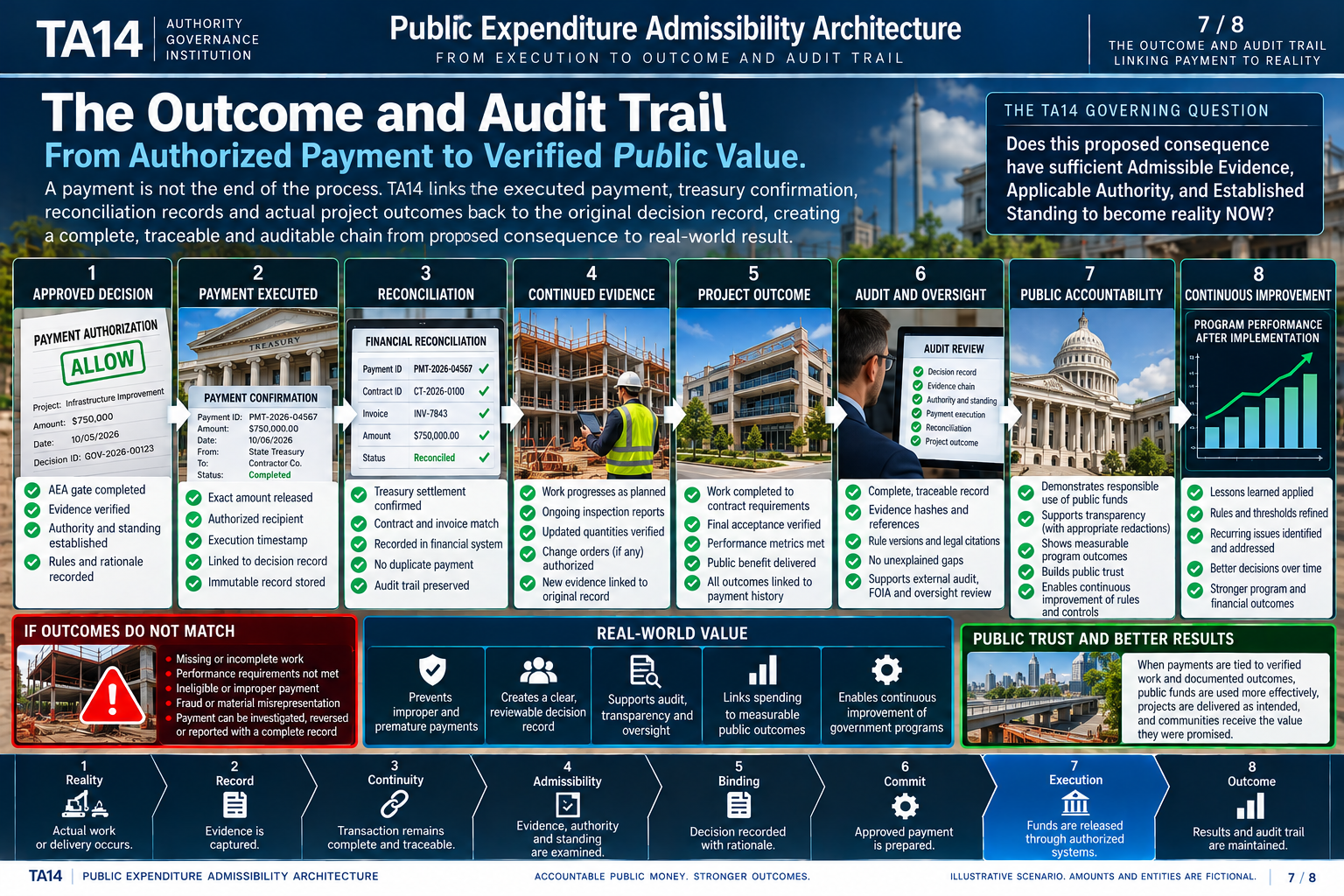
A payment execution receipt proves that funds moved; it does not prove the construction achieved its promised public benefit. The audit chain should link the authorized decision to settlement, reconciliation, remaining obligations, subsequent inspections, corrections and ultimate delivery evidence. If a payment is reversed, a defect appears, or the project misses a milestone, those events belong in the same inspectable history. Auditors need to distinguish documented payment compliance from verified project outcomes. The displayed buildings, values and records are fictional illustrations and do not represent an actual government contract. Transparency must also respect protected procurement, banking and personal information.
8 / 8 · The Future of Accountable Public Spending
Samantha's lesson transcript
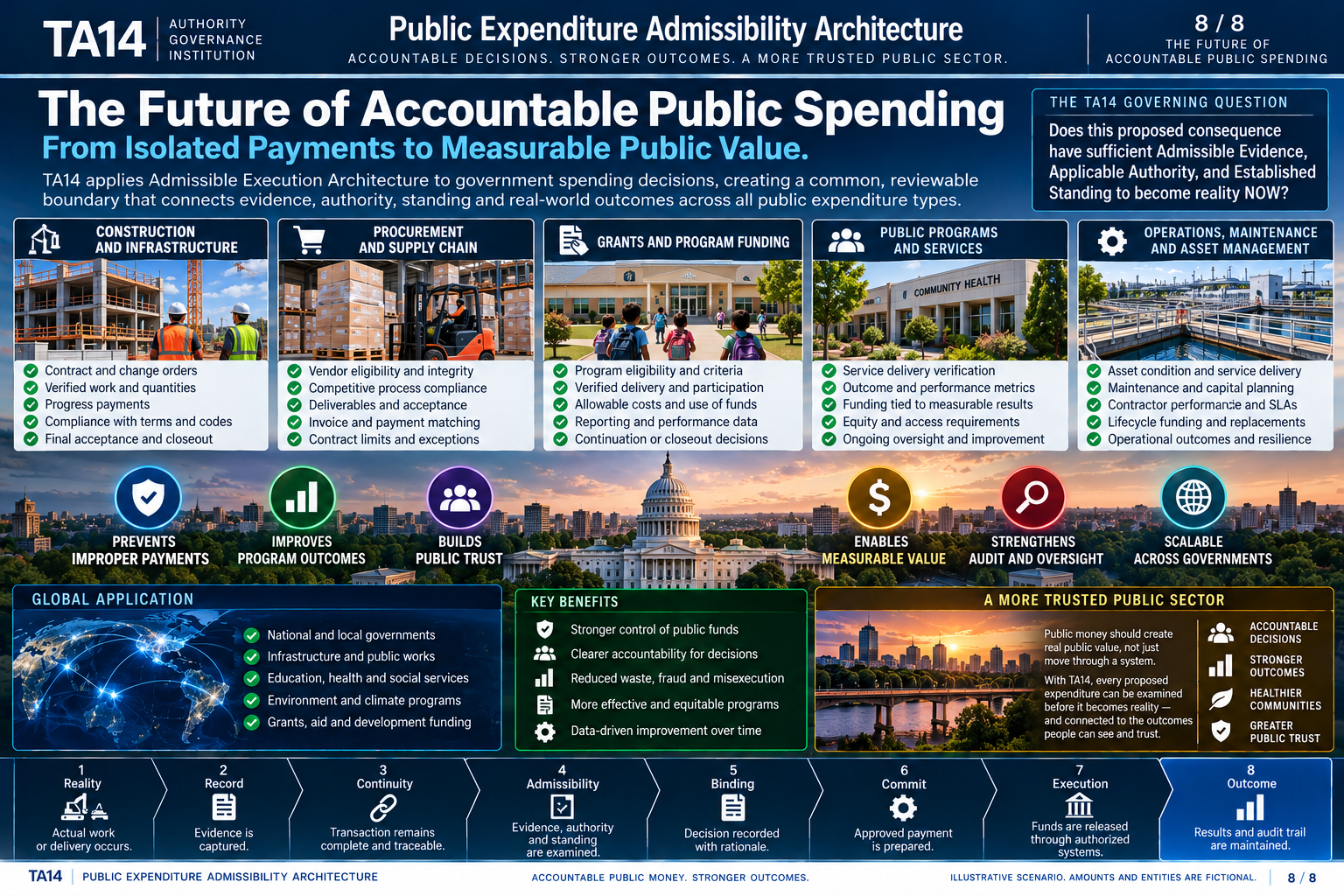
This final image broadens the possible use cases: construction draws, procurement invoices, grants, services and public assets. Each domain has different laws, evidence and authorized actors, so the architecture must be mapped locally rather than copied as an automatic approval rule. A credible institutional evaluation begins with one bounded transaction class, a consenting agency or contractor, historical or synthetic records and a legally reviewed control map. Test false holds, false allows, operator burden, exception handling and incremental detection compared with existing controls. Do not claim reduced fraud, recovered funds or savings without independent measurement. The invitation is to examine whether a traceable consequence boundary adds defensible value to the controls government already has.
This conceptual examination does not replace statutory appropriations, agency approvals, treasury controls, procurement requirements or independent auditing. Agencies must validate applicability, operational burden and incremental value before any production use.
For public agencies, procurement and finance officials, auditors and infrastructure organizations: TA14 welcomes a bounded written discussion of how admissible evidence, applicable authority and established standing might complement your existing controls. This concept is not a government endorsement or a request to bypass lawful procedures.
To explore an institutional evaluation, send a written inquiry identifying the transaction class, jurisdiction and relevant control owner. No confidential financial or personal records are needed for an initial discussion.
Request an Institutional Assessment
Explore how TA14's evidence, authority and standing framework could support accountable public expenditure decisions within your existing legal and financial controls.
No obligation. Written inquiries welcome. Formal assessments are separately scoped. Do not include confidential financial records or personal data.
Apply the governance principles to three hypothetical cases relevant to the proposed operational consequence. Choose a determination, then examine the reasoning. These cases teach the distinction between Admissible Evidence, Applicable Authority, and Established Standing; they do not issue real-world authorization.
CASE 01
Evidence is not yet admissible
A proposed consequence is supported by an observation, but the source attribution or record continuity is missing. What should happen before execution? Consider this in the context of the proposed operational consequence.
CASE 02
The actor exceeds authority
The record is current and reliable, but the proposed consequence falls outside the scope of applicable authority. What is the supported determination?
CASE 03
A higher authority is required
The proposed consequence triggers a documented requirement for review by another designated authority. What is the appropriate route?
Independent educational examples only. The questions are hypothetical and do not assess a real institution, building, person, or operating system. Actual governance determinations require case-specific evidence, applicable authority, established standing, and bounded review.