Atmospheric Integrity Records, Admissible Execution Architecture, and the independent governance layer between physical reality and authorized consequence.
SHOWROOM v2.1 · INDEPENDENT ARCHITECTURAL DEMONSTRATION · ILLUSTRATIVE SCENARIOS · NO NIST OR OTHER INSTITUTIONAL ENDORSEMENT · NO CLAIM OF OPERATIONAL INTEGRATION
Governance does not need to become the technology it governs.
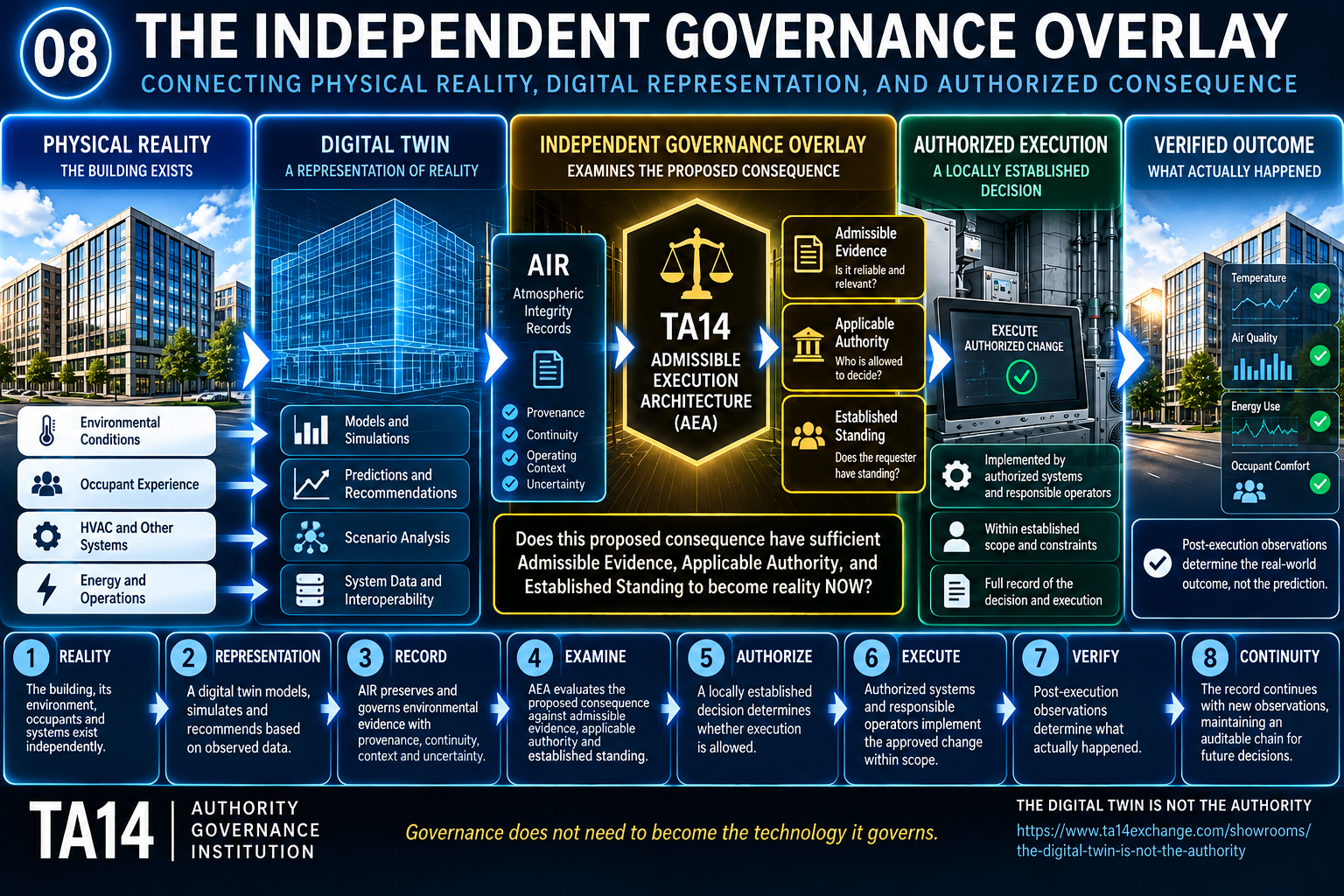
Sensors observe. AIR governs environmental evidence. Digital twins model and recommend. AEA examines proposed consequences. Locally authorized systems execute. Preserved post-execution observations support verification.
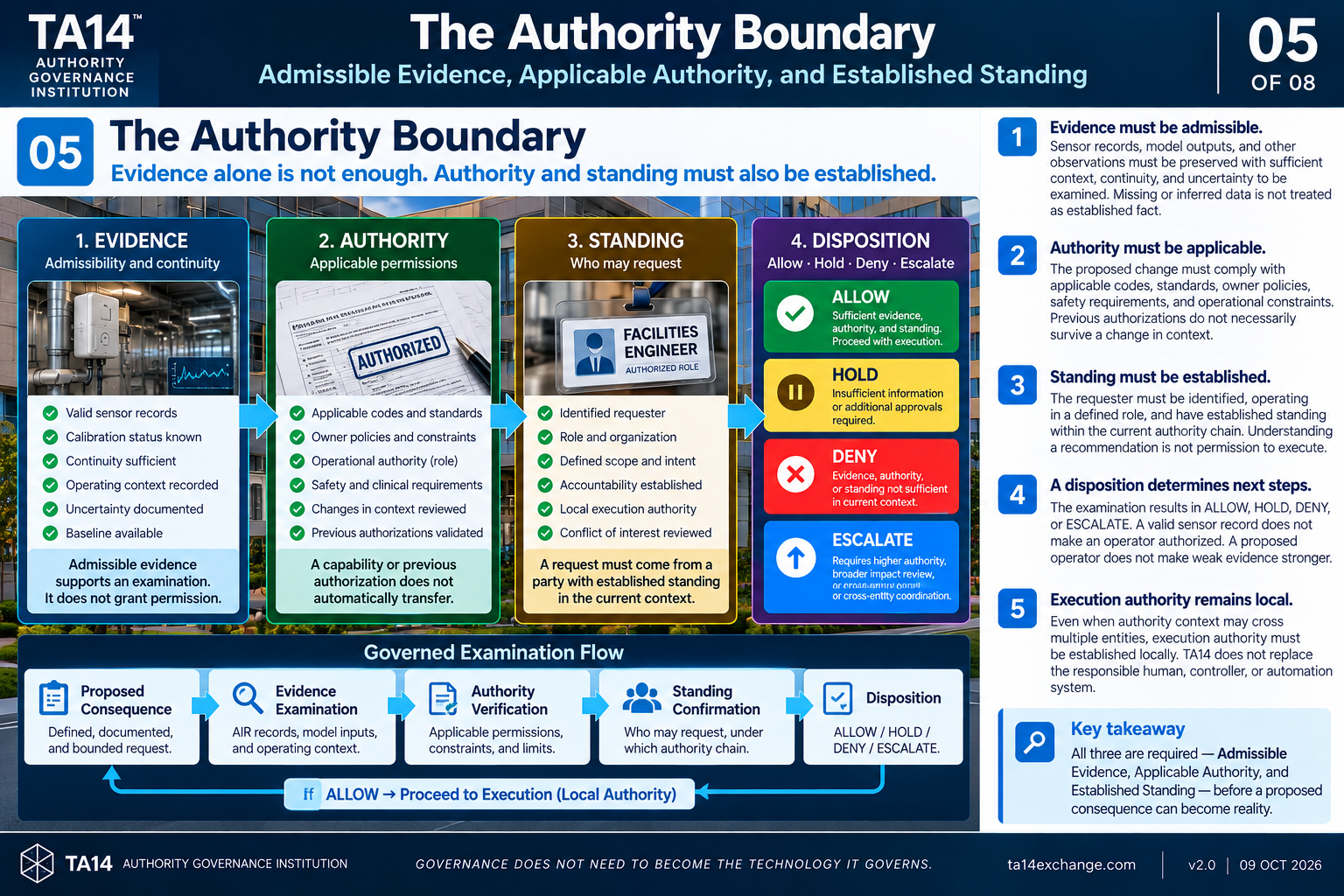
Does this proposed consequence have sufficient Admissible Evidence, Applicable Authority, and Established Standing to become reality NOW?
Voice availability depends on your browser and device. Manual scrolling remains enabled.
Read narration transcript
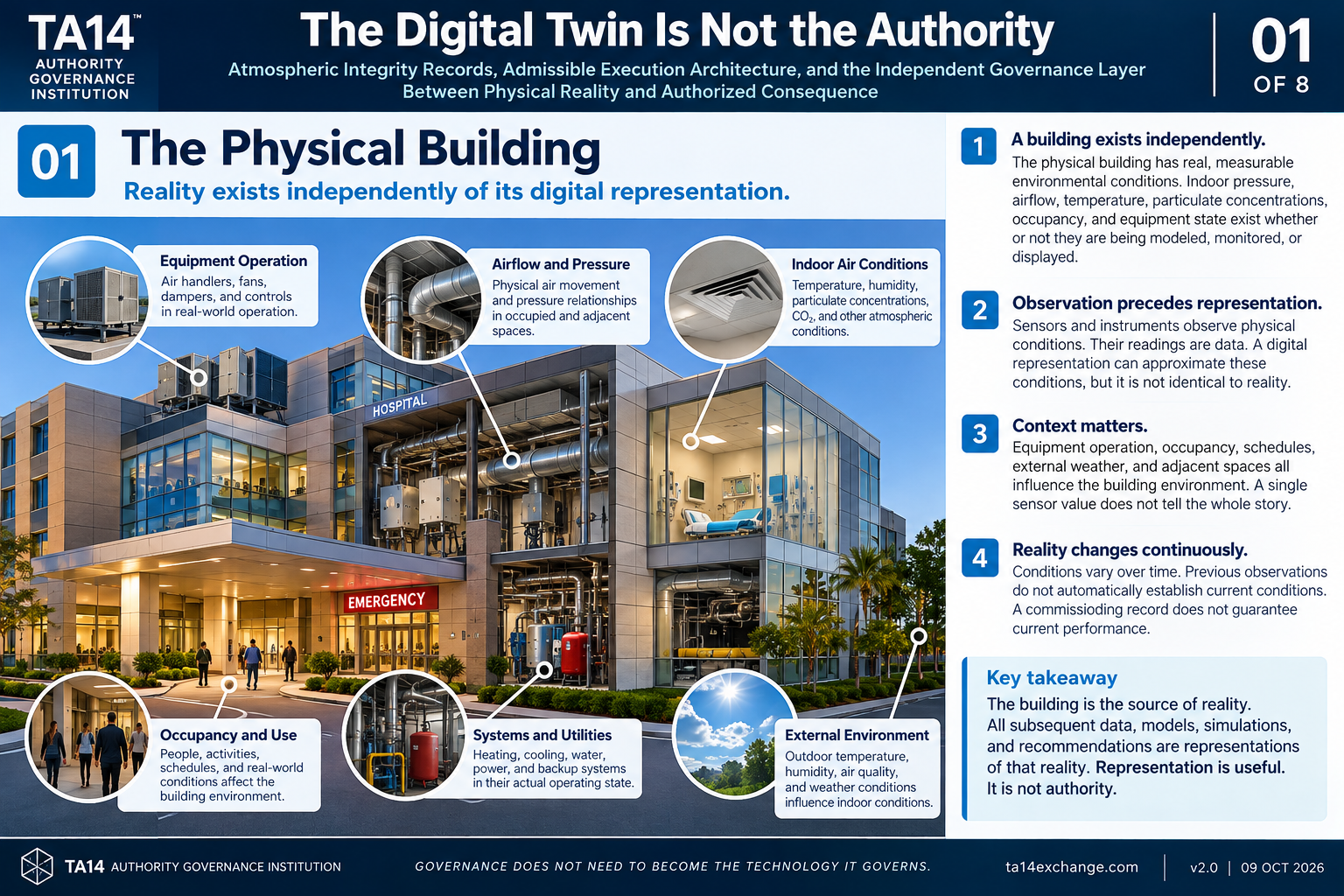
The physical building exists whether or not a digital model is operating. Its equipment, occupants, atmospheric conditions, and operating history are the reality that engineering systems attempt to understand. A sensor can observe a condition, but the instrument reading is not the building itself. A model can approximate the building, but its simulation is not physical reality. We begin here because every subsequent claim must be traceable to what actually existed. We must distinguish observed conditions from inferred conditions, and preserve the original state before a consequential intervention. The governing principle is simple: reality precedes representation. TA14 does not need to own the building to examine whether a proposed consequence is sufficiently supported.
TEACHING IMAGE 02 / 08
Atmospheric Integrity Records Preserve Evidence
Voice availability depends on your browser and device. Manual scrolling remains enabled.
Read narration transcript
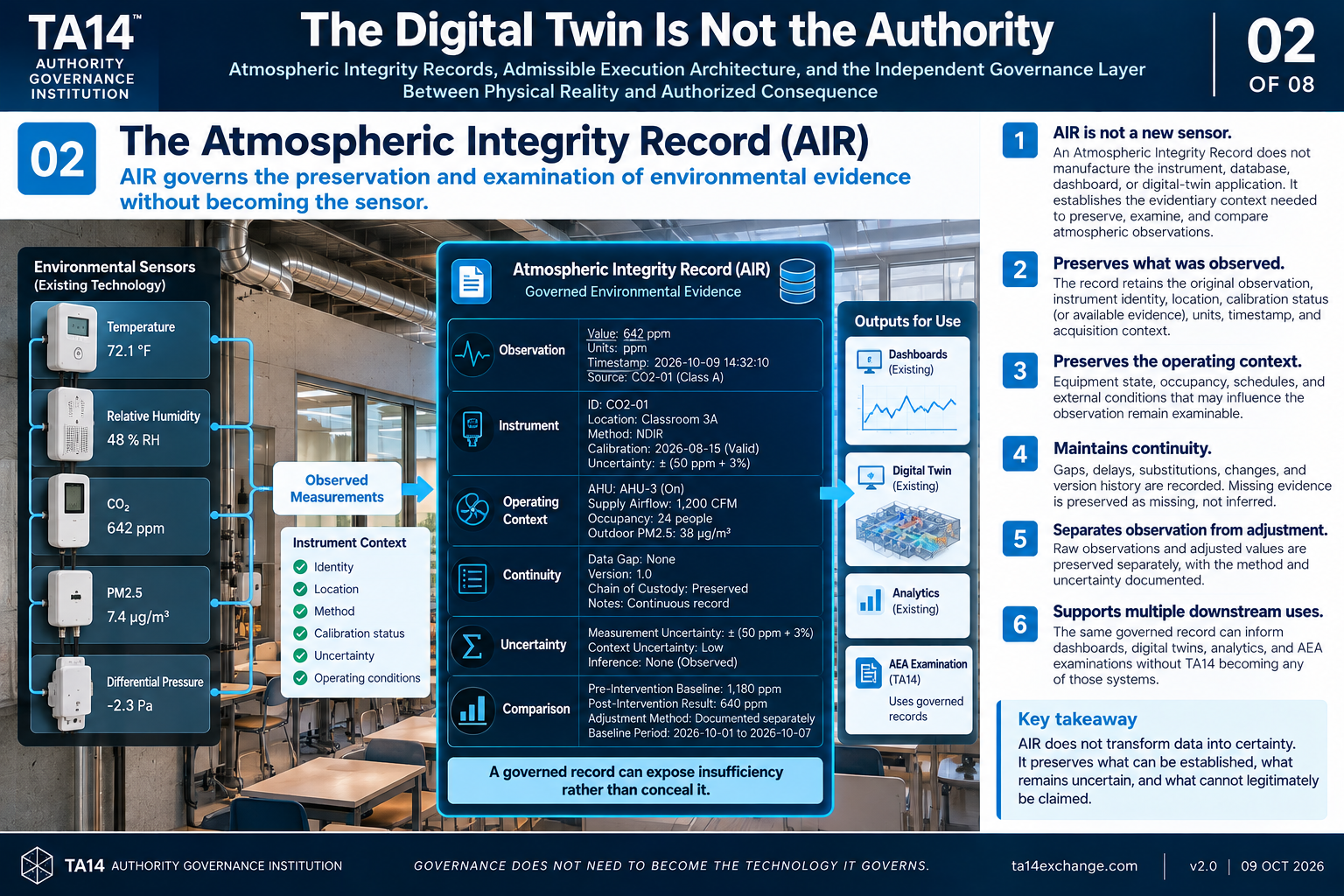
An Atmospheric Integrity Record, or AIR, is an environmental evidence governance construct, not a new sensor or dashboard. Existing instruments observe temperature, carbon dioxide, particulate matter, pressure, and other conditions. AIR establishes requirements for preserving observations with instrument identity, timestamps, operating context, continuity, uncertainty, and relevant changes. Gaps must remain visible. Raw observations and adjusted values must remain distinguishable. An AIR does not make every reading accurate or admissible. Instead, it makes the evidence and its limitations examinable. Digital twins and analytics may consume governed records without TA14 becoming their database or application. The distinction is preservation and examination of evidence, not ownership of the technology that measured it.
TEACHING IMAGE 03 / 08
The Digital Twin Is Not the Authority
Voice availability depends on your browser and device. Manual scrolling remains enabled.
Read narration transcript
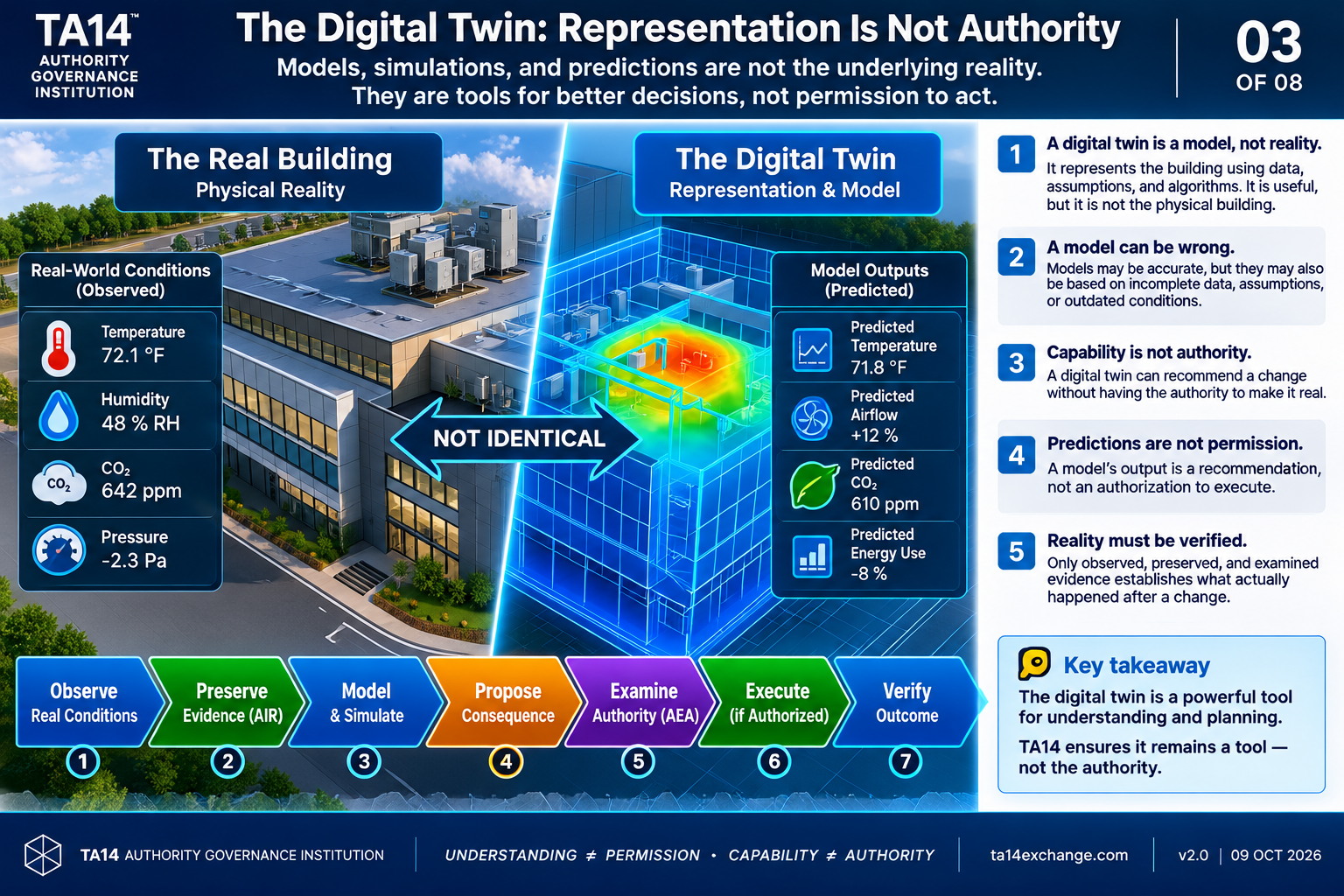
A digital twin may combine models, measurements, simulations, and predictions to represent a physical facility. It can discover patterns and propose changes to ventilation or other systems. That is a valuable engineering capability. But a prediction is not an observation, and a recommendation is not authorization. The model may rely on incomplete inputs, uncertain assumptions, or changed conditions. TA14 therefore preserves the boundary between what the twin represents, what the underlying evidence establishes, and what a responsible party is permitted to execute. Understanding is not permission. Capability is not authority. A digital twin remains an independent tool, while governance examines the proposed consequence.
TEACHING IMAGE 04 / 08
A Recommendation Is Not Permission
Voice availability depends on your browser and device. Manual scrolling remains enabled.
Read narration transcript
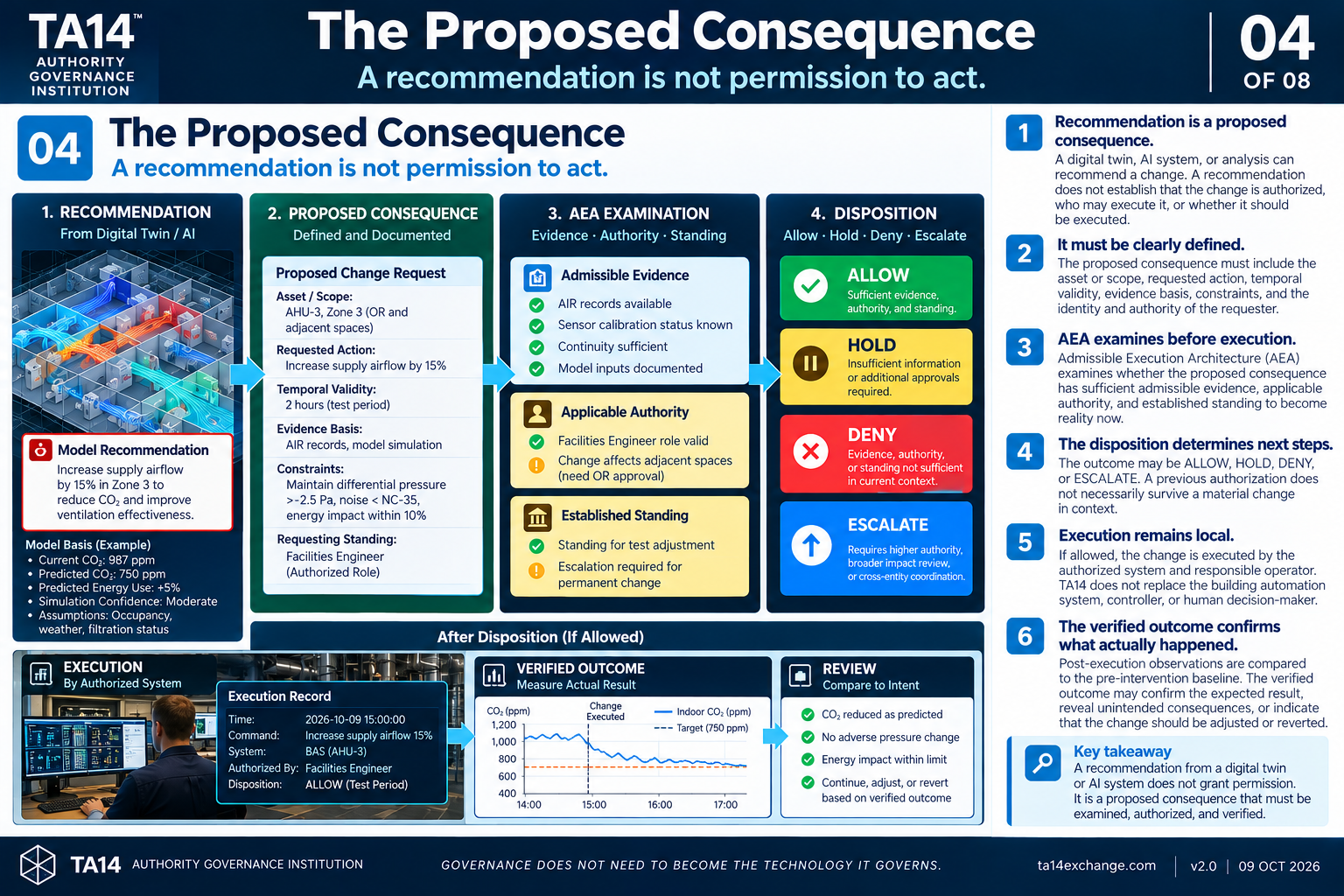
When a digital twin proposes increasing airflow, the suggestion must first become a bounded proposed consequence. Identify the asset, the precise requested action, the scope, timing, evidence basis, requesting party, and operating constraints. An attractive prediction or apparent benefit does not grant permission. The proposal is then eligible for an independent examination of admissible evidence, applicable authority, and established standing. A recommendation may be held, denied, escalated, or allowed within specific bounds. None of those dispositions is created simply by the intelligence of the model. TA14 governs the crossing from a technical recommendation toward a real-world consequence.
TEACHING IMAGE 05 / 08
The Authority Boundary
Voice availability depends on your browser and device. Manual scrolling remains enabled.
Read narration transcript
The TA14 governing question is: Does this proposed consequence have sufficient Admissible Evidence, Applicable Authority, and Established Standing to become reality NOW? Evidence must be sufficient for the specific purpose, not merely available. Authority must apply to the actual intervention and current context. Standing must establish who is entitled to request or commit the action. The examination may result in ALLOW, HOLD, DENY, or ESCALATE. These are bounded dispositions, not generic certifications. A prior permission does not necessarily survive changed circumstances. The authority boundary is independent of the digital twin, the sensor, and the controller. No admissible evidence. No admissible execution.
INTERACTIVE TEACHING EXAMINATION · SIMULATED DATA · NOT A FORMAL DISPOSITION
The digital twin recommends an action. Who authorizes it?
A hypothetical hospital digital twin proposes increasing ventilation. Its prediction alone does not authorize a building change. Examine three illustrative gates below.
Practitioner pressure test
Which observation, missing record, authority constraint, or change in operating conditions would alter your disposition? Submit a bounded technical challenge through registered governance; registration does not guarantee acceptance or an ALLOW disposition.
Voice availability depends on your browser and device. Manual scrolling remains enabled.
Read narration transcript
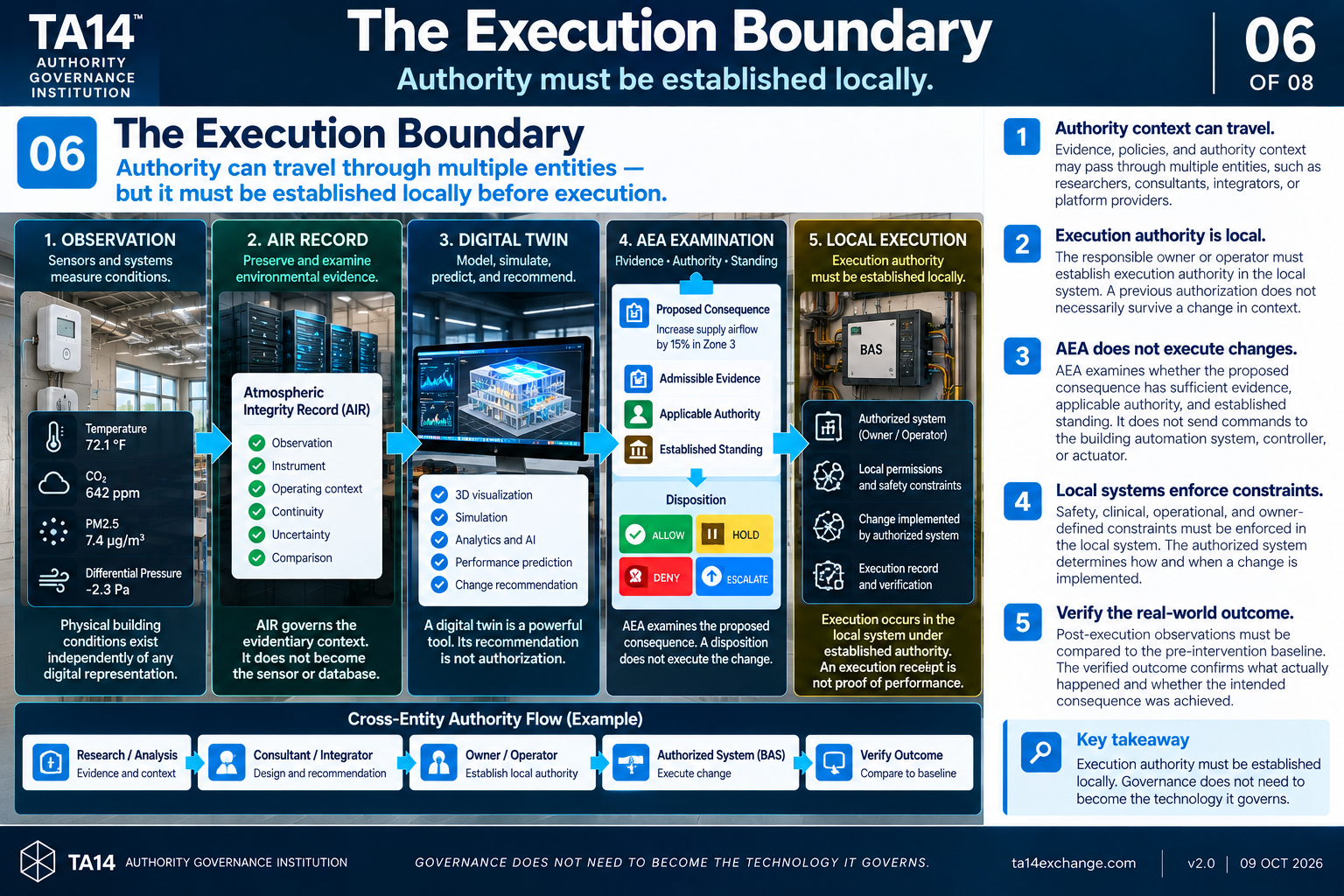
Authority context can cross organizational and technical boundaries, but execution authority must be established locally. A researcher may supply observations. An engineer may develop a simulation. A digital twin may recommend a change. An external governance examination may assess the proposed consequence. Yet the actual building system and responsible operator must establish the authority and constraints for that local action. AEA does not replace the building automation system, controller, actuator, or human decision maker. It governs the conditions under which the consequence may proceed. An execution receipt records an action, but it does not prove that the intended result occurred.
TEACHING IMAGE 07 / 08
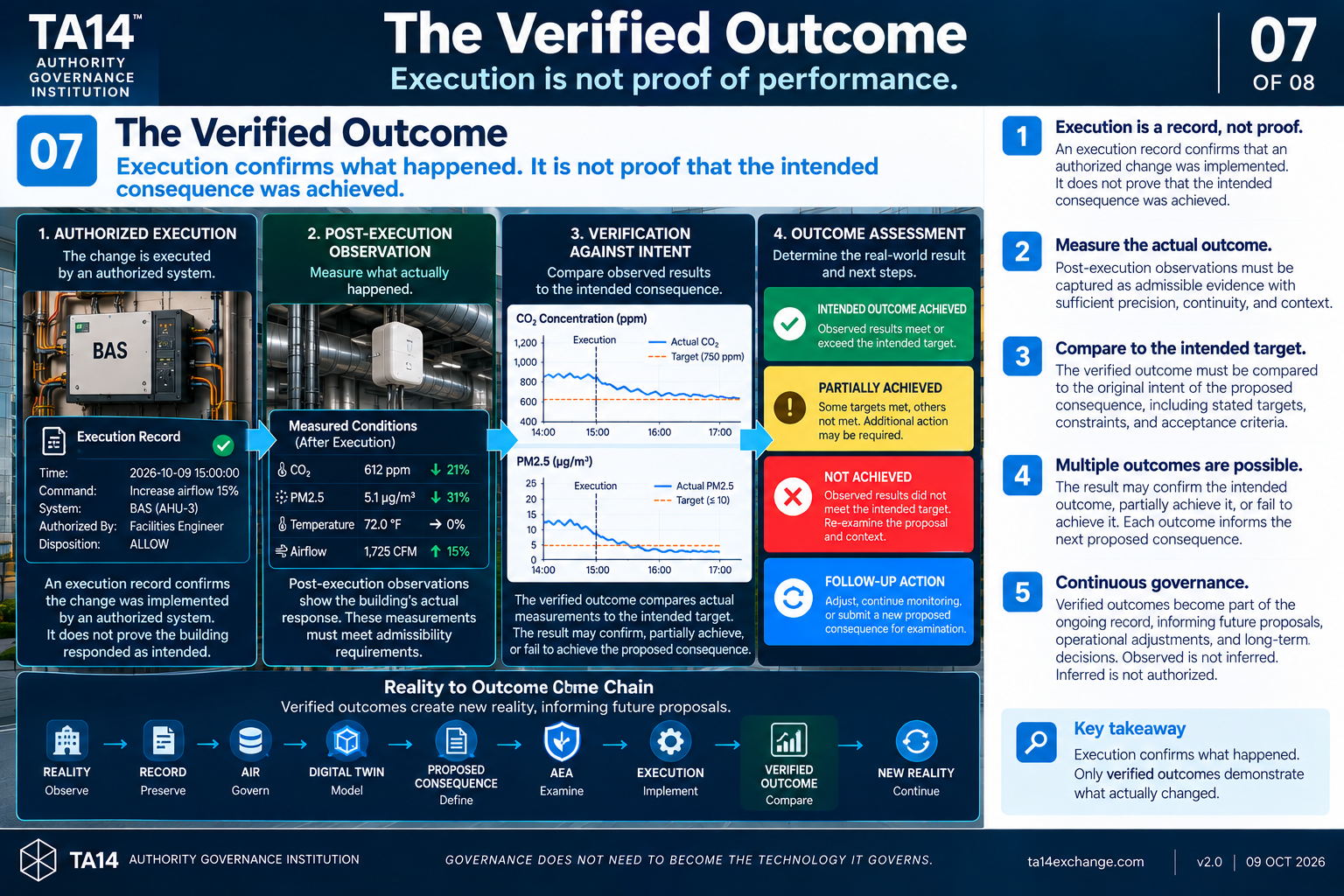
Execution Is Not Proof of Performance
Voice availability depends on your browser and device. Manual scrolling remains enabled.
Read narration transcript
After a locally authorized intervention, we must observe the actual physical response. An execution log may establish that a command was issued or a setting changed. It does not prove that indoor air improved, that pressure constraints remained satisfied, or that unintended consequences were avoided. Post-execution observations need their own preserved evidence, chronology, context, and uncertainty. Compare the resulting conditions with the original baseline and the stated acceptance criteria. The outcome may be improved, restored, unchanged, degraded, or unresolved. An outcome cannot be inferred solely from the command history or the model prediction. Verification returns us to new physical reality, which becomes the basis for any future proposal.
TEACHING IMAGE 08 / 08
The Independent Governance Overlay
Voice availability depends on your browser and device. Manual scrolling remains enabled.
Read narration transcript
The complete architecture separates responsibilities rather than merging technologies. Sensors observe. Environmental records preserve what can be established. Digital twins represent and simulate. Proposed consequences are defined. AEA examines evidence, authority, and standing. Existing locally authorized systems execute. New records support outcome verification. Across this process the TA14 governing chain remains Reality, Record, Continuity, Admissibility, Binding, Commit, Execution, Outcome. The overlay can potentially apply to hospitals, schools, factories, public infrastructure, and other domains without TA14 becoming their sensor, artificial intelligence, digital twin, or controller. This showroom is an independent educational architecture, not proof of an operational integration or institutional endorsement.
Examine a bounded integration
This is a proposed interoperability examination, not an existing product certification. A digital-twin developer or building owner may identify one bounded proposed consequence, the environmental evidence available, the relevant local authority, and the required post-execution verification. TA14 can then assess whether a founding demonstration is appropriate following governance registration and an agreed baseline.
Research collaboration, registration, and commercial engagement do not imply institutional endorsement or automatic execution authority.
Apply the governance principles to three hypothetical cases relevant to the proposed operational consequence. Choose a determination, then examine the reasoning. These cases teach the distinction between Admissible Evidence, Applicable Authority, and Established Standing; they do not issue real-world authorization.
CASE 01
Evidence is not yet admissible
A proposed consequence is supported by an observation, but the source attribution or record continuity is missing. What should happen before execution? Consider this in the context of the proposed operational consequence.
CASE 02
The actor exceeds authority
The record is current and reliable, but the proposed consequence falls outside the scope of applicable authority. What is the supported determination?
CASE 03
A higher authority is required
The proposed consequence triggers a documented requirement for review by another designated authority. What is the appropriate route?
Independent educational examples only. The questions are hypothetical and do not assess a real institution, building, person, or operating system. Actual governance determinations require case-specific evidence, applicable authority, established standing, and bounded review.