KEYSTONE · ELIAS SYSTEMS LTD · v1.0.0-rc8 · GOVERNED FINANCIAL EXECUTION
The system can move the money. That does not mean it may.
IDENTITY ≠ AUTHORITY · AUTHORITY ≠ PERMISSION · CAPABILITY ≠ EXECUTION
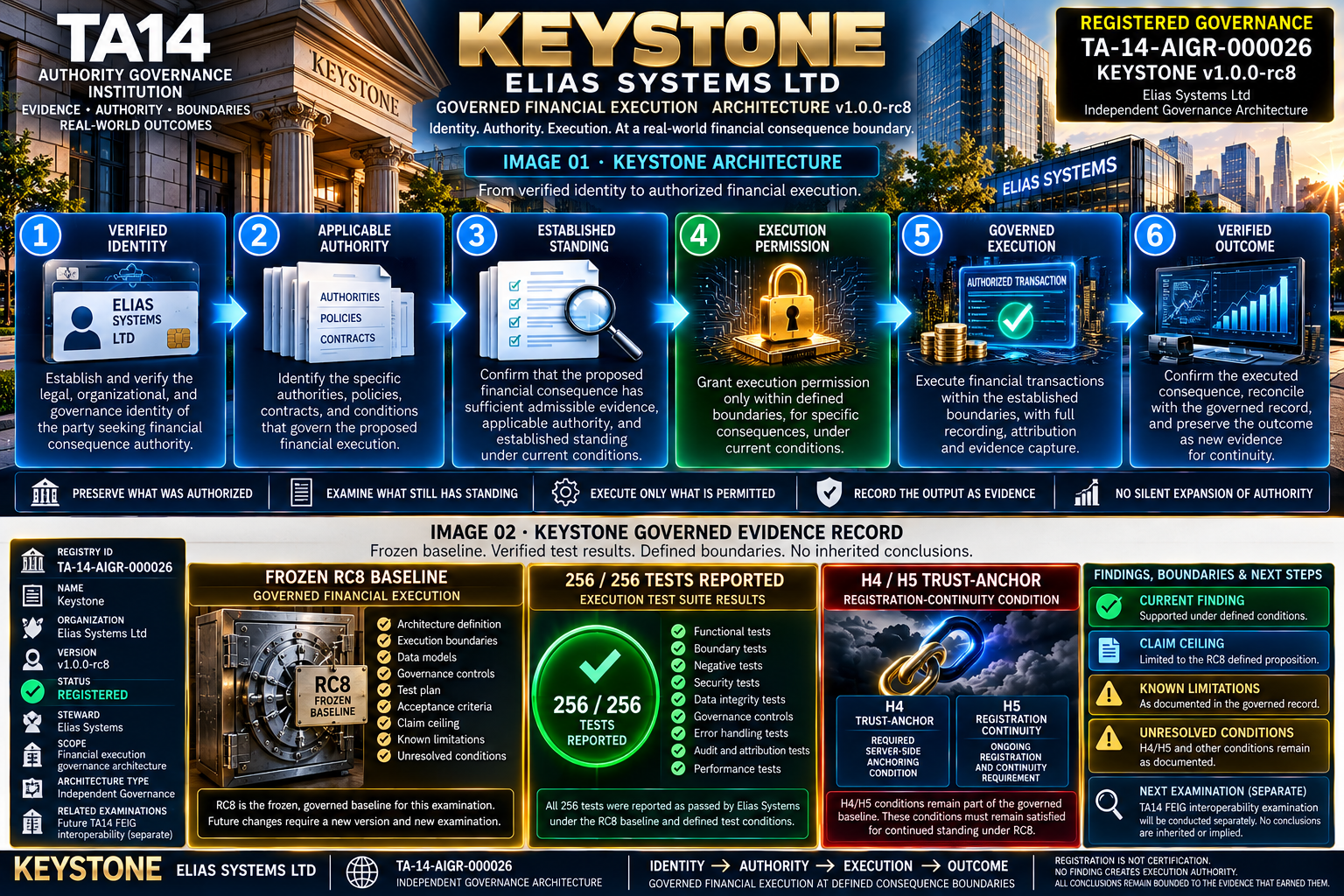
Keystone puts a governance boundary in front of consequence-bearing financial execution. Before an action becomes real, the record must establish who is acting, what authority applies, whether standing exists, exactly what payload is permitted, and whether those conditions still hold at the moment of execution. RC8 is preserved here as the frozen baseline—including the evidence that supports it and the H4/H5 condition that still constrains it.
01 · THE CONSEQUENCE BOUNDARY
A financial action should not execute because a system can do it. It should execute only when the authority chain survives the boundary.
READ SAMANTHA'S IMAGE 01 NARRATION
Keystone separates identity, authority, standing, payload-bound permission, execution-time revalidation, and recorded outcome. Each burden must remain distinct at the financial consequence boundary.
02 · OPERATE THE BOUNDARY
Push the proposed transaction forward. Every click exposes the next burden that still has to be established.
EXECUTION PERMITTED · BOUNDED
Permission is bound to the specific governed financial action, not treated as a reusable blanket entitlement.
03 · THE RECORD THAT CANNOT BE CHERRY-PICKED
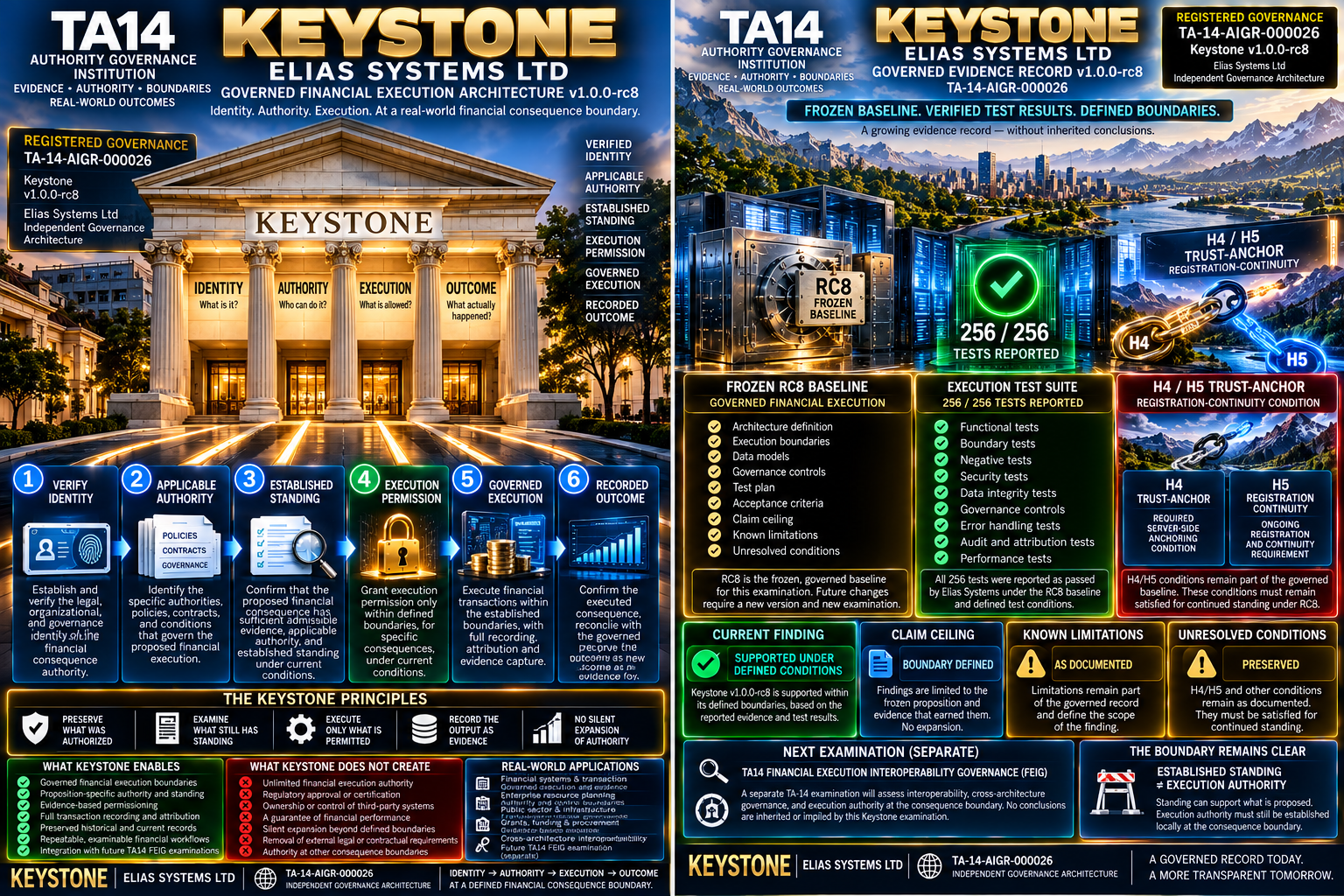
256 reported successes travel with the adverse condition. Governance does not get to keep one and discard the other.
READ SAMANTHA'S IMAGE 02 NARRATION
RC8 preserves the 256/256 reported test position and the H4/H5 continuity condition together. Evidence and limitation travel together; later comparison does not rewrite the frozen baseline.
04 · FREEZE THE TRUTH BEFORE COMPARISON
Keystone v1.0.0-rc8 is a dated, attributable governance object whose evidence, claims, limitations, and adverse conditions remain fixed for later comparison.
Reported by Elias Systems under the RC8 baseline and defined test conditions. The showroom does not convert participant-reported success into independent universal validation.
The frozen record retains the server-side anchoring condition rather than hiding it behind the reported test result.
Registration and continuity remain part of the governed standing burden for the frozen version.
The record does not establish regulatory approval, production readiness, universal security, successor-version validity, or unrestricted execution authority.
05 · THE CONDITION THAT THE PASS CANNOT ERASE
256 / 256 reported tests do not make H4/H5 disappear.
The RC8 record preserves a bounded trust-anchor and registration-continuity condition in which an unrelated K2 replacement could inherit a K1 checkpoint without authorized rotation. That condition is not erased by the reported 256/256 test position. Any correction belongs to a distinct successor release with its own evidence and, where applicable, re-examination.
06 · CLAIM CEILING
The evidence may support Keystone. It does not authorize us to say more than Keystone earned.
Identity, authority, standing, permission, payload binding, fail-closed behavior, execution-time revalidation, and provenance are treated as distinct governance burdens.
The frozen RC8 object, participant-reported test position, limitations, H4/H5 condition, and baseline chronology remain attributable.
TA-14 certification, endorsement, production-readiness certification, universal security, immunity from compromise, or blanket successor-release validity.
A future Keystone × TA-14 FEIG finding cannot be presumed from registration, terminology overlap, or this frozen baseline.
07 · THE NEXT QUESTION IS HARDER
What happens when Keystone says the transaction may proceed—but TA-14 says the evidence for the consequence does not presently have standing?
The frozen RC8 object now makes a controlled future comparison possible without moving either architecture after exposure to the other. The bounded question would be whether an action satisfying Keystone identity, authority, permission, and payload-binding conditions can still be withheld when TA-14 independently finds that the evidence required for an admissible financial consequence lacks present standing.