School Air Quality:
From Concern to Accountable Action
A visual, eight-lesson walkthrough showing how environmental observations can support defensible decisions, authorized interventions and verified outcomes.
EDUCATIONAL EXAMINATION: Classroom 214, readings, decision examples and outcomes are hypothetical. No school finding, medical conclusion, safety certification or execution permission is asserted.
Does this proposed consequence have sufficient Admissible Evidence, Applicable Authority, and Established Standing to become reality NOW?
Existing IAQ programs measure, investigate and improve environments. What happens at the decision boundary?
TA14 examines the continuity of environmental evidence (EIG and AIR) and whether that evidence, together with actual authority and standing, supports one bounded action (AEA). Monitoring, data-quality methods and safety controls already exist: this is an examination of the complete evidence-to-consequence chain, not a claim to have invented those components.
A School Air Quality Concern
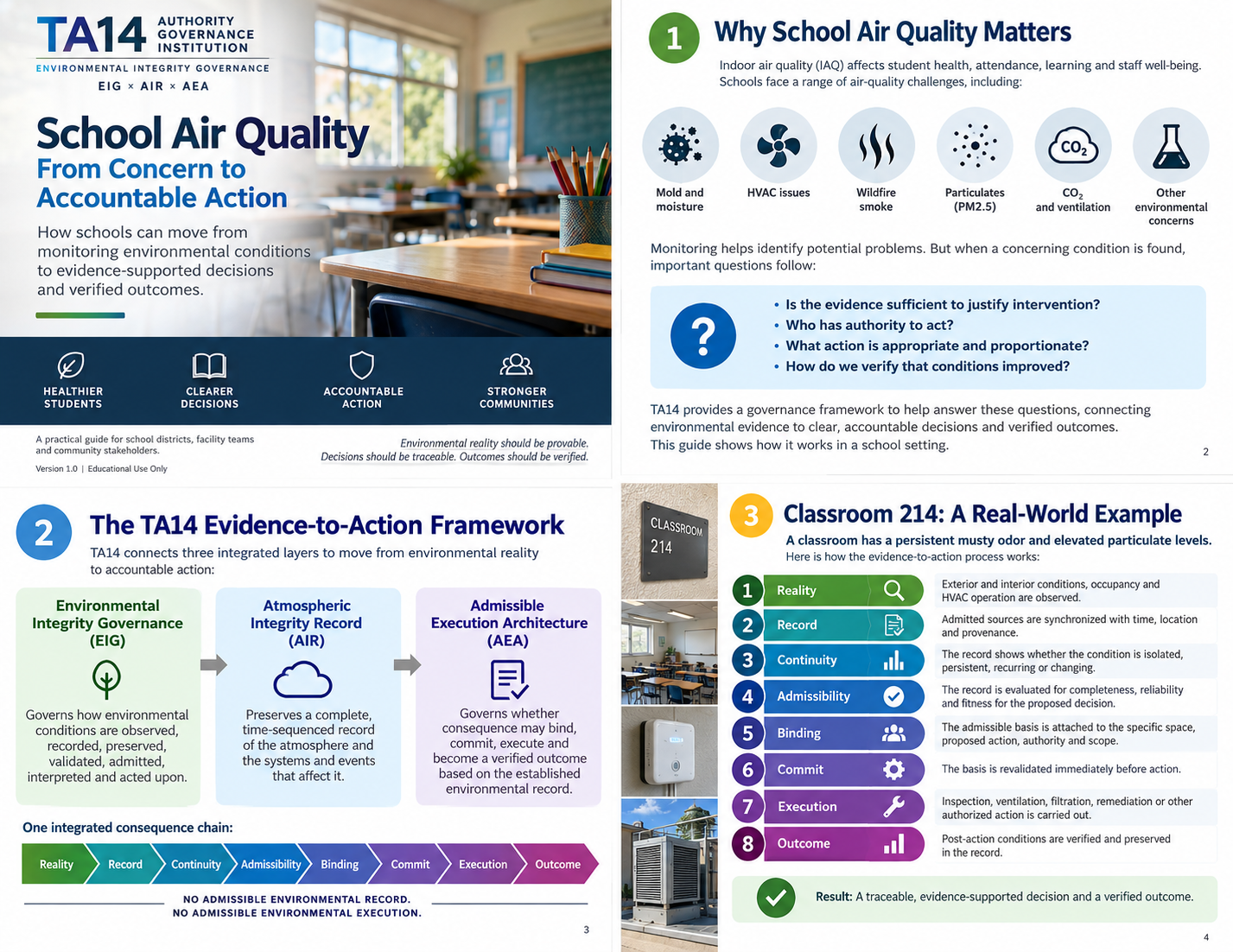
Look at the opening image. A school air quality concern is the beginning of an investigation, not proof of its cause. Someone may report discomfort, odors, or a suspected ventilation problem. The first responsibility is to record what was reported, where, when, and under what conditions. We must distinguish the concern from a measured condition, and a measured condition from a justified response. A school should not ignore a report, but it should not invent a diagnosis either. Our first lesson is that concern creates a duty to examine reality. It does not, by itself, authorize a particular physical intervention.
A reported concern deserves a documented investigation, not an unsupported conclusion.
WHAT COMES NEXTNext we examine the complete environmental context.
What Is Actually Happening?
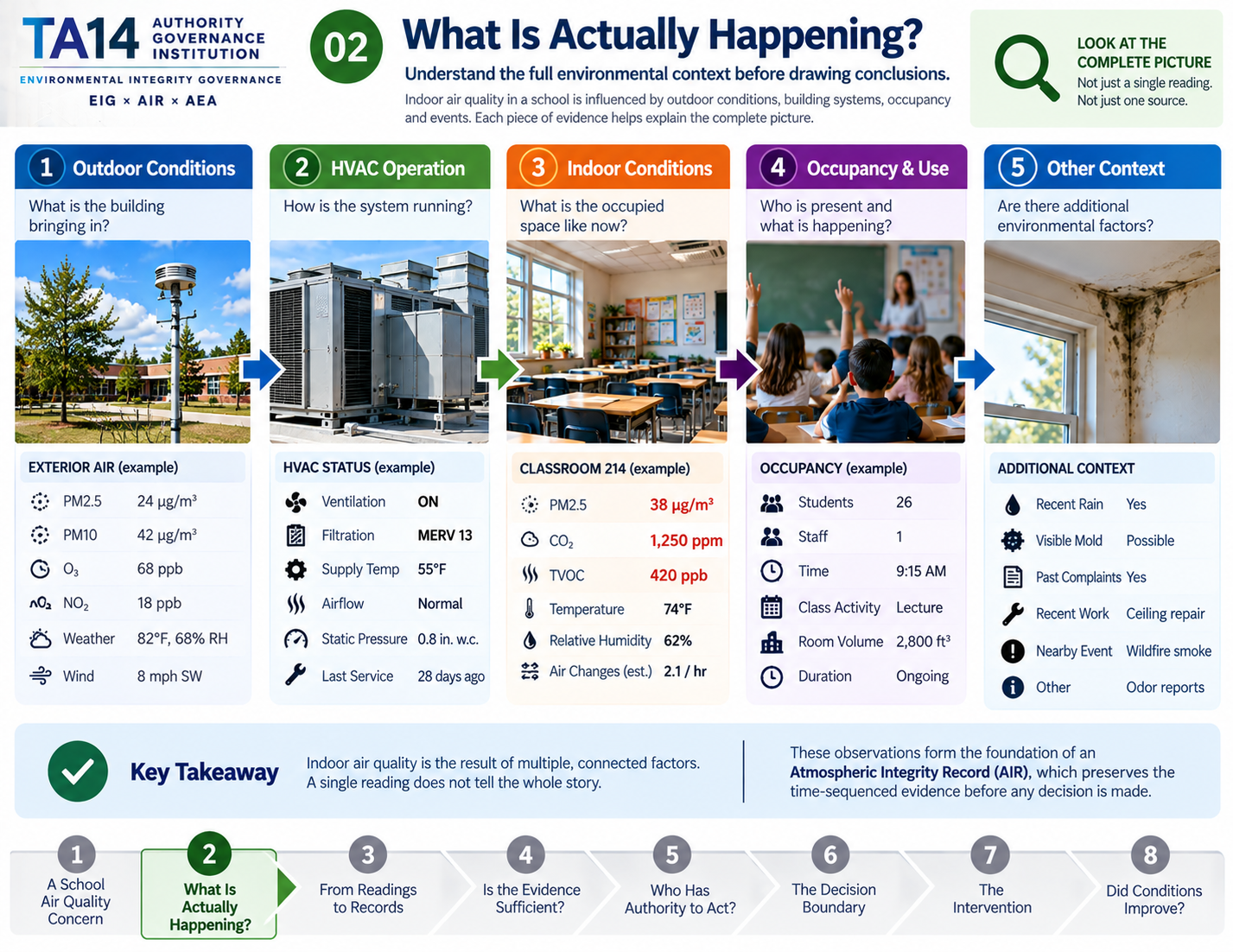
This image expands the investigation beyond one number on a screen. The air students experience is shaped by outdoor conditions, indoor sources, occupancy, ventilation, filtration, equipment operation, and time. A carbon dioxide reading might help evaluate ventilation, but it cannot explain every pollutant or every exposure. We need to know what the instruments measured, which classroom or zone they represent, whether the HVAC system was operating normally, and how conditions changed. The complete picture comes from relating these observations without pretending that any one sensor explains the whole environment.
Exterior conditions, occupied-space observations, HVAC state, and occupancy are different evidence streams.
WHAT COMES NEXTNext we preserve observations in a traceable environmental record.
From Readings to Records
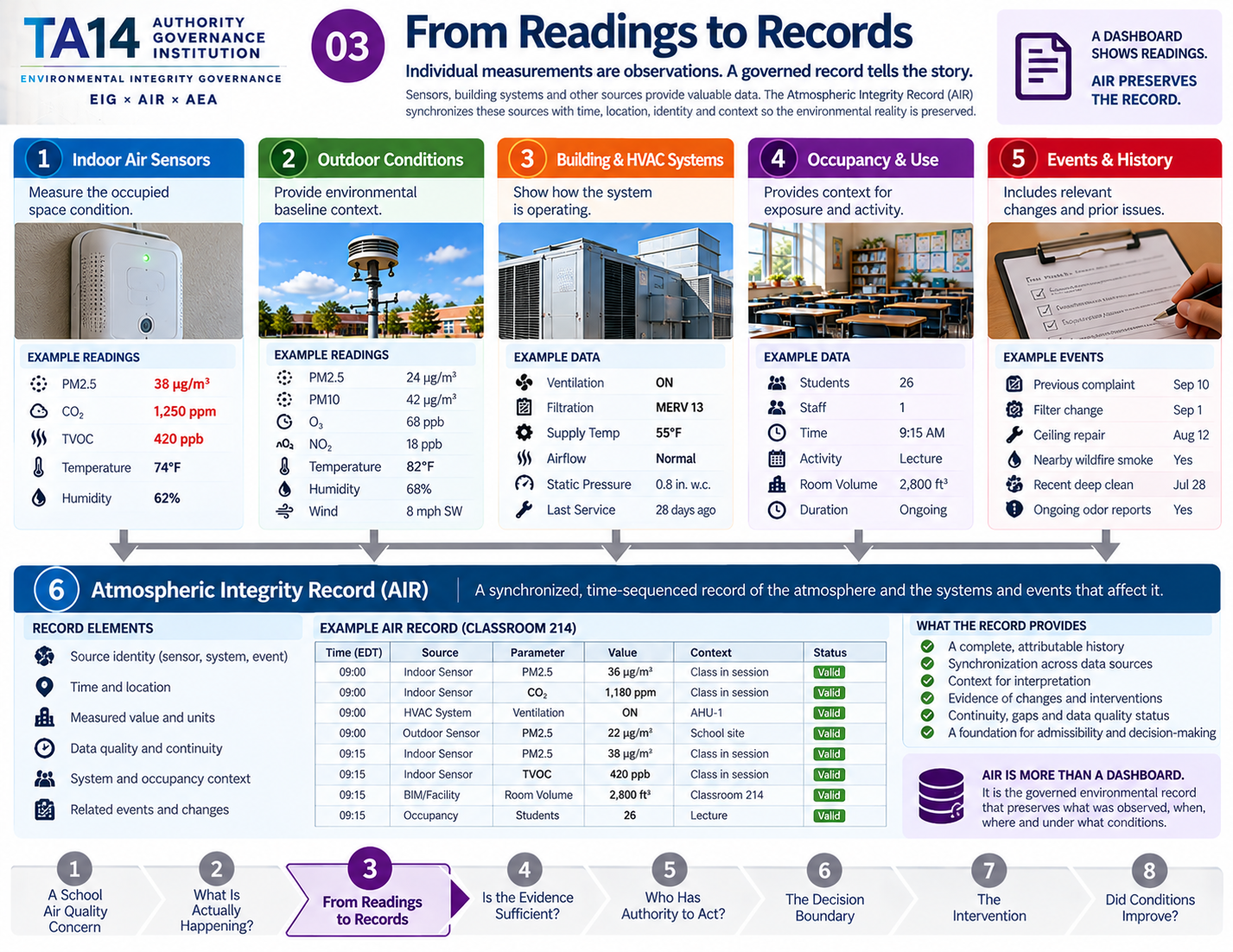
Here the image asks us to cross from readings to a governed record. Imagine a monitor reports a value at ten o'clock. To rely on that observation later, we need its source, location, timestamp, quality status, and the equipment and occupancy context. We must also preserve missing intervals and changes rather than smoothing them away. TA14 calls its proposed atmospheric evidence class the Atmospheric Integrity Record, or AIR. Existing historians and building systems already preserve much of this information. The governance question is whether the assembled record is complete and continuous enough for the particular action under consideration.
AIR is intended to preserve source, observation time, location, operating context, gaps, and continuity. A dashboard alone is not the record.
WHAT COMES NEXTNext we test whether that record supports the proposed decision.
Is the Evidence Sufficient?
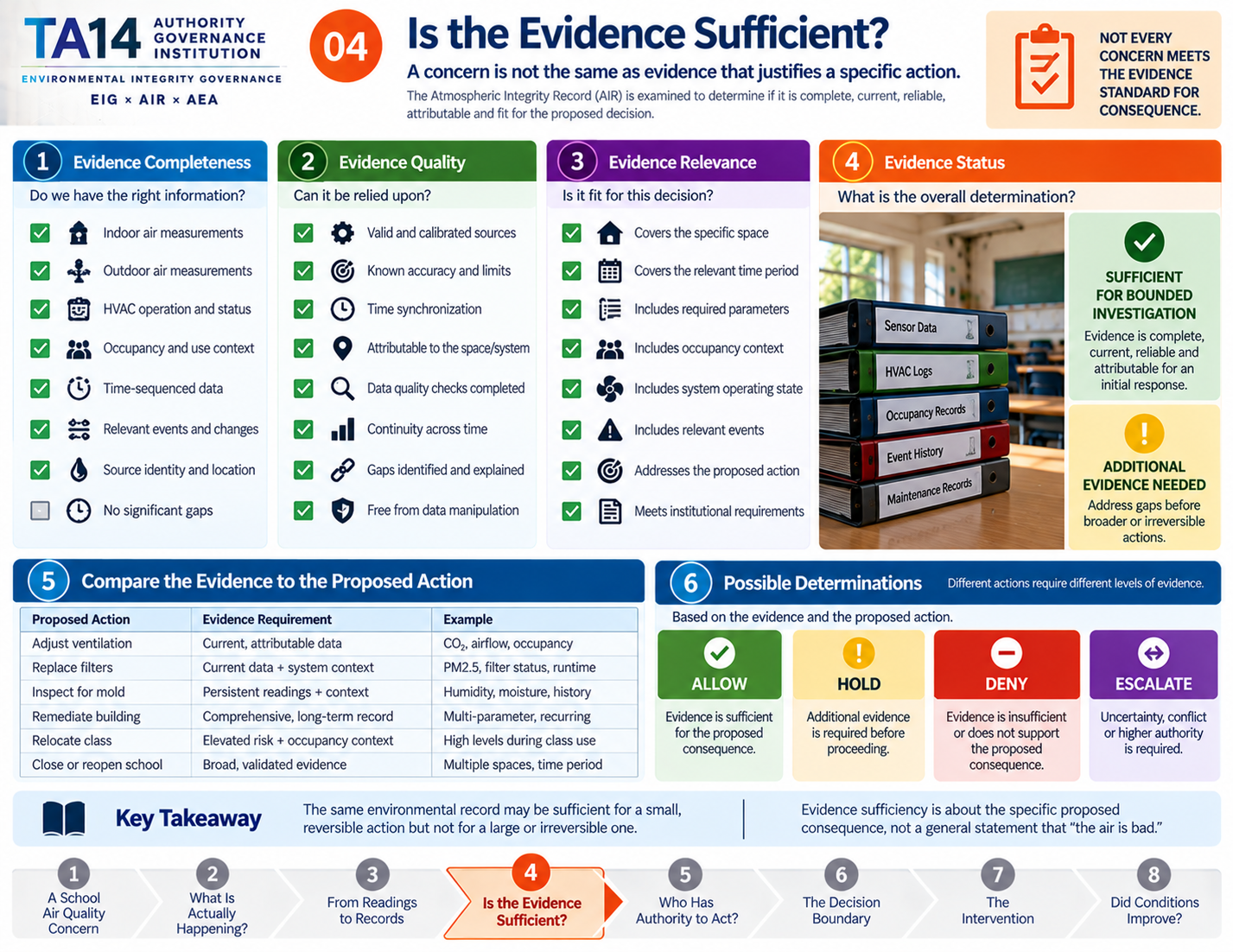
This image presents the evidence sufficiency gate. Evidence adequate to justify a closer inspection may not be adequate to authorize a costly renovation, relocation, or change to a control sequence. Before deciding, identify the exact proposed consequence. Then ask whether the relevant sources are attributable, timely, reliable, and sufficiently complete for that consequence. A missing or conflicting observation must be identified, not silently converted into certainty. Established environmental data-quality methods already address fitness for use. TA14 applies that discipline at the boundary where evidence would support a specific action now.
An inspection and a major remediation may require different evidence. Admissibility is consequence-specific.
WHAT COMES NEXTNext we establish who actually has authority and standing.
Who Has Authority to Act?
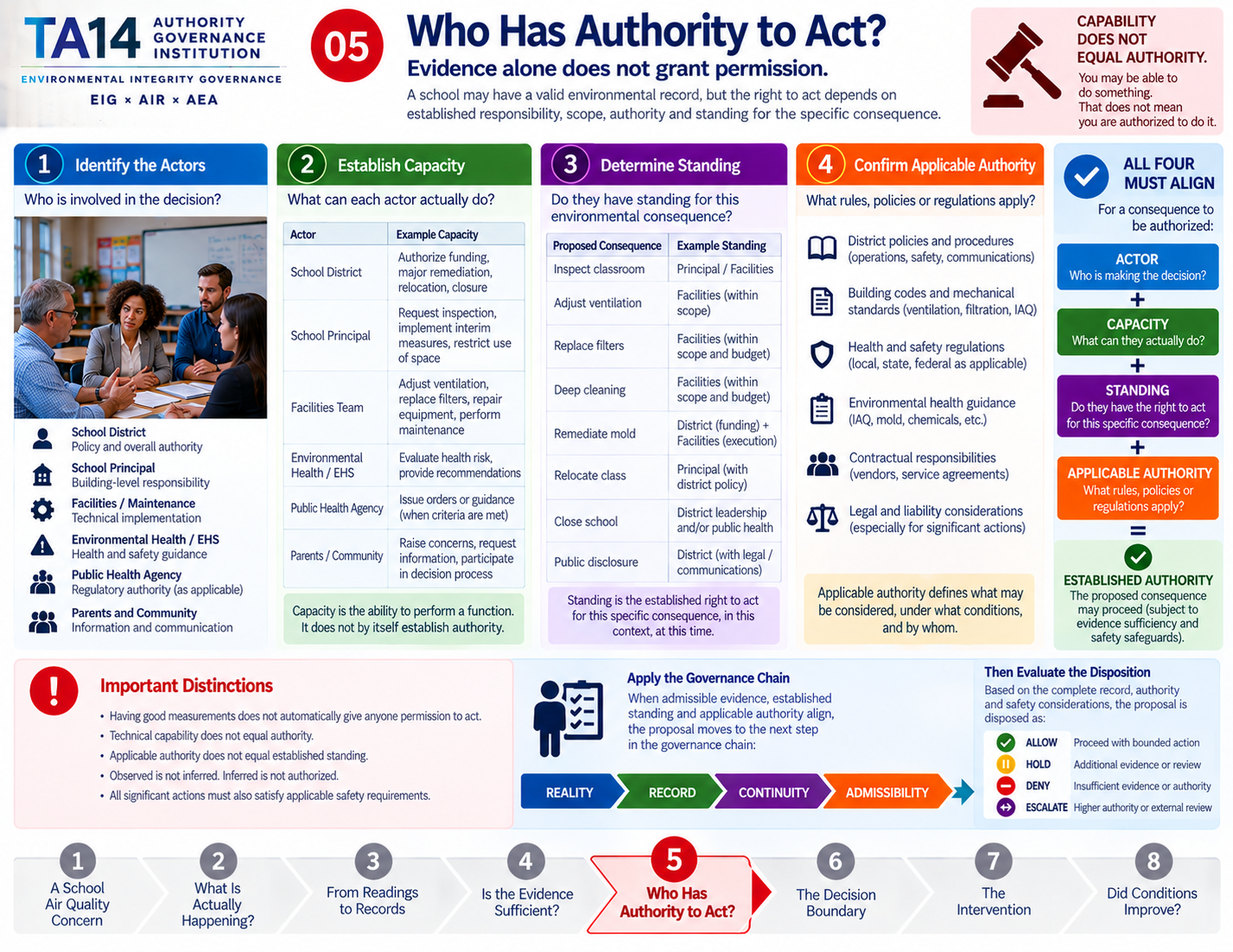
Notice that a technically persuasive record is not the same thing as permission to act. This image moves from evidence into authority governance. We need to identify the actor, the capacity in which that actor is acting, the basis of their standing, and the authority relationship that applies to the particular school, space, equipment, and intervention. A contractor, principal, district official, or automated controller may have different powers and limits. Even when the evidence is admissible, the proposed consequence must remain within the actual scope of authorized responsibility. Capability is not authority.
Admissible evidence does not itself give anyone authority. Actor, capacity, standing basis, and authority relationship must be established.
WHAT COMES NEXTNext we test the proposed consequence at the decision boundary.
The Decision Boundary
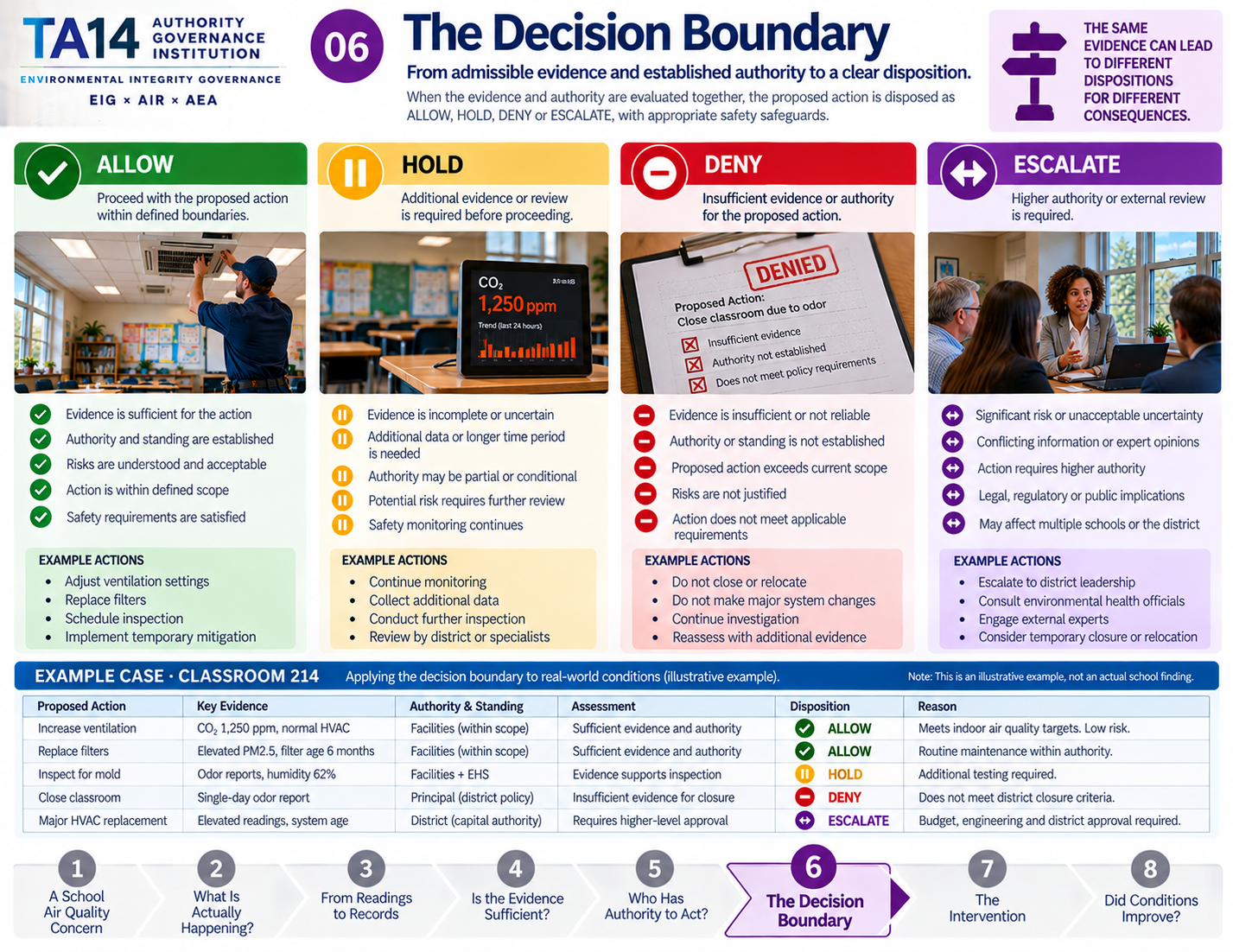
This image is the decision boundary. TA14 expresses four possible dispositions: ALLOW, HOLD, DENY, and ESCALATE. ALLOW means the stated requirements are satisfied for a bounded action, not unlimited permission. HOLD means required evidence or authorization is not yet sufficient. DENY means the proposed action fails an applicable requirement. ESCALATE means a qualified decision maker or established process must resolve the issue. Importantly, HOLD is not automatically safe. Emergency response, protective interlocks, and established fail-safe procedures must continue to operate. The decision must reflect the present condition and the exact proposed consequence.
ALLOW, HOLD, DENY, and ESCALATE are bounded governance dispositions. HOLD must not override established emergency or fail-safe procedures.
WHAT COMES NEXTNext we follow an authorized intervention into physical execution.
The Intervention
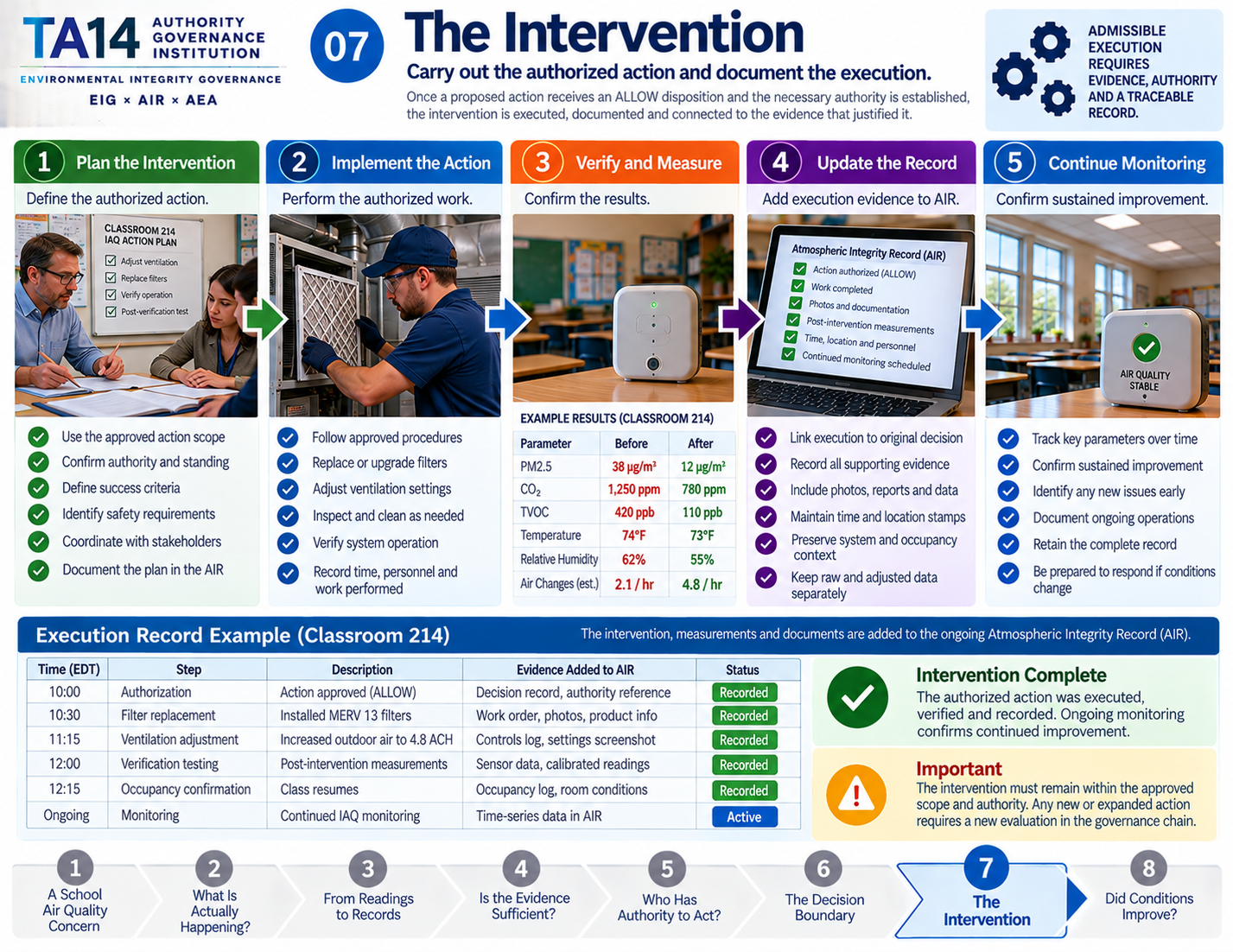
The intervention image takes us from a decision to physical work. Suppose a qualified team is authorized to inspect a ventilation system, replace filtration, or make a bounded operational adjustment. The record should connect the approved scope to the actual actor, equipment, location, time, and action performed. A prior authorization cannot silently expand to different equipment or a more intrusive intervention. Conditions may change between approval and execution, so the required evidence and authority must still be valid at the commit boundary. We preserve what happened, including refusals, deviations, and safety-system behavior.
Document scope, accountable actor, applicable authorization, implementation evidence, and the state at execution.
WHAT COMES NEXTNext we determine whether the intended outcome actually occurred.
Did Conditions Improve?
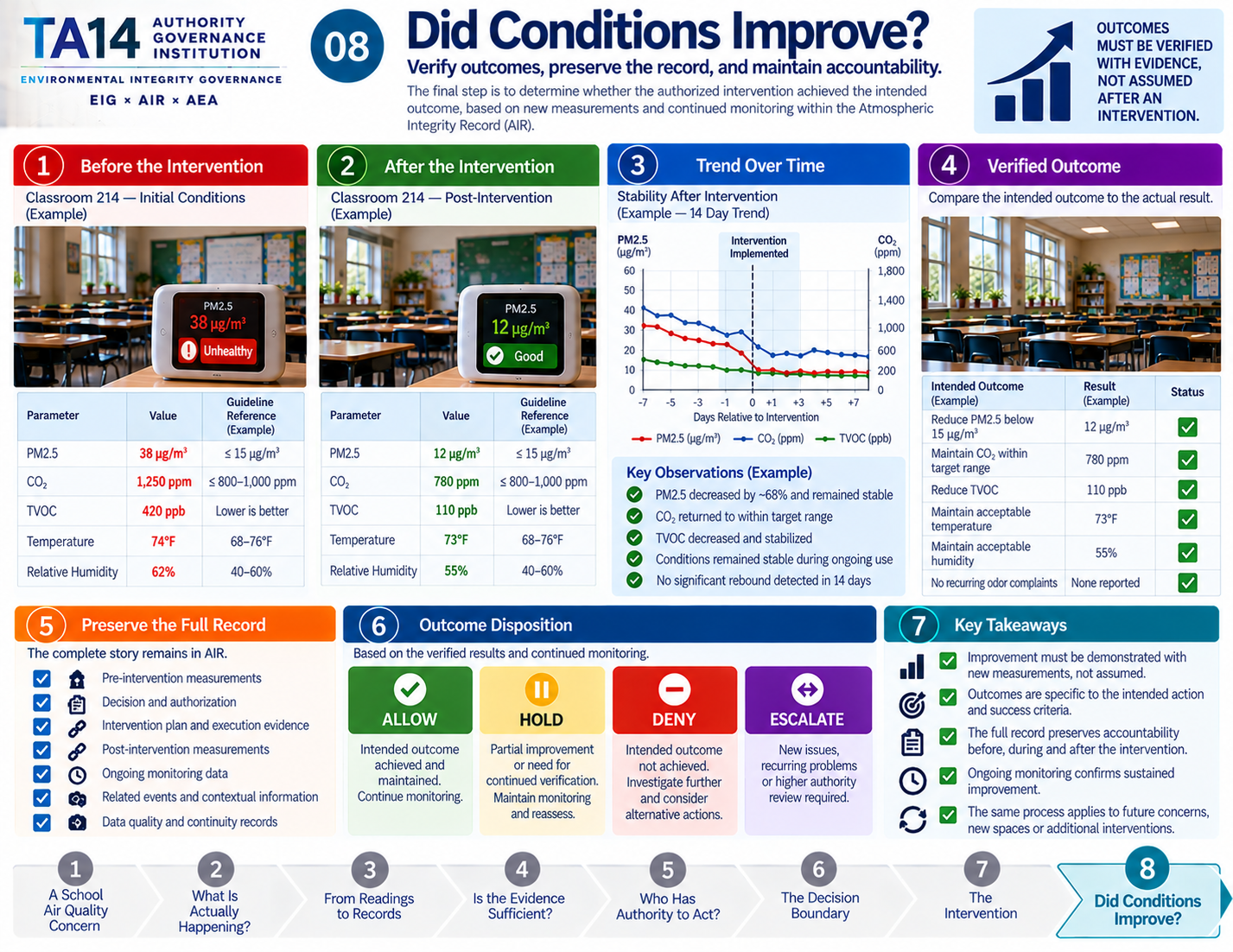
The final image asks a question that no dashboard promise can answer on its own: did conditions actually improve? We need post-intervention observations, a documented comparison method, and awareness of changes in occupancy, weather, and equipment state. Improvement in one metric does not establish every health or environmental outcome. The measured result, including an unexpected or adverse result, belongs in the record. That outcome closes this particular evidence-to-action chain and becomes part of the next environmental reality. The demonstration is hypothetical; real validation requires measured school or test-bench evidence.
Preserve post-intervention measurements and compare conditions under a documented method. The resulting outcome informs the next environmental reality.
WHAT COMES NEXTThe lesson closes; technical reviewers can examine the underlying R1-R9 record.
What does a defensible decision leave behind?
A traceable record of what was observed, how reliable it was, what specific action was proposed, who could authorize it, what happened, and what outcome was actually measured.
The original R1–R9 technical examination identified substantial existing overlap with established IAQ, environmental-quality, building-control and safety practice. The proposed full composition remains unvalidated in a live school deployment.
Educational material only. Follow applicable codes, district policy, qualified engineering, public-health and emergency procedures. When delaying action may itself create harm, established protective procedures take priority.