CASE 01
Evidence is not yet admissible
A proposed consequence is supported by an observation, but the source attribution or record continuity is missing. What should happen before execution? Consider this in the context of air-quality intervention.
TA14 AUTHORITY GOVERNANCE INSTITUTION · MANUFACTURER-FACING TECHNICAL PRE-EXAMINATION
Environmental Integrity Governance (EIG) × Atmospheric Integrity Records (AIR)
Eight illustrated stages showing how a sensor's number becomes dashboard awareness, then a source-linked AIR record that supports defensible decisions, locally established authority and examined outcomes—without replacing the manufacturer's equipment.
INDEPENDENT EDUCATIONAL DEMONSTRATION · BASELINE NOT FROZEN · NO FORMAL DISPOSITION. Illustrative scenarios, data, decisions and architecture only. No manufacturer affiliation, integration, independent validation, regulatory certification, legal admissibility determination or authority to control a real facility is claimed.
Manufacturer Integration & Evidence Assurance Edition · Independent technical reference
↓ DOWNLOAD TECHNICAL REFERENCE v2.0 (PDF)THE PINNACLE OF A SENSOR'S PURPOSE
A number is the beginning. A dashboard makes it visible. A governed architecture record preserves its evidence, decision rights and real-world consequence.
Manufacturer opportunity: extend the value of the existing measurement platform through a governance-compatible record, not a replacement sensor or an unearned assurance claim.
Does this proposed consequence have sufficient Admissible Evidence, Applicable Authority, and Established Standing to become reality NOW?
Capability ≠ Authority. Observed is not inferred. Inferred is not authorized.
SECTION 01 / 08
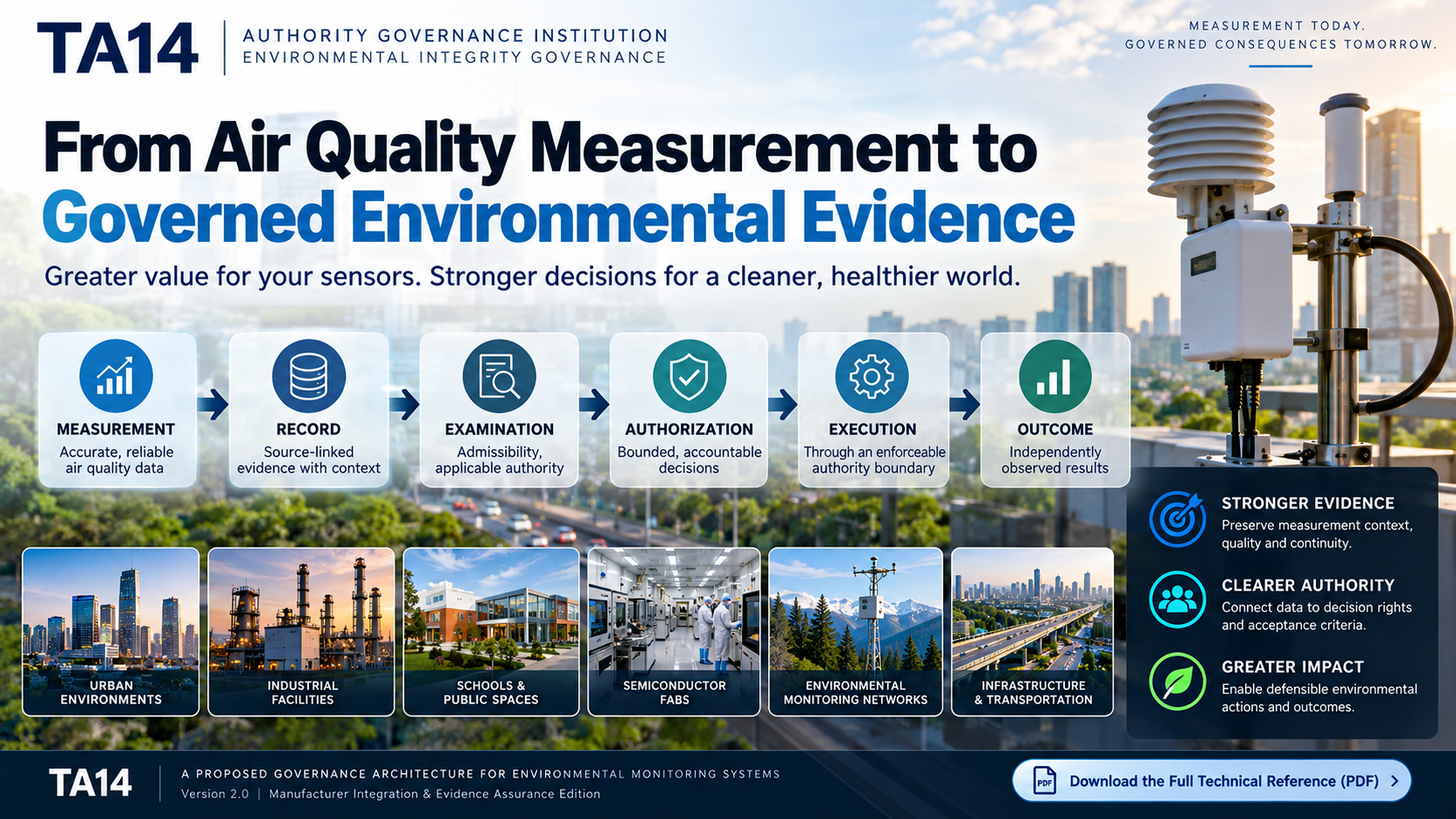
A sensor measures an environmental condition. A dashboard adds context and visibility. The highest proposed contribution is a governed record that preserves what the observation can support, who may act, and what happened next.
Practitioner examination: Keep the instrument and dashboard intact. Add a source-linked evidence export; the sensor itself does not grant permission or prove an outcome.
SECTION 02 / 08
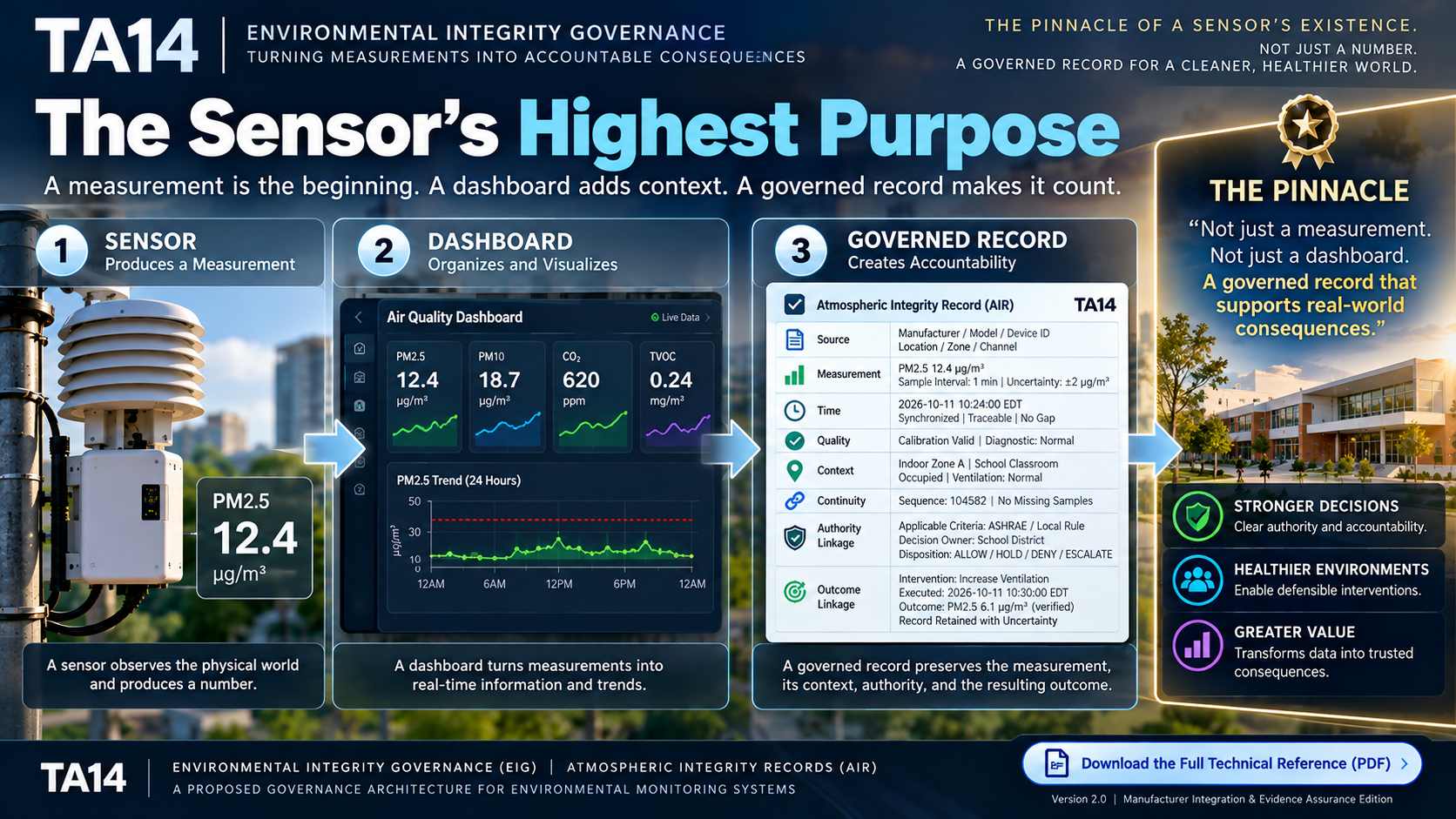
A displayed value is not the end of the measurement's journey. An AIR record can carry source identity, event time, units, location, calibration status, uncertainty, continuity and revision history into an examination.
Practitioner examination: Retain original readings separately from adjusted values. The illustrated data are hypothetical. A hash alone does not authenticate source or time.
SECTION 03 / 08
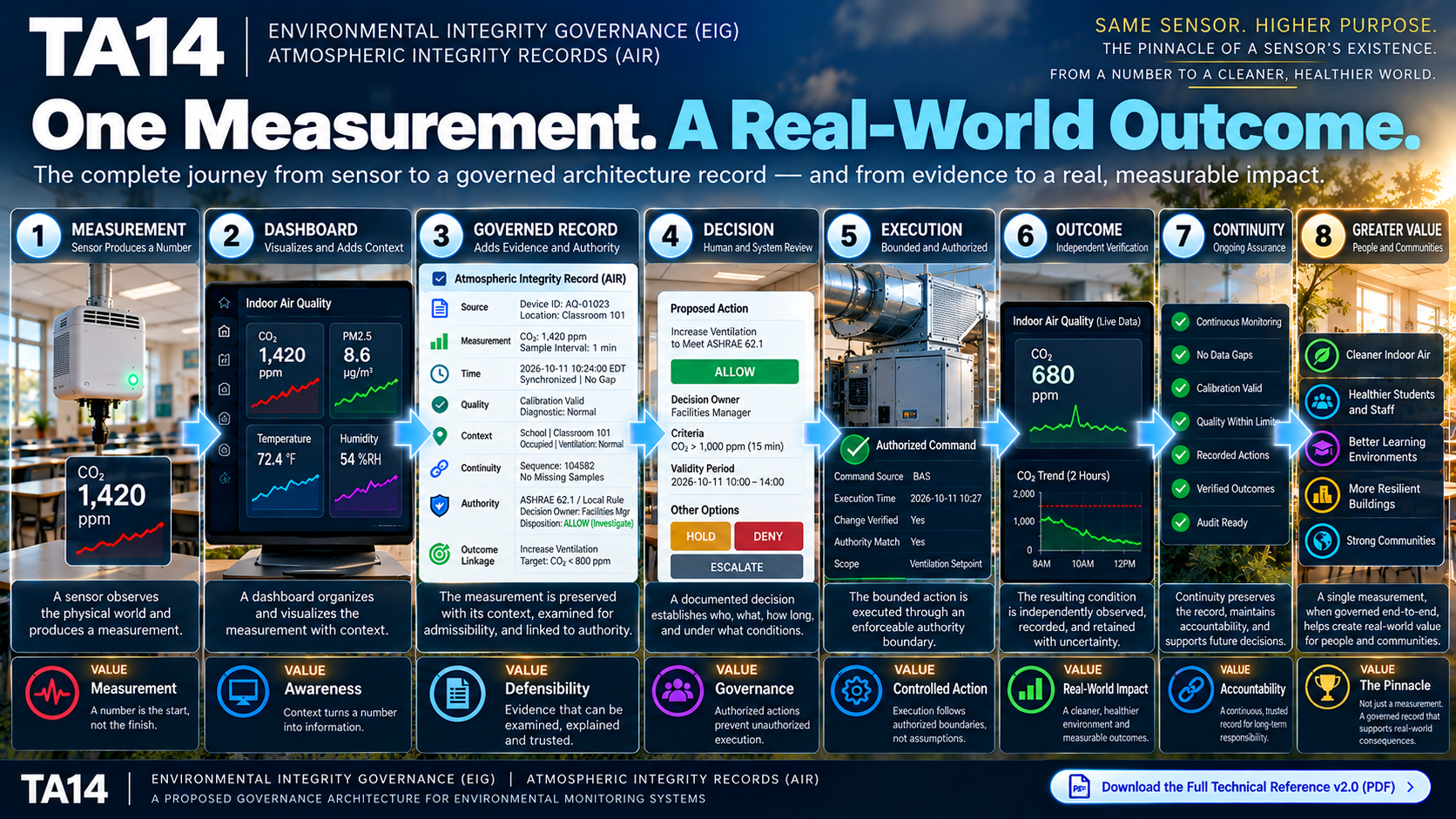
TA14 examines each crossing: physical reality, source records, continuity, admissibility, applicable authority, bounded commitment, actual execution, and independently assessable outcome.
Practitioner examination: Do not let one verified reading imply valid exposure, compliance, authorization or remediation claims. Each proposition has its own proof burden.
SECTION 04 / 08
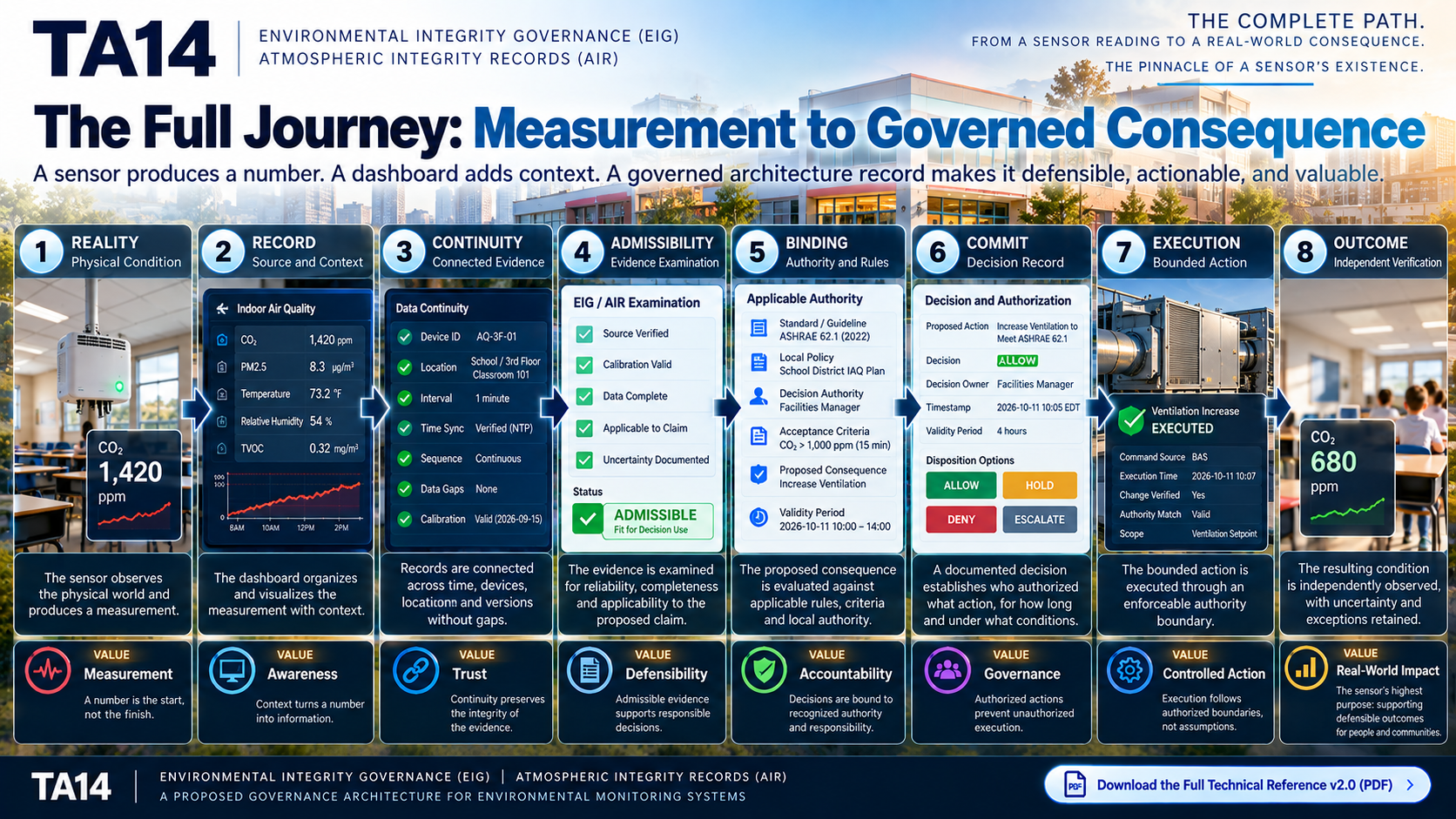
A hypothetical school monitor shows an elevated reading. A dashboard highlights a trend; AIR preserves the evidence and its limits. Local personnel assess the conditions and facility procedures before deciding whether to change ventilation.
Practitioner examination: A record sufficient to investigate may be insufficient to control equipment. HOLD an unproven control change while other authorized investigation continues.
SECTION 05 / 08
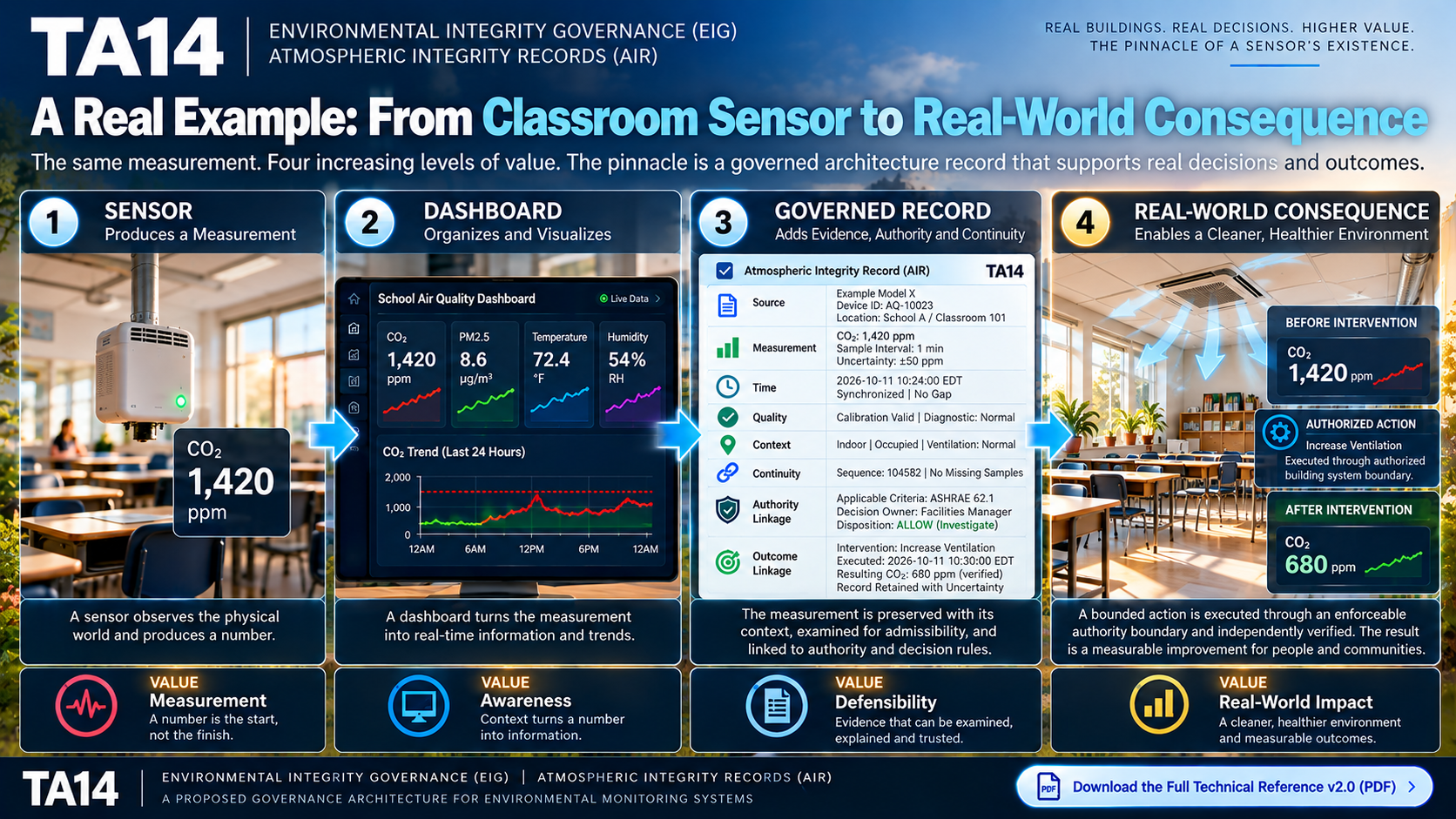
The sensor supplies observations. The dashboard presents them. AIR preserves context. EIG examines the proposed claim and decision rights. Local authorities govern consequential actions on real equipment.
Practitioner examination: An internal ALLOW record is not proof of enforceable mediation. Examine inherited credentials, overrides, direct commands, alternate APIs and background processes.
SECTION 06 / 08
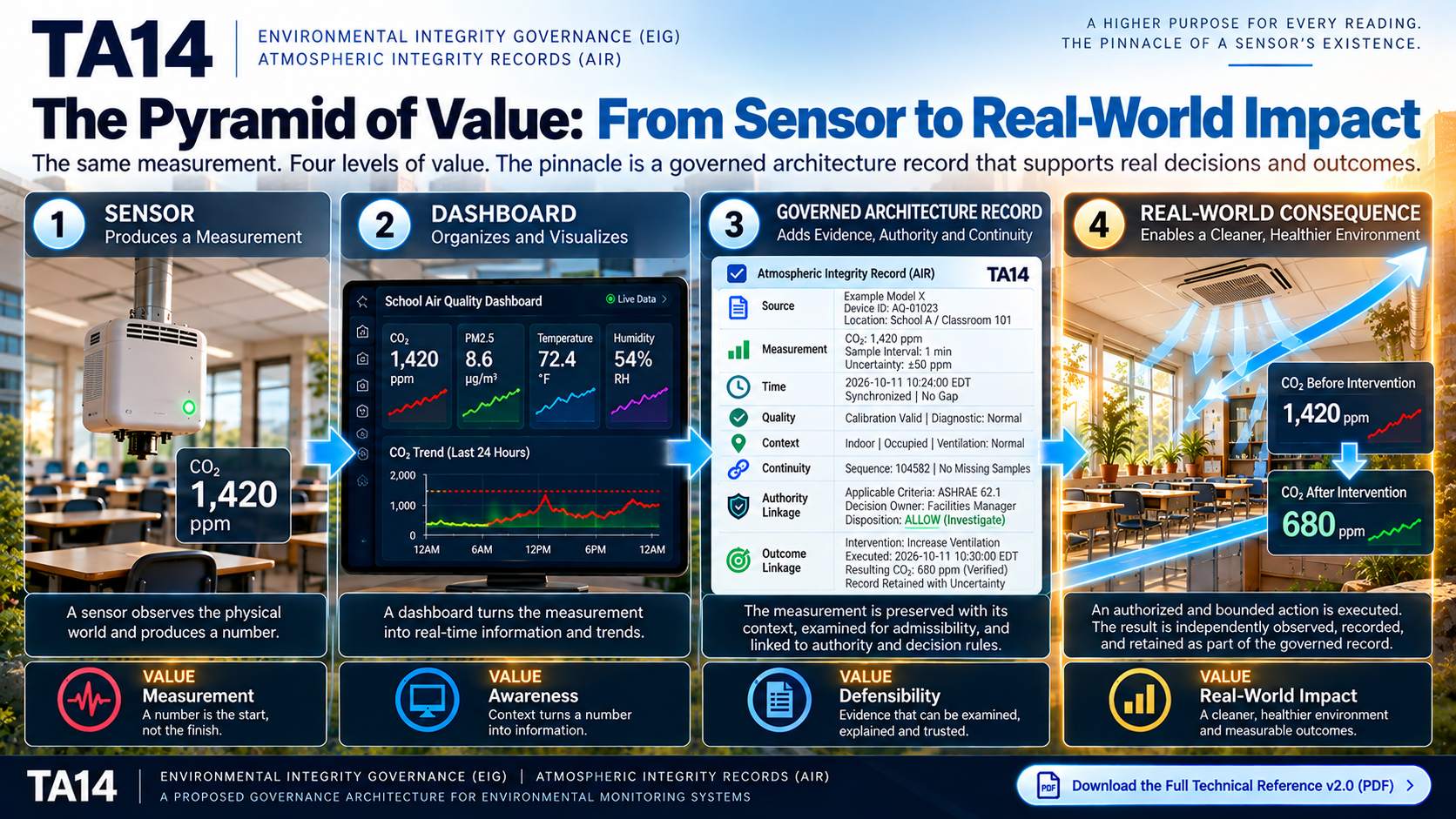
A sensor contributes a measurement. A dashboard builds awareness. A governed record makes the claim reconstructable. A separately authorized intervention with verifiable outcome evidence can establish real-world value.
Practitioner examination: Value levels are not TA14 dispositions. Every proposed consequence still receives ALLOW, HOLD, DENY or ESCALATE according to its own evidence and authority.
SECTION 07 / 08
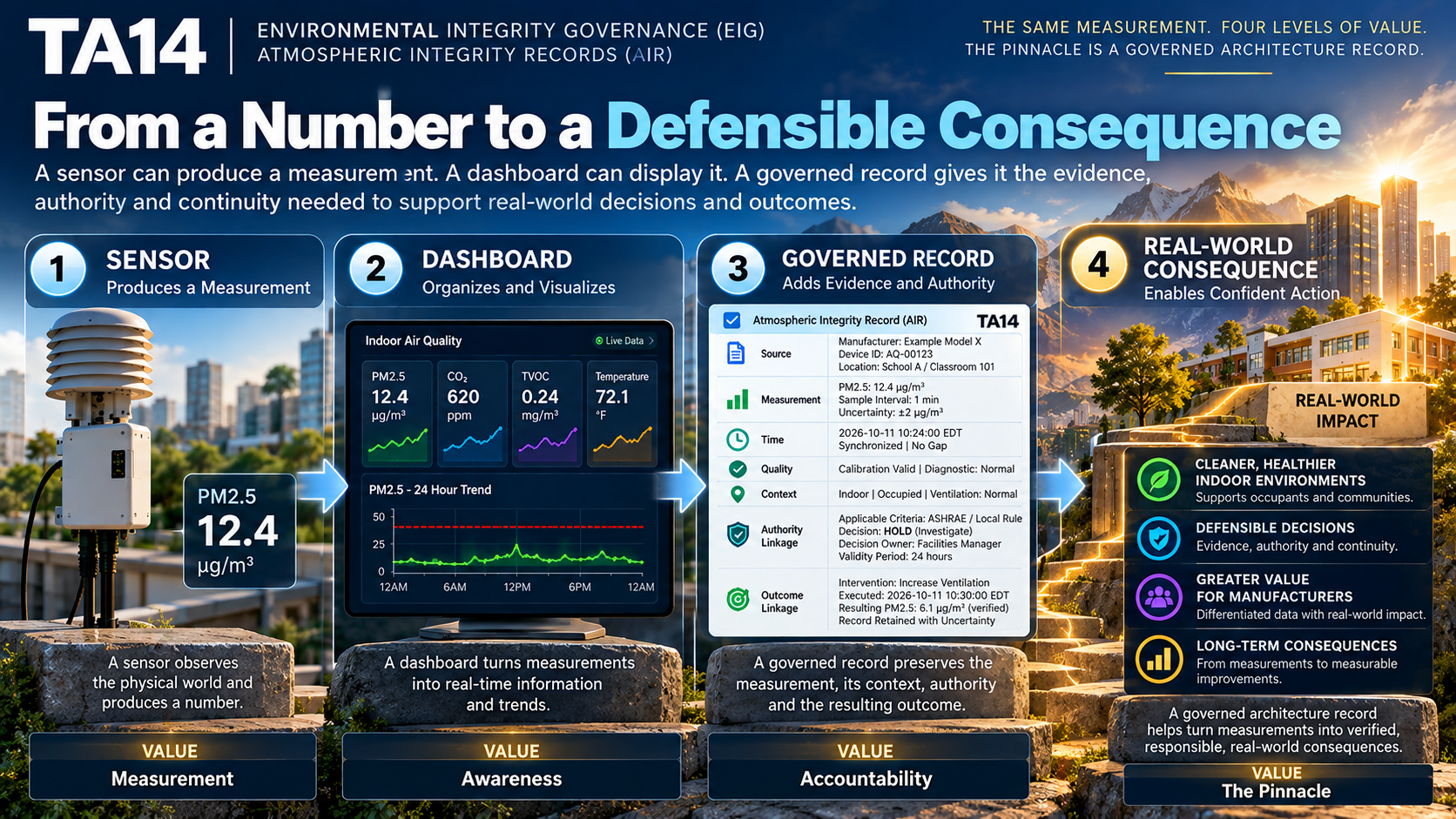
An authorized ventilation command does not prove actuation, successful remediation or causation. Preserve permission, equipment response, follow-up observations, measurement uncertainty and potential confounders separately.
Practitioner examination: Before-and-after graphics are illustrative, not evidence of real-world improvement. Independent or appropriately separated verification remains necessary.
SECTION 08 / 08
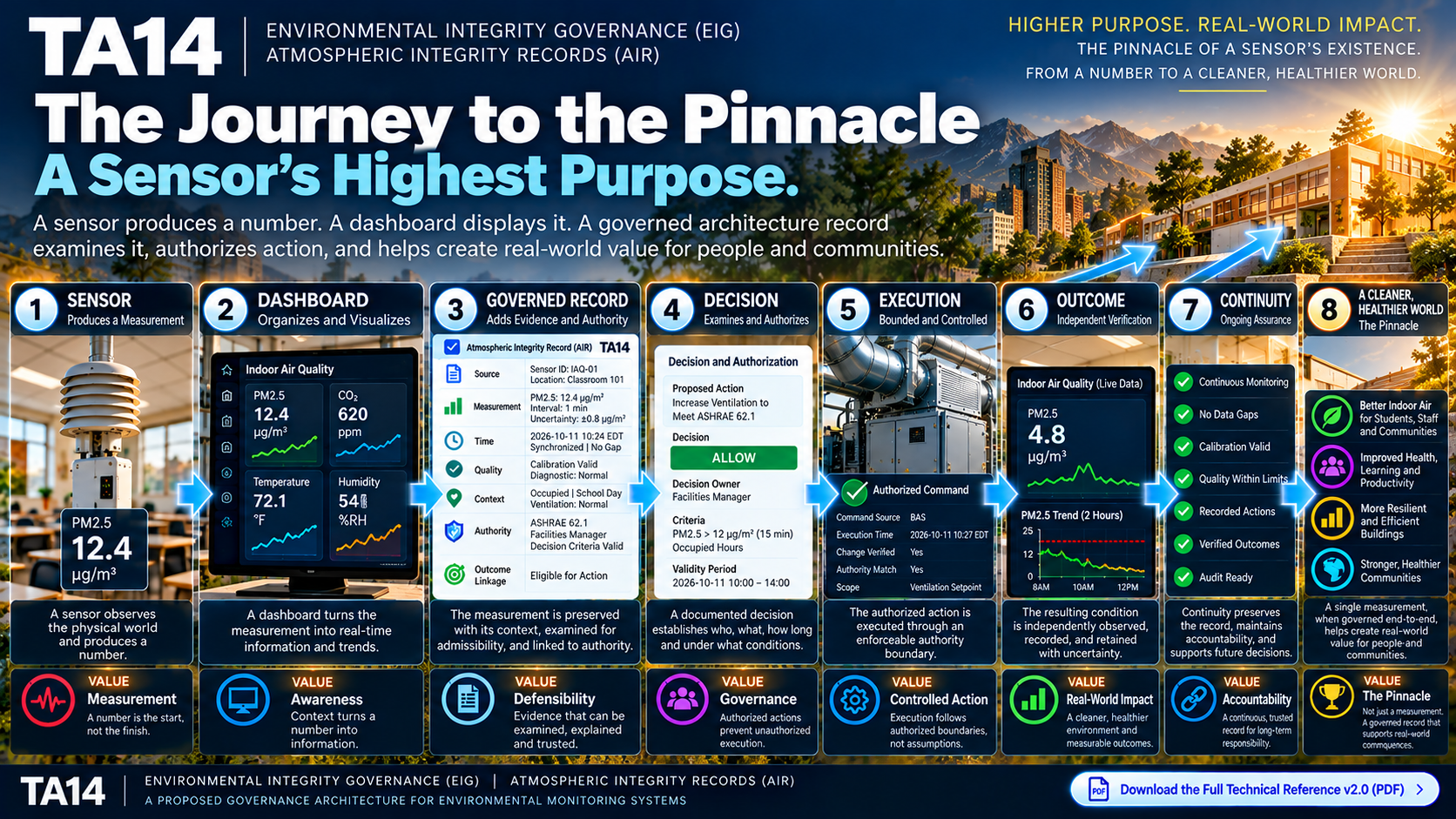
The highest use of a sensor reading is not a particular dashboard number. It is participation in a persistent, defensible governance record that qualified people can use to examine decisions and consequences over time.
Practitioner examination: Proposed pilot: one consenting site, one source stream and one bounded consequence. Freeze baseline, test failure cases, establish local authority and require independent assessment before assurance claims.
One consenting site, one named sensor stream, one specified environmental claim and one proposed consequence. Freeze source references and declare negative tests before examination. Preserve all unfavorable findings. Manufacturer registration or data access does not confer local operating authority.
The illustrated images are conceptual teaching panels with hypothetical readings, approvals and results; they do not depict deployed equipment or verified field outcomes. Browser narration uses Samantha where available and a local English voice otherwise; scrolling remains under reader control.
TA-14 ACADEMY · INDEPENDENT REVIEW CHALLENGE
Apply the governance principles to three hypothetical cases relevant to air-quality intervention. Choose a determination, then examine the reasoning. These cases teach the distinction between Admissible Evidence, Applicable Authority, and Established Standing; they do not issue real-world authorization.
CASE 01
A proposed consequence is supported by an observation, but the source attribution or record continuity is missing. What should happen before execution? Consider this in the context of air-quality intervention.
CASE 02
The record is current and reliable, but the proposed consequence falls outside the scope of applicable authority. What is the supported determination?
CASE 03
The proposed consequence triggers a documented requirement for review by another designated authority. What is the appropriate route?
Independent educational examples only. The questions are hypothetical and do not assess a real institution, building, person, or operating system. Actual governance determinations require case-specific evidence, applicable authority, established standing, and bounded review.