FROM CLINICAL EVIDENCE TO ENVIRONMENTAL CONSEQUENCE
Eight visual lessons on the American Lung Association's Invisible Risks survey — and the boundary between clinical advice and authorized changes to the buildings where people breathe.
PRE-EXAMINATION · BASELINE NOT FROZEN · HOLD Independent TA14 interpretation. Not authored, reviewed, approved, sponsored or endorsed by the American Lung Association. Not clinical advice, certification, or a completed examination. All building scenarios and dashboard values in the visuals are illustrative, not verified case results.
OFFICIAL TA14 TECHNICAL REFERENCE · v1.0
Read the complete independent six-page technical governance reference before or after the guided lessons.
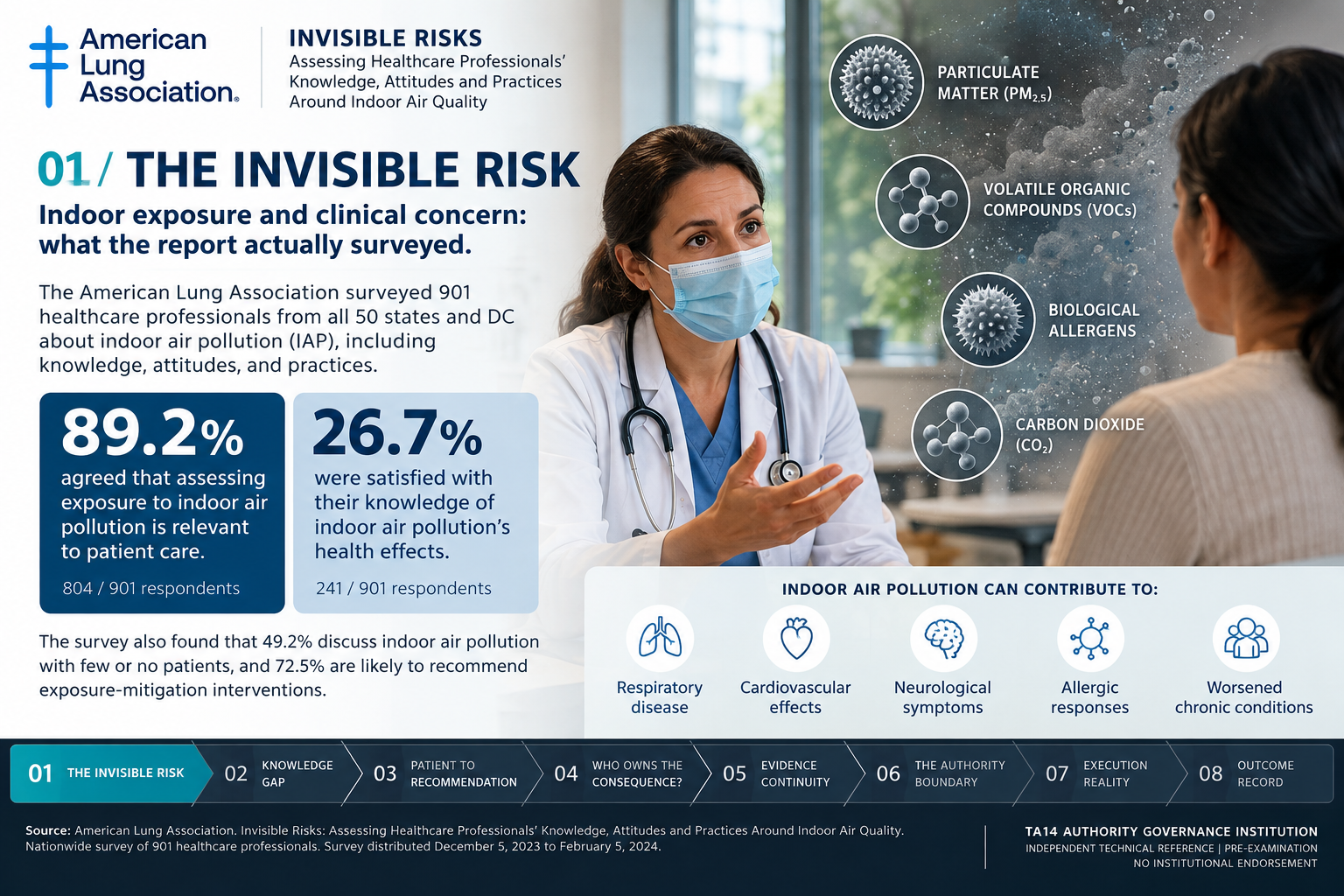
Imagine walking into a room that looks clean but contains tiny particles you cannot see. Indoor air can affect health even when it looks normal. The American Lung Association asked nine hundred and one healthcare professionals across all fifty states and Washington D C about what they know, believe, and do regarding indoor air pollution. This was a survey of professionals, not a measurement of the air in any particular school or hospital. Eight hundred and four respondents, eighty nine point two percent, agreed that assessing indoor pollution can matter to patient care. That tells us professionals recognize the issue. It does not prove any individual building is dangerous. Here is the first lesson: we must never turn a survey answer into a claim about a specific room without evidence from that room. Ask yourself: what do we actually know, and what would we still need to measure?
Narration uses your device's available English voice, preferring Samantha where installed. When Samantha finishes, the next visual appears automatically without starting narration or scrolling. The complete teaching transcript remains readable.
01 / 08
KEEP THE COMPLETE TECHNICAL REFERENCE
Return to the original PDF for the complete independent TA14 reference.
ALLOW / HOLD / DENY / ESCALATE · Observed is not inferred. Inferred is not authorized.
Source: American Lung Association, Invisible Risks: Assessing Healthcare Professionals’ Knowledge, Attitudes and Practices Around Indoor Air Quality, 14-page report. Survey fielded December 2023–February 2024. TA14 analysis and illustrative scenarios are separate from the Association's reported findings.
TA-14 ACADEMY · INDEPENDENT REVIEW CHALLENGE
Can you defend the determination?
Apply the governance principles to three hypothetical cases relevant to the proposed operational consequence. Choose a determination, then examine the reasoning. These cases teach the distinction between Admissible Evidence, Applicable Authority, and Established Standing; they do not issue real-world authorization.
CASE 01
Evidence is not yet admissible
A proposed consequence is supported by an observation, but the source attribution or record continuity is missing. What should happen before execution? Consider this in the context of the proposed operational consequence.
CASE 02
The actor exceeds authority
The record is current and reliable, but the proposed consequence falls outside the scope of applicable authority. What is the supported determination?
CASE 03
A higher authority is required
The proposed consequence triggers a documented requirement for review by another designated authority. What is the appropriate route?
Independent educational examples only. The questions are hypothetical and do not assess a real institution, building, person, or operating system. Actual governance determinations require case-specific evidence, applicable authority, established standing, and bounded review.