CASE 01
Evidence is not yet admissible
A proposed consequence is supported by an observation, but the source attribution or record continuity is missing. What should happen before execution? Consider this in the context of filtration and indoor air.
TA14 AUTHORITY GOVERNANCE INSTITUTION · INDEPENDENT TECHNICAL PRE-EXAMINATION
Eight-image educational examination of filtration evidence, authority, execution and bounded outcomes.
A school installs high-efficiency filters and announces cleaner air. The filter rating is documented. But were the installation, airflow, measurements, authority and outcome actually established? Follow the evidence before accepting the claim.
PRE-EXAMINATION · BASELINE NOT FROZEN · NO FORMAL DISPOSITION · NO THIRD-PARTY ENDORSEMENT. Images and numerical examples are illustrative, not field evidence.
↓ DOWNLOAD TECHNICAL REFERENCE v2.0 (PDF)Written showroom content remains in English. Select the spoken narration language.
French audio uses an available French voice on your device. Samantha is used when available for the selected language.
Does this proposed consequence have sufficient Admissible Evidence, Applicable Authority, and Established Standing to become reality NOW?
IMAGE 01 OF 08
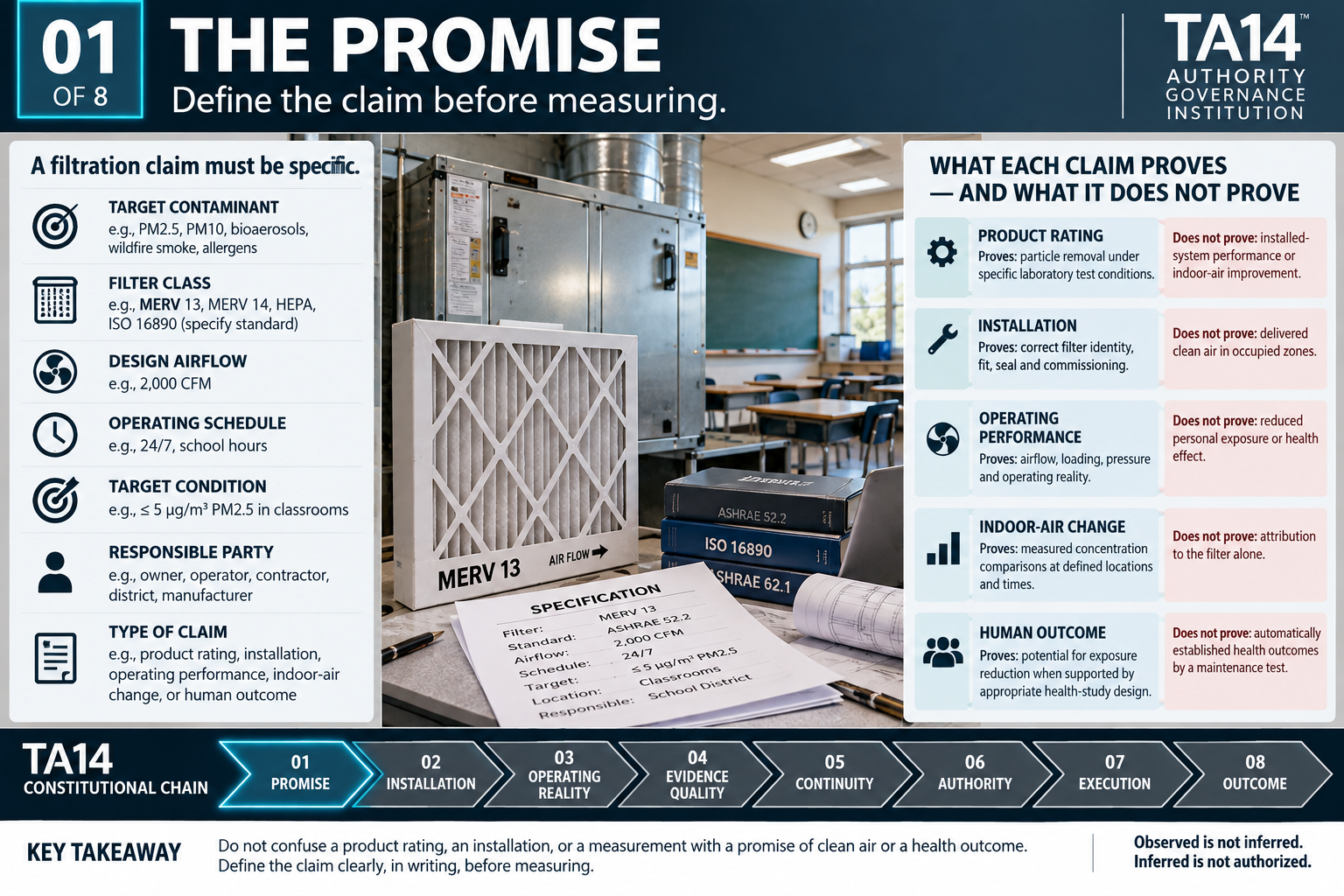
Image one, the promise. Start with the exact claim: which contaminants, which spaces, what filter classification, airflow, duty cycle and measurable acceptance criteria? A laboratory rating describes a tested product under specified conditions, not the actual performance of an installed system. Preserve the claim and its boundaries before selecting measurements. An attractive performance label is not admissible proof of cleaner occupied air.
WHAT YOU JUST LEARNED
A filter classification is a bounded laboratory claim, not proof that occupied air became cleaner. We must define the contaminants, spaces, operating assumptions and acceptance criteria before examining results.
WHAT YOU’RE ABOUT TO LEARN
Next, examine the physical installation. Does the installed filter match the claim, fit the frame and prevent bypass?
IMAGE 02 OF 08

Image two, the installation. Confirm the actual filter model, dimensions, airflow orientation, frame seating, gasket condition and potential bypass. Check installation and commissioning records, including deviations and who performed the work. A filter can meet a product specification and still perform poorly when air passes around it. Installation must be observed and documented, not assumed from procurement or completion.
WHAT YOU JUST LEARNED
A correctly rated product can still fail to deliver the intended result if it is mis-sized, poorly seated or bypassed. Procurement and installation records are not substitutes for inspection.
WHAT YOU’RE ABOUT TO LEARN
Next, move from installation records to operating reality: airflow, fan operation, pressure differential, occupancy and changing environmental conditions.
IMAGE 03 OF 08
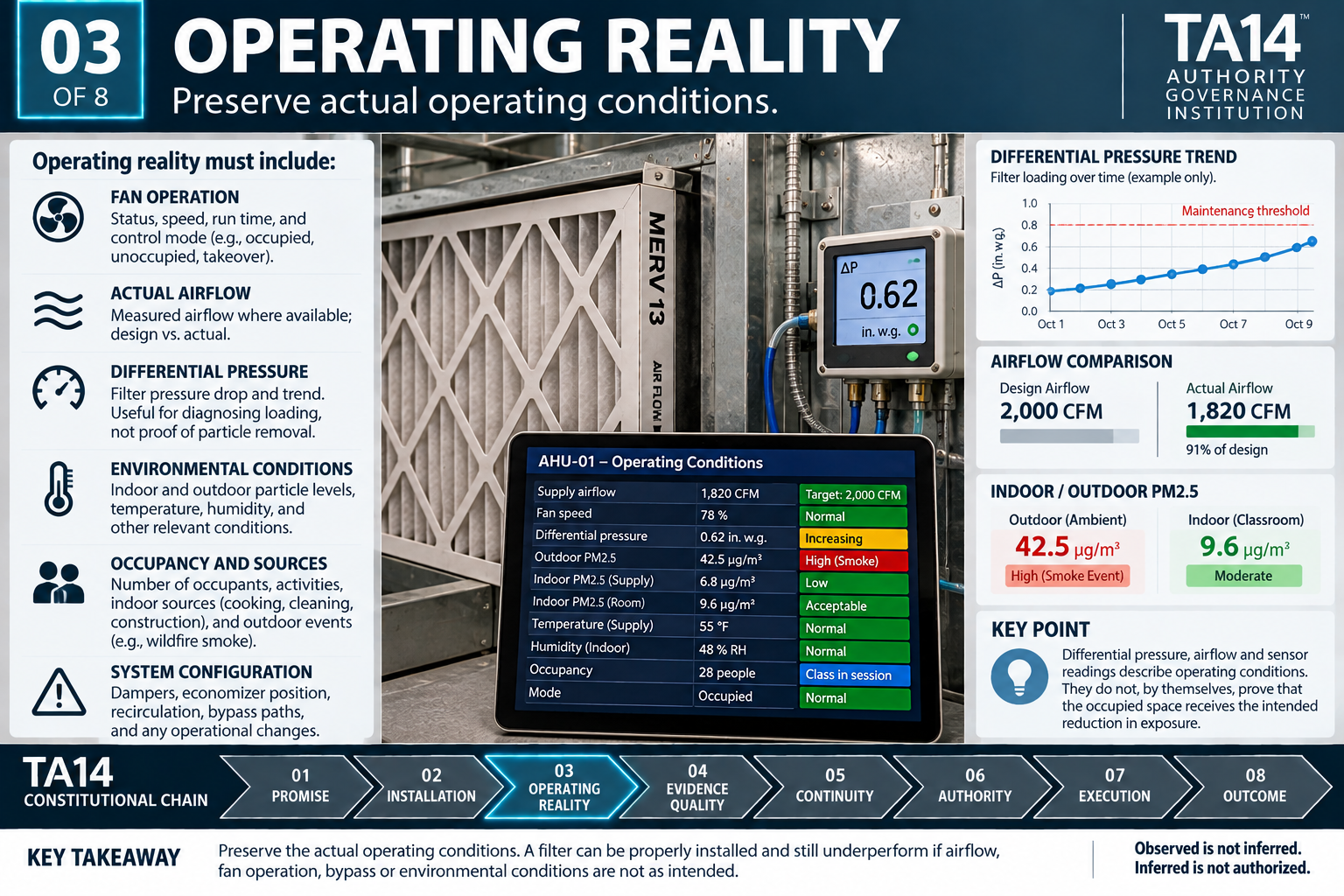
Image three, operating reality. Capture the actual system state, fan operation, airflow, pressure differential, occupancy, ventilation schedule and indoor and outdoor environmental conditions. Record when and where readings were taken. Pressure drop alone does not establish filtration efficiency or occupant exposure. Conditions can change during operation, so one snapshot may not represent the relevant time period.
WHAT YOU JUST LEARNED
Actual operating conditions determine whether a filtration claim can be meaningfully tested. A single pressure reading or snapshot cannot establish filtration effectiveness or occupant exposure.
WHAT YOU’RE ABOUT TO LEARN
Next, ask whether the measurements themselves are trustworthy, representative, traceable and sufficiently precise for the proposed conclusion.
IMAGE 04 OF 08
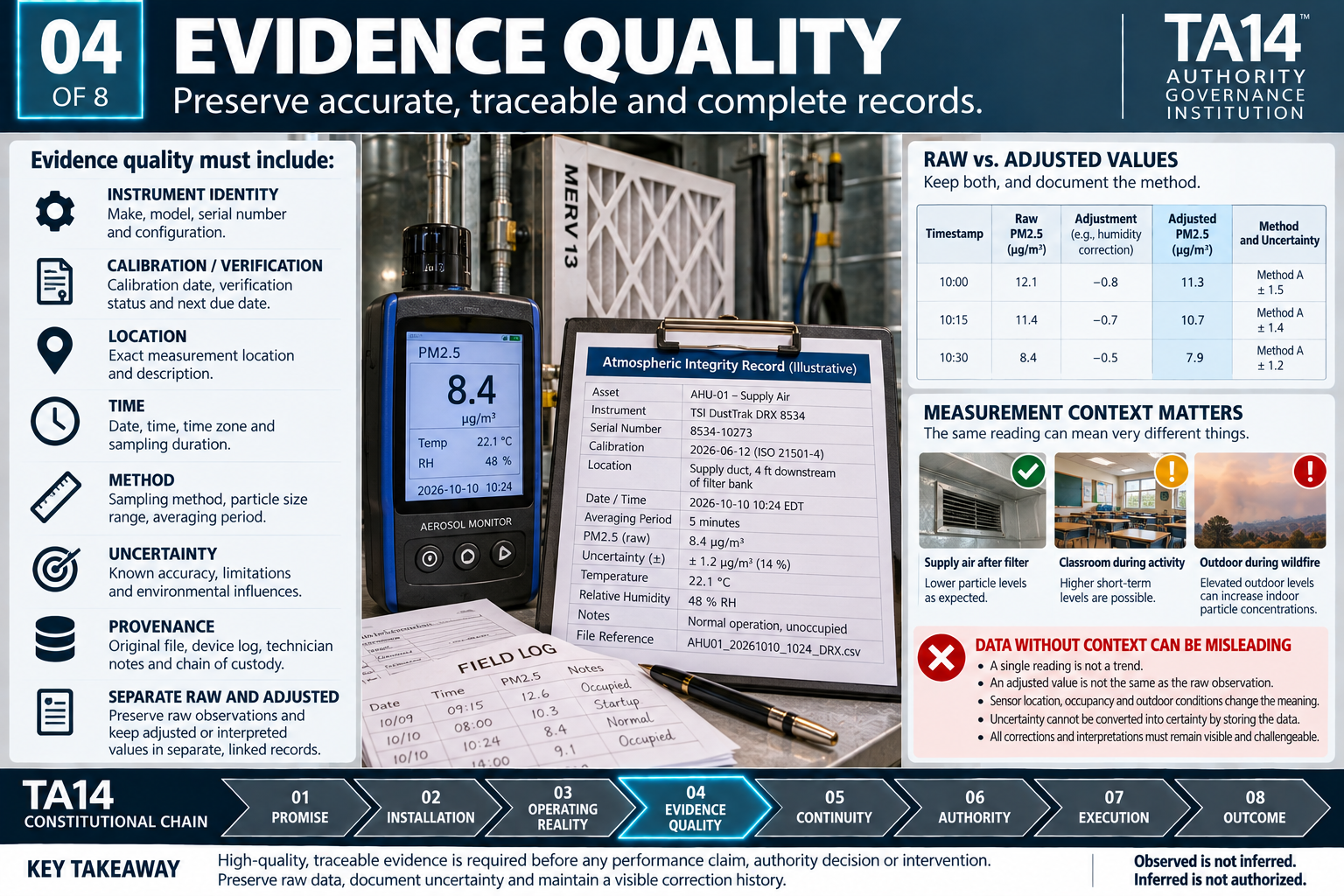
Image four, evidence quality. Preserve the original sensor readings, instrument identity, sampling method, calibration or verification status, timestamps, units, locations and known uncertainty. Keep raw observations separate from adjusted or normalized values. Record every correction with a method and provenance. If an instrument is unreliable or the sample is not representative, hold the conclusion until the evidence is sufficient for the proposed use.
WHAT YOU JUST LEARNED
Measurements become usable evidence only when their provenance, instrument status, sampling method, uncertainty and corrections are preserved. Unreliable evidence requires a HOLD, not a confident claim.
WHAT YOU’RE ABOUT TO LEARN
Next, connect individual records across time. Can an independent examiner reconstruct what changed and when?
IMAGE 05 OF 08
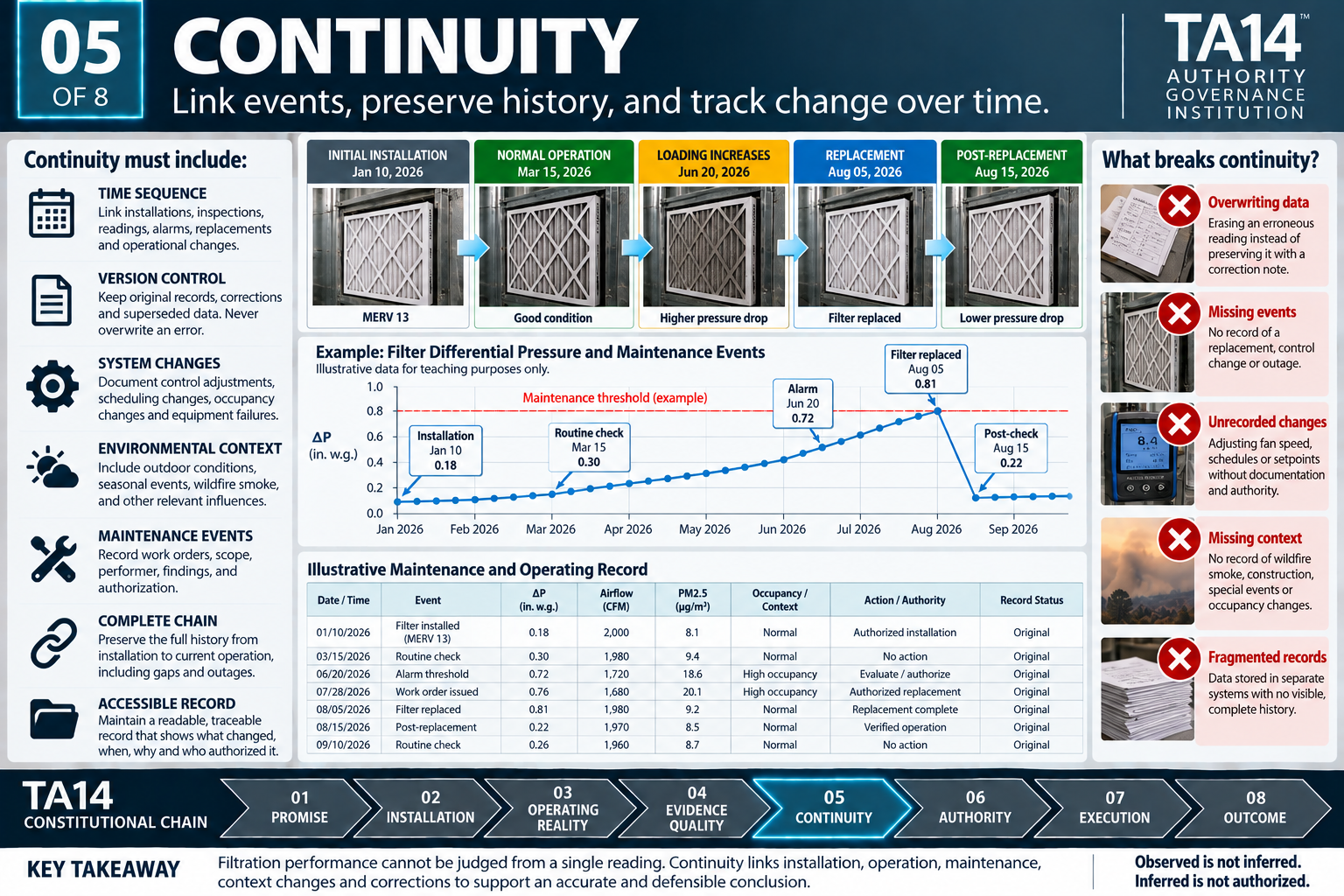
Image five, continuity. Connect the original promise, installation, operating history, inspections, filter changes, sensor readings, alarms, maintenance and subsequent changes into a traceable chronology. Retain superseded records, explain gaps and preserve version history. A new reading does not erase what happened before. The goal is to let an independent examiner reconstruct the condition that existed when a consequential decision was made.
WHAT YOU JUST LEARNED
A defensible chronology preserves earlier conditions, maintenance events, gaps and superseded records. New measurements must not erase the history on which a decision depended.
WHAT YOU’RE ABOUT TO LEARN
Next, separate evidence from permission. Who has applicable authority and established standing to authorize a particular intervention NOW?
IMAGE 06 OF 08
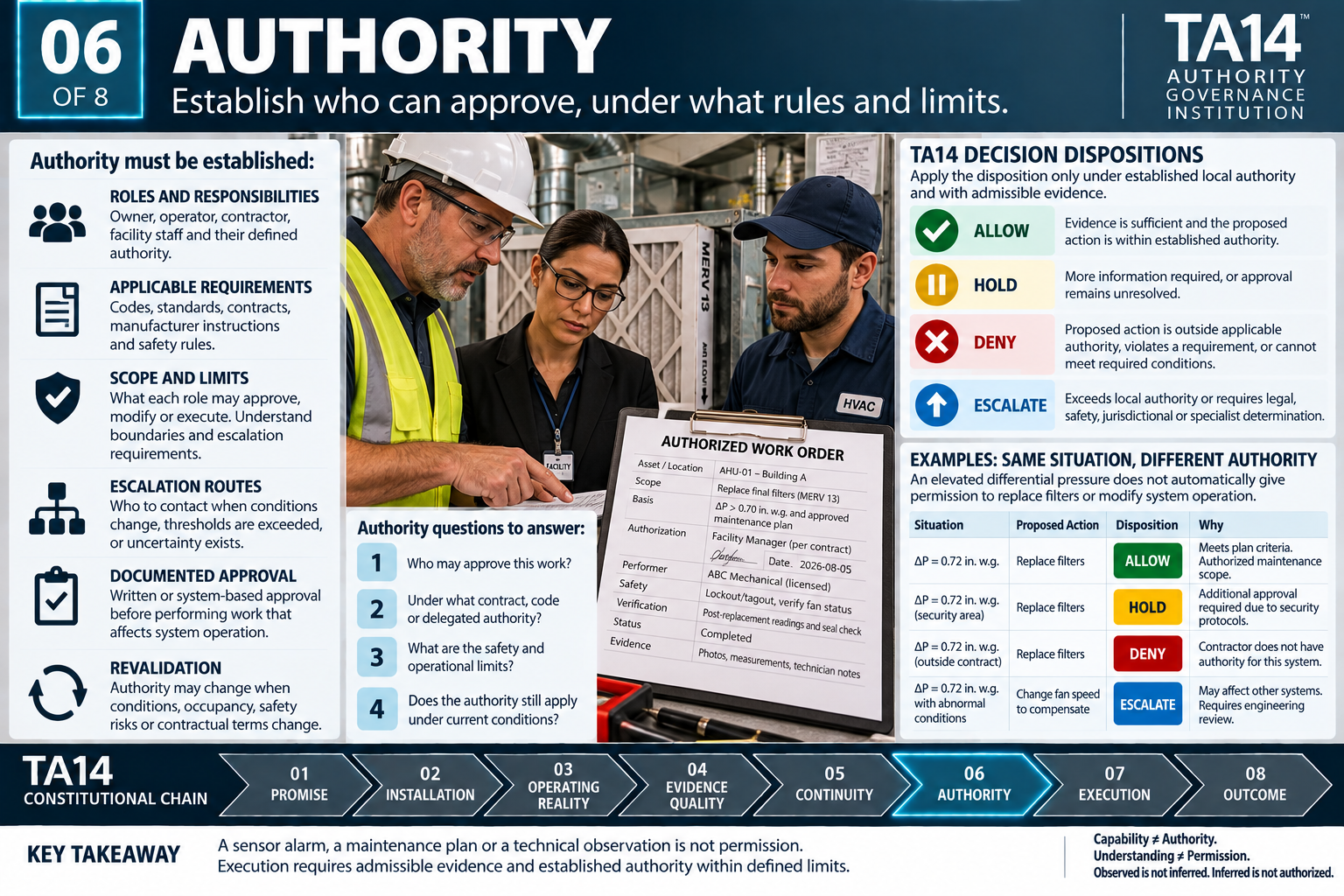
Image six, authority. Evidence may support a proposed intervention, but evidence is not permission. Identify the asset owner, responsible operator, qualified contractor, applicable requirements, delegation, scope, time limits and affected people. Ask whether admissible evidence, applicable authority and established standing exist now. Record a bounded decision: allow, hold, deny or escalate. An authorized installation in the past does not authorize every future change.
WHAT YOU JUST LEARNED
Even strong evidence does not grant permission. The proposed intervention requires applicable authority, established standing and a bounded determination under present conditions.
WHAT YOU’RE ABOUT TO LEARN
Next, follow the authorized work into the field. Was the approved action actually performed within scope, and was authorization revalidated if conditions changed?
IMAGE 07 OF 08
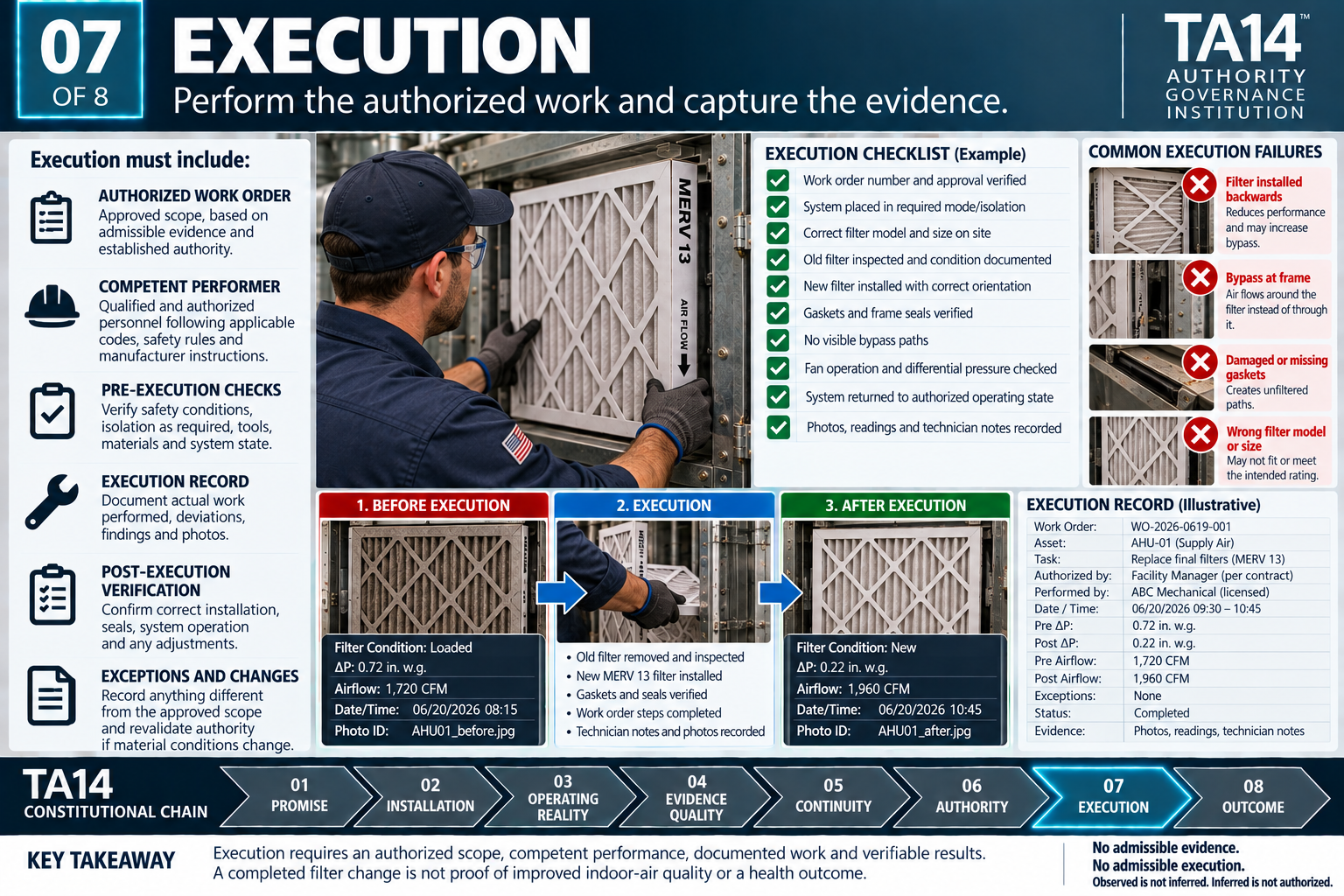
Image seven, execution. Compare the approved work order with what was actually performed. Confirm competent personnel, required safety and isolation checks, filter model, orientation, seals, documented exceptions and before and after operating state. Preserve photographs, measurements, timestamps and technician notes. If conditions or scope materially change, revalidate the authorization. An approved work order is not proof that the work occurred or succeeded.
WHAT YOU JUST LEARNED
An approved work order is not proof of execution or success. The record must show who acted, what they did, exceptions encountered and the operating state before and after.
WHAT YOU’RE ABOUT TO LEARN
Finally, compare actual results against predefined criteria, distinguish system performance from occupant exposure, and state what remains unproven.
IMAGE 08 OF 08
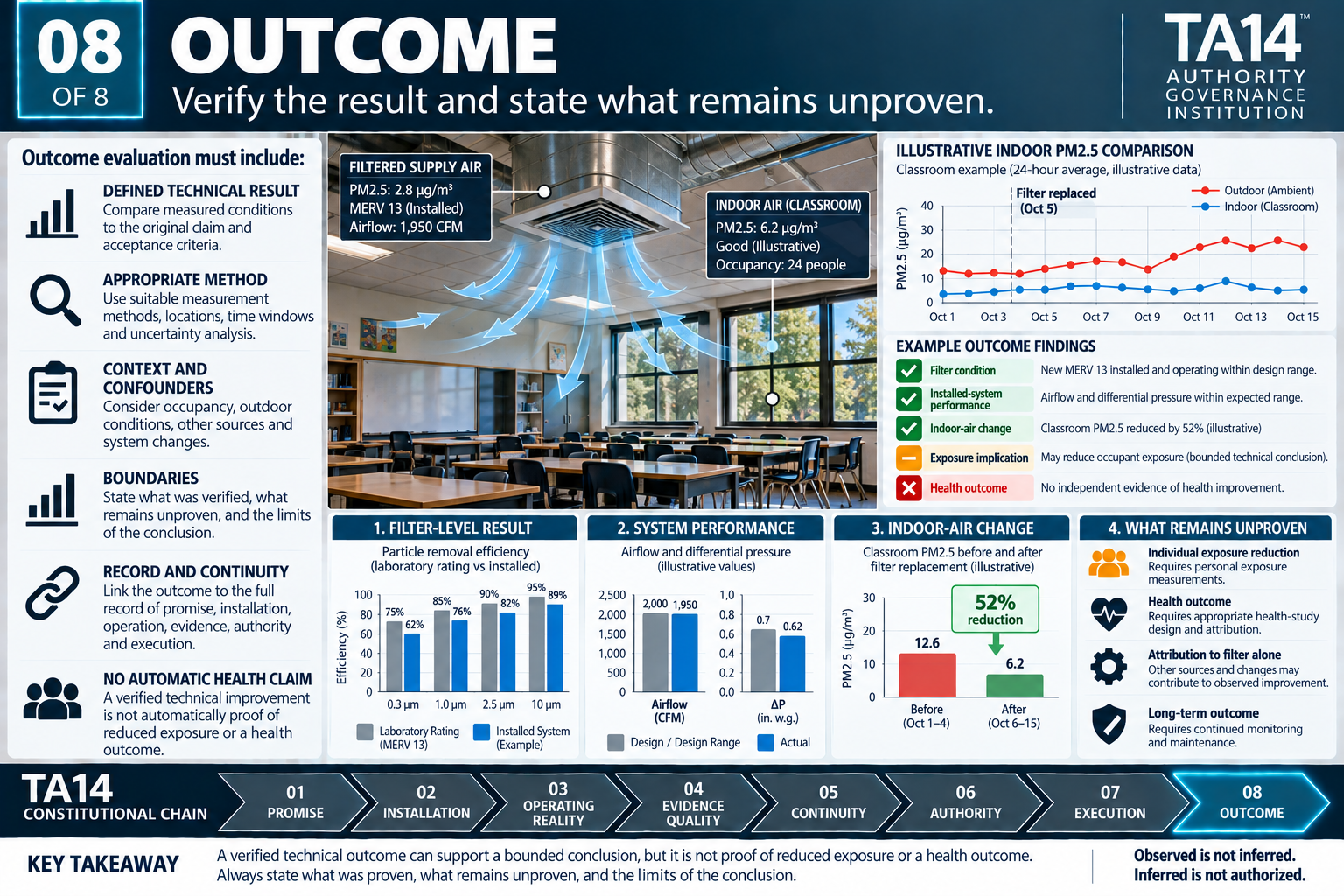
Image eight, outcome. Verify the actual technical result against the previously defined criteria, using appropriate comparison periods, measurements and uncertainty. Separate filter condition and system performance from indoor air changes. An observed reduction in particulate concentration does not, by itself, establish a reduction in an individual's exposure or a health improvement; other sources and changing conditions may contribute. State what was proven, what remains unproven and what continued monitoring is needed.
WHAT YOU JUST LEARNED
An outcome must be demonstrated against the original criteria, with uncertainty and alternative explanations acknowledged. A lower particulate reading alone does not prove a health benefit.
WHAT YOU’RE ABOUT TO LEARN
Next, apply all eight lessons in the interactive pressure test. Decide whether a hypothetical cleaner-air claim has enough established conditions even to proceed to independent review.
INTERACTIVE EDUCATIONAL PRESSURE TEST
Hypothetical school filtration scenario. Select which conditions have been established. These selections are illustrative assertions, not verified evidence.
ILLUSTRATIVE RESULT — NOT A FORMAL DISPOSITION
One or more required conditions remain unestablished. Do not treat the cleaner-air claim as verified or the intervention as authorized.
A defensible examination would preserve the asset and filter identity; original installation and maintenance records; timestamped operating conditions; instrument identity, calibration status and uncertainty; raw and adjusted readings separately; record continuity and revisions; authority and standing; execution evidence; and bounded outcome verification.
Observed is not inferred. Inferred is not authorized.
TA14 examines admissibility, applicable authority and established standing before a proposed consequence. Possible dispositions are ALLOW, HOLD, DENY or ESCALATE. A filter rating, an observation or an approved work order alone does not authorize execution or establish success.
Building owners, filtration manufacturers, schools and institutional partners can explore a registered governance examination or a narrowly scoped pilot. This educational showroom is not a certification, endorsement, operational integration or field performance claim.
Explore registered governanceTA-14 ACADEMY · INDEPENDENT REVIEW CHALLENGE
Apply the governance principles to three hypothetical cases relevant to filtration and indoor air. Choose a determination, then examine the reasoning. These cases teach the distinction between Admissible Evidence, Applicable Authority, and Established Standing; they do not issue real-world authorization.
CASE 01
A proposed consequence is supported by an observation, but the source attribution or record continuity is missing. What should happen before execution? Consider this in the context of filtration and indoor air.
CASE 02
The record is current and reliable, but the proposed consequence falls outside the scope of applicable authority. What is the supported determination?
CASE 03
The proposed consequence triggers a documented requirement for review by another designated authority. What is the appropriate route?
Independent educational examples only. The questions are hypothetical and do not assess a real institution, building, person, or operating system. Actual governance determinations require case-specific evidence, applicable authority, established standing, and bounded review.